

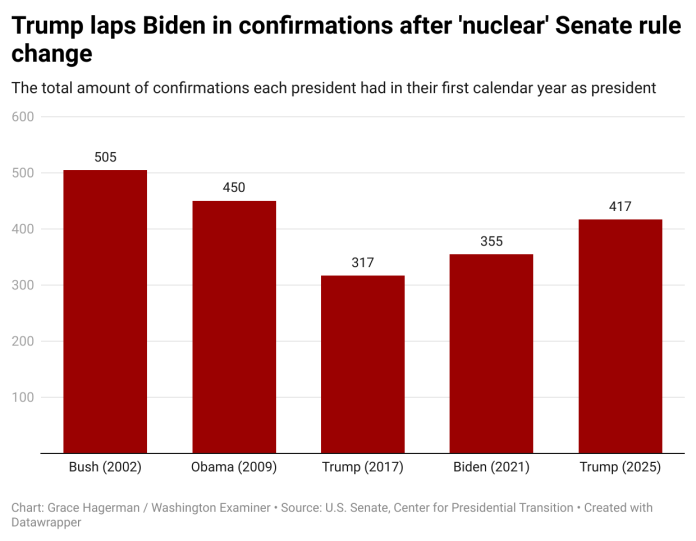
Nearly 100 more nominees were confirmed by the Senate late Thursday, enabling President Donald Trump to close out his first calendar year back in the White House with more confirmations compared to the same time for his predecessor.
A change in Senate rules earlier this year by Republicans paved the way to bypass Democratic roadblocks and fast-track lower-level nominees in large groups over the last several months, catapulting Trump’s confirmations to the highest first-year rate since then-President Barack Obama in 2009.
Trump is ending 2025 with 417 confirmations since his second-term inauguration on Jan. 20, outpacing his own first term with 317 in 2017 and President Joe Biden with 355 in 2021, according to data from the Senate and the Center for Presidential Transition. Obama had 450 confirmations during the same period in 2009, and President George W. Bush clocked in at 505 in 2002.
TRUMP ADVISES THAT ANYONE BURNING AMERICAN FLAG WILL BE IMPRISONED FOR A YEAR
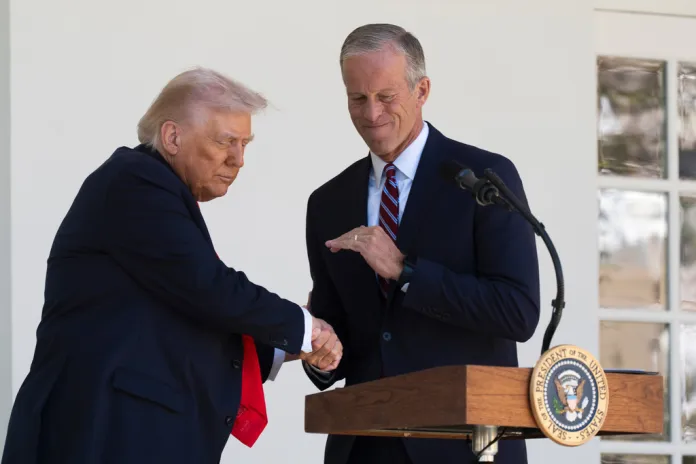
In a wide-ranging and exclusive interview Wednesday with the Washington Examiner, Senate Majority Leader John Thune (R-SD) touted the feat as an example of the GOP majority’s first-year achievements under Trump.
“I think we’re doing everything we can to get the team in place, give them the tools they need to do the job that they were elected to do,” Thune said.
The GOP-controlled chamber churned through more than 250 confirmations, or roughly 60% of the 417, in the final four months of the year since invoking the “nuclear” option in September to alter chamber rules, mostly through three separate batches with dozens of nominees in each. The latest, consisting of 97 nominees, was passed Thursday night in a 53-43 vote along party lines and marked one of the upper chamber’s final acts of the year before departing for Christmas recess. The Senate returns Jan. 5.
TRUMP SLOWS BLEEDING OF INDEPENDENT VOTERS: WHITE HOUSE REPORT CARD
But the move, like any partisan Senate rules change before it, was a controversial one that drew jeers from the other side of the aisle. Republicans insisted the alteration was necessary to sidestep “unprecedented” Democratic obstruction, while Democrats said Trump’s “historically bad” nominees deserved additional scrutiny and vowed retaliation once back in the majority despite previously championing the same rule change under Biden.
“They changed the game, and we had to make sure that we did what it took to let the Senate function,” said Sen. Katie Britt (R-AL), herself a former Senate staffer and an architect of the rule change.
Top Democrats told the Washington Examiner they saw the alteration as “inevitable” to please Trump, regardless of whether they would’ve ceased slow-walking nominees and allowed more to be confirmed without time-consuming procedural votes. Trump, at the time, lacked a single nominee confirmed via voice vote or unanimous consent due to Democrats, a level of opposition that presidents before him had not faced.
“They will continue to do it over and over and over again to get their agenda done. They don’t care about the rules. They just care about getting Trump’s agenda done,” said Sen. Chris Murphy (D-CT), a leadership member who urged Democrats to change the rules under Biden. “But they’ve teed us up when we have the majority to do what we need to do to get our agenda done, too.”
Senate Minority Whip Dick Durbin (D-IL) saw it as the GOP’s “plan from the beginning” and predicted at least a half-dozen unspecified nominees in a recent bunch of nearly 100 “could not weather the political storm if they were brought to the floor individually.”
But Durbin, the top Judiciary Committee Democrat who is not seeking reelection in 2026, went on to advocate overhauling the broader nomination process to reduce the number of presidential picks requiring Senate confirmations, which have amounted to an eye-popping 1,300 positions.
The Senate itself shoulders the blame, Durbin said, advocating fewer nominees outside the Cabinet and judicial positions to undergo confirmation. But he suggested that senators stand in the way because they relish the power of advancing nominees in their committees of jurisdiction.
DEMOCRATS NEED TO TEMPER THEIR EXPECTATIONS OF A 2026 BLUE WAVE
“The regular nominations below the Cabinet level — there are way too many of them, and I blame the Senate itself,” Durbin said. “Senate chairmen refuse to give up these nominations. They like to have the power to appoint people to these positions.”
The rule change applied only to lower-level executive branch nominees, such as sub-Cabinet, ambassadors, and U.S. attorneys. It did not apply to the Supreme Court, Cabinet secretaries, and federal judges. Still, it marked the latest escalation in a decadeslong tit for tat between the two parties of eroding the chamber’s traditions and regulations to favor the party in power.
“This historic record comes despite unprecedented obstruction from the Democrat minority,” said Majority Whip John Barrasso (R-WY), who led the charge among leadership this summer for the rule change.
Notably, Republicans have held firm in resisting calls from Trump to nuke the Senate’s 60-vote legislative filibuster, which both parties have weakened in recent decades, and the chamber’s century-old “blue slip” process that allows senators to sink judicial nominees from their home state.
SENATE CONFIRMS FIRST BATCH OF TRUMP NOMINEES USING ‘NUCLEAR’ OPTION
Britt vowed Republicans will embrace the same level of obstructionism they say Democrats have waged under Trump whenever the GOP next finds itself back in the minority.
“If you think for one minute our base is going to allow us to do anything but exactly what they did to us, you’re wrong,” she said.
David Sivak contributed to this report.
