

He’s no Sen. Bernie Sanders, but Republican presidential candidate Donald Trump has so far won more support from younger voters than the last two GOP presidential candidates and Hillary Rodham Clinton.
A new analysis of the primary youth vote from Tufts University’s Jonathan M. Tisch College of Civic Life shows that in 21 primaries, Trump received 828,675 votes from those up to age 29, and Clinton 766,425. Sanders owned the category, receiving 2,052,081 votes.
Recommended Stories


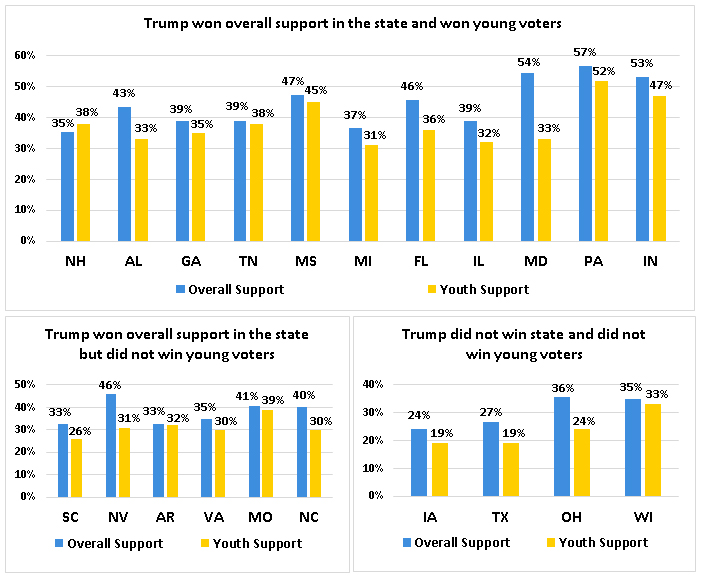
And, said the report, “During the primary season, Donald Trump received a slightly larger proportion of youth votes than the two previous Republican nominees, Senator John McCain (2008) and Governor Mitt Romney (2012). Before all other candidates suspended their campaigns, Trump was receiving an average of 33 percent of youth votes per state, compared to McCain’s average of 29 percent and Romney’s 28 percent in their competitive primaries.”
Tuft’s Center for Information and Research on Civic Learning & Engagement (CIRCLE), the school’s research arm, said that Trump did fairly well among the millennials despite their unfavorable view of him.
He did well among younger voters with no college degree, a group that Tufts said tends to vote in higher numbers in the general election than in primaries.
The analysis listed these “potential implications” for the general election:
— Young people without a four-year college degree—one of Mr. Trump’s strongest constituencies among youth—tend to vote at higher rates in general elections than in primaries. However, their overall turnout is still fairly low. This could inform Mr. Trump’s campaign outreach strategy and suggests a need to mobilize a great deal of non-college youth to move the overall youth electorate in his favor.
— Consistent with the political polarization of the general electorate, about two-thirds of young people who participated in the Republican primaries identified as conservatives rather than moderates. However, like many young voters today, young Republican primary participants were less likely than older voters to identify with the Republican Party.
“With less than five months until Election Day, Mr. Trump’s campaign has both challenges and opportunities with young voters. On the one hand, the youth electorate has been very active this year, with youth participation in the GOP and Democratic contests more evenly split than in recent presidential cycles. On the other hand, youth of color and young women are currently the least likely groups to support Mr. Trump,” said Kei Kawashima-Ginsberg, director of CIRCLE. “In addition, it would be a mistake for Mr. Trump to take young conservative voters for granted. Not only does he need them to win the White House, but the Republican Party needs them to build for the future. As always, youth outreach and mobilization will matter in 2016.”
Paul Bedard, the Washington Examiner’s “Washington Secrets” columnist, can be contacted at [email protected]
