

Despite facing a high-energy opponent in Rep. Beto O’Rourke, Texas Republican Sen. Ted Cruz appears to be headed for reelection and the Republicans are poised to boost their majority in the Senate, according to a new election analysis.
While races are tightening around the country, the Republicans could add two or more seats in the Senate, giving it a 53-47 majority, one that could help the party hold the line on a more conservative agenda should moderates like Sens. Lisa Murkowski of Alaska and Susan Collins of Maine continue their role as holdouts on some issues.
“At least for now, the elephant endures,” headlines the latest analysis from the University of Virginia’s Center for Politics via Larry Sabato’s “Crystal Ball.”

The biggest news in Managing Editor Kyle Kondik’s latest report was that even though the Cruz-O’Rourke race is within single digits, it appears that the Republican will make it across the finish line first.
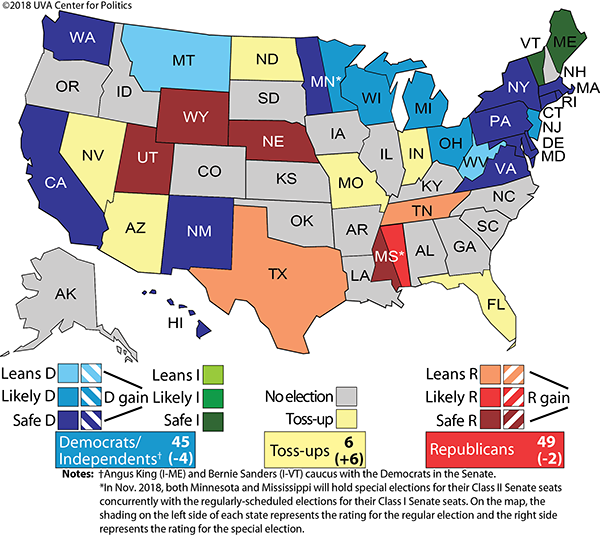
While the race was moved from “likely Republican” to “leans Republican,” Kondik wrote, “we still like Cruz’s chances, just not quite as much as before.”
He reasoned that the state is still Republican red and while Hillary Clinton was able to get to within nine points of President Trump in the 2016 election, the gap remains huge. “Here’s our logic: While Hillary Clinton lost Texas, she got within single digits of winning (Trump’s winning margin was nine points). Given the environment and O’Rourke’s resources, shouldn’t he be able to get closer than nine points? We’re inclined to think so, which means the margin in this race could be something like the mid-single digits or even closer,” he wrote.
The report also raised doubts about the campaigns of Democrat Sens. Heidi Heitkamp of North Dakota and Bill Nelson of Florida.
While it describes the “path” for Democrats to take charge, the report falls into line with others that suggest the Senate majority is safe for Republicans.
The report conclusion:
“If Democrats swept the closest races and captured a small majority, it would be surprising, but not shocking. Nor would it be shocking if Republicans started next year with a larger majority than their current one, thanks to victories in dark red states against some Democratic incumbents.
“One thing we do feel confident in saying, though: Barring some major change in the national environment, we would not expect much net change in the Senate. In other words, a net change of something akin to 1998 (no change) or 2002 (two seats in favor of the GOP) is likelier than what we’ve seen in the last three midterms, when the non-presidential party netted at least half a dozen seats in each election.”
