With his plans to stop the Trump administration’s elimination of regulations, put back in place Obama-era rules sidelined by the GOP, and pile on his own environmental restrictions, President-elect Joe Biden is set to become the nation’s regulator in chief.
When he arrives in the Oval Office, Biden is expected to issue a freeze on all Trump regulations working through the system. That could trap several eleventh-hour rules and deregulatory actions, including several from the Environmental Protection Agency.
Recommended Stories
According to the American Action Forum, which studies the impact of regulations, that would stop plans aimed at saving the economy billions and tightening immigration further.
Trapped in that action could be the EPA’s Science Transparency Rule, another on the Clean Air Act, and a Labor Department rule to raise the wage requirements of those on H-1B visas.
“Once that is over, I think we’ll start to see the undoing of older Trump rules, and the redoing of Obama rules,” said Dan Bosch, the director of regulatory policy at the American Action Forum.
That could include deregulatory changes to vehicle emissions, the Clean Water Rule known as “WOTUS,” and the Clean Power Plan.
Also in focus will be reversing President Trump’s 2016 promise to cut regulations.
“Biden has signaled in all areas that the Trump regime, such as the one-in, two-out plan, are disappearing,” said Clyde Wayne Crews Jr., the policy director at the Competitive Enterprise Institute.
Crews also raised an eyebrow over the return of power to the administrative swamp. He said it is “interesting to listen to the incoming progressives and Left make appeals to ‘democracy’ while they advance an untethered, unelected administrative state.”
Helping Biden with his regulatory agenda is the control of the Senate. That may allow his administration to win changes legislatively instead of through agencies and executive orders, said Bosch.
“If they can get some of their environmental and labor priorities through the Senate, perhaps if the filibuster is revised in some way to make it easier to pass things, then they wouldn’t have to spend as much time undoing Trump rules,” he said.
Early appointees suggest that climate change will be a key feature of every Cabinet department and foreign policy.
Bosch also suggested that Biden likely won’t be a big user of the Congressional Review Act, which can kill regulations from the last 60 days. He reasoned, “The CRA is a pretty blunt instrument, with its provision that does not allow a ‘substantially similar’ rule to be issued in the future, so Democrats may just prefer that agencies rewrite Trump rules rather than risk jeopardizing future rules by using the CRA.”
In a report co-authored by Dan Goldbeck, a senior research analyst for regulatory policy at the AAF, they cited targets that were expected to save the economy $6.2 billion.
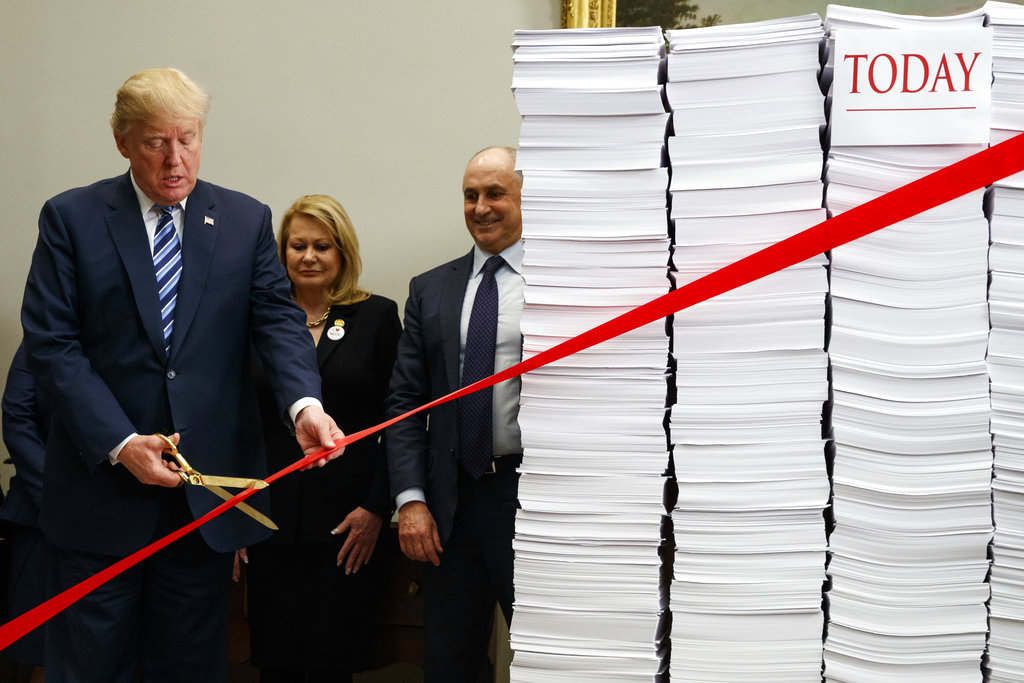
During his four years, Trump made history in eliminating regulations, especially early in his administration. He promised to cut two regulations for every new one and at times was killing 20 for every new rule, winning cheers from business and industry.
In a new report, Crews said that Trump in 2020 again made good on that promise.
“It bores people,” he wrote, “but Trump’s regulatory cuts and unique liberalization agenda have distinguished the beefy [Unified Agenda regulations] report, with the administration proclaiming that agencies continue to meet the requirement to eliminate at least two significant regulations for every new rule added, and to not merely maintain net-zero new costs but generate substantial savings.”
That ends on Inauguration Day, said Bosch. “Given what policies Biden promised to advance during the campaign, it seems clear we can expect his administration to be more like Obama’s than Trump’s when it comes to use of regulation,” he said.
