

Union membership has been cut nearly in half since 1983, with virtually all industries bleeding membership, according to a new Pew Research Center analysis.
In a report out Monday, Pew found that 11 percent of the workforce belongs to a union, down from 20 percent in 1983. In numbers, there are 14.6 million union members compared to 17.6 million in 1983.
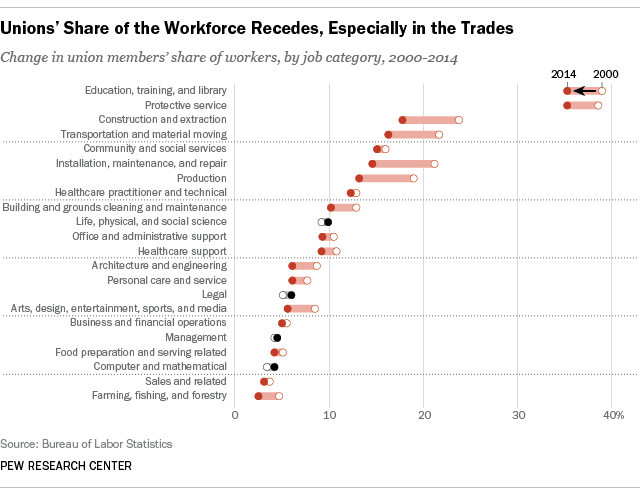
Pew also found that most sectors of workers that have unions are down. The exceptions are in the legal field, management, computer and mathematical jobs, and life, physical and social science occupations.
“The manufacturing-type jobs that once were the foundation of the U.S. labor movement have shriveled in both absolute and percentage terms. In 2000, 19 percent of the 11.1 million Americans in production occupations (2.1 million) were union members. Last year, total employment in those occupations was 8.1 million, only 13.2 percent (or 1.1 million) of whom were union,” said Pew.
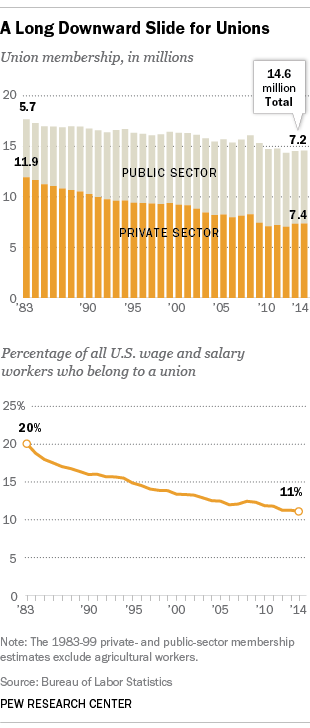
The top unions continued to be comprised of public workers, but even those are shrinking, said Pew:
“Last year, the two groups with the highest unionization levels were protective service occupations (such as police officers, firefighters and security guards) and education, training and library occupations, both at 35.3 percent. Not surprisingly, both groups are composed largely of public-sector workers. Federal, state and local governments have far higher unionization rates overall (ranging from 27.5 percent to nearly 42 percent) than the private sector (6.6 percent). But unionization has slipped even among those groups: In 2000, 39 percent of people in education, training and library occupations and 38.6 percent of people in protective service occupations were unionized.”
Paul Bedard, the Washington Examiner’s “Washington Secrets” columnist, can be contacted at [email protected].
