

Hillary Rodham Clinton’s virtual lock on black and Latino voters, key blocks in early primary and caucus states, should put her on the way to securing the Democratic nomination by mid-March, and possibly as early as March 1, according to a sweeping election analysis.
What’s more, entry into the race by Vice President Joe Biden could help her bid by dividing the white vote further between Clinton, Biden and Vermont Sen. Bernie Sanders, according to the University of Virginia analysis.
“Given Clinton’s overwhelming appeal among nonwhites and Sanders’ relatively small hold over them in horserace polls, much of Biden’s additional support might actually come from white voters. This would then only further divide white Democrats while non-white Democrats may remain predominantly in Clinton’s camp,” wrote Geoffrey Skelley, in the school’s Center for Politics “Crystal Ball.”
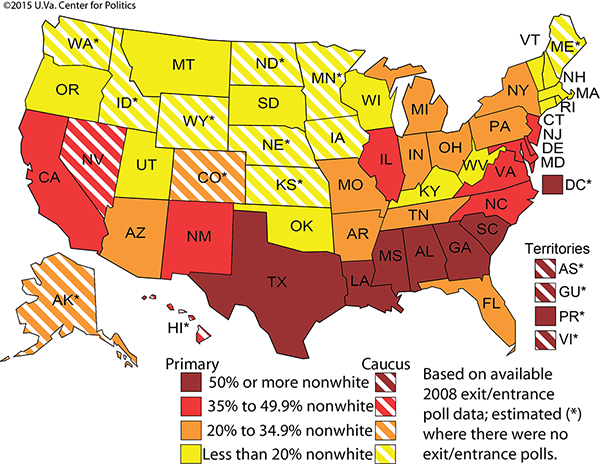
It is evidence that Clinton’s pivot to building support among minorities is a shrewd move to protect her lead even if Biden jumps in.
In reviewing the primary and caucus schedule and the percentages of minority voters in each, Skelley suggests that Clinton might have trouble in the first two, Iowa and New Hampshire, which feature an overwhelming white electorate. But after that, she looks golden.
Nevada, with a large Latino population and a 36 percent non-white vote in 2008, is third followed by South Carolina which has a large black population and a 57 percent non-white vote in 2008.
Referring to Iowa and New Hampshire, Skelley wrote, “After those two states vote, Clinton’s support among nonwhite voters may well prove to be a huge difference maker for the former senator and first lady.”
Then on March 1, 13 states vote, many in the south with big minority populations that are trending Clinton over Sanders seven to one. And by March 15, another 12 states vote, including those like Colorado, Florida, Louisiana, Mississippi and Illinois with big minority populations.
“Of the delegates in the states that have contests up through March 1, 72 percent will come from states that had at least 20 percent non-white primary and caucus electorates in 2008. These states, among them Arkansas (in some ways still Clinton’s home — she won 70 percent there in 2008), will be in a position to pledge a fair number of delegates to Clinton, strengthening her as we move deeper into the campaign,” added Skelley.
Paul Bedard, the Washington Examiner’s “Washington Secrets” columnist, can be contacted at [email protected].
