

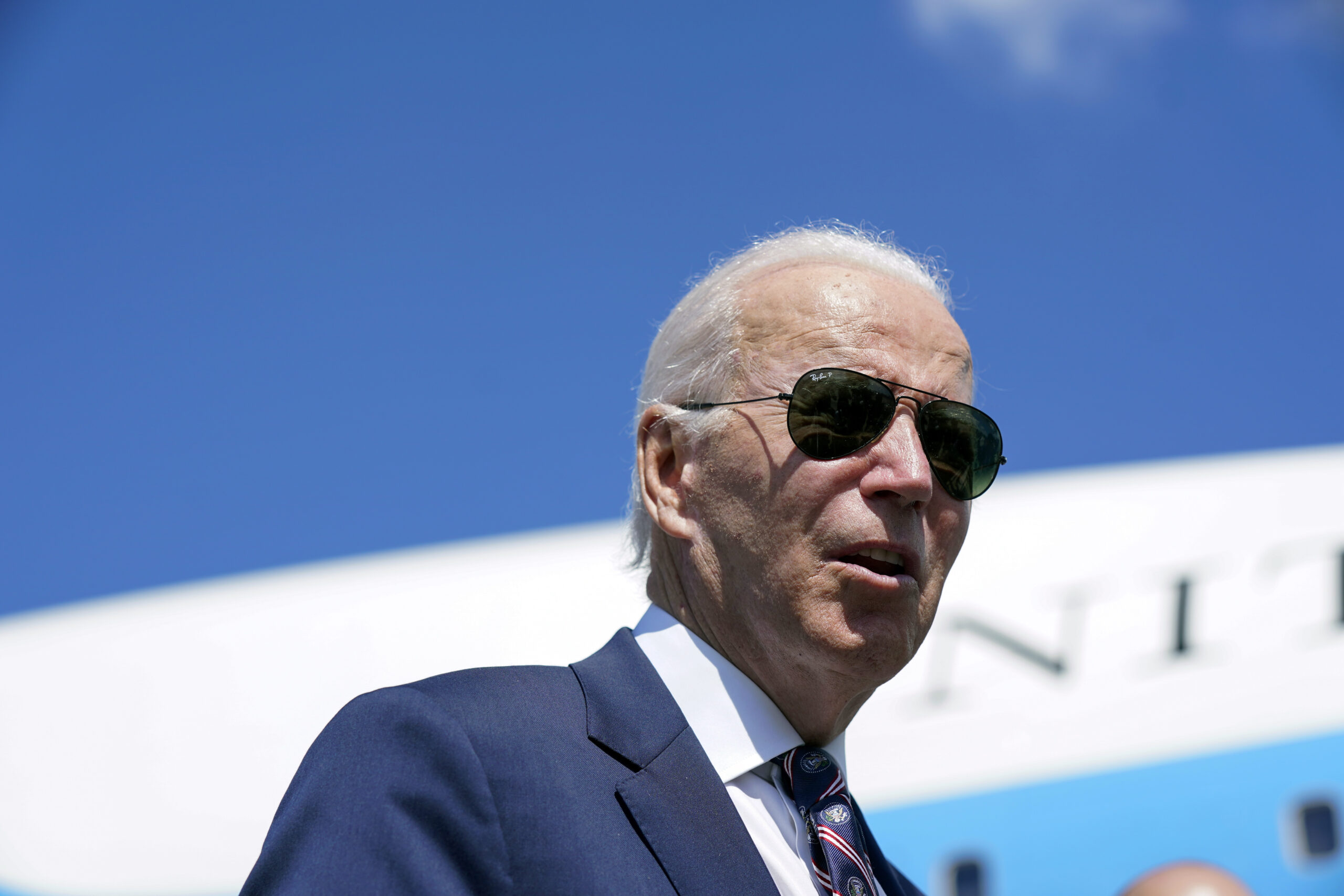
OXON HILL, Maryland — The liberal pressure campaign on President Joe Biden to cancel federal student loan debt was immense, his executive action last month underscoring the importance of energizing the disenchanted Democratic activist base before November’s midterm elections.
Recommended Stories


But Biden seems to be selective about when he mentions his long-awaited decision as Republicans work to frame the move as an elite debt bailout.
SENATE MARRIAGE BILL COULD COMPLICATE DEMOCRATS’S ‘MAGA’ SUPREME COURT ATTACKS
JPMorgan Chase Institute data indicate Biden’s student loan cancellation plan will benefit wealthy families more than poor ones, though lower-income and minority households are more likely to have the breadth of their debt forgiven. At the same time, Republicans cite Gallup numbers demonstrating that inflation is causing financial hardship for a majority of the public.
“Joe Biden bailed out wealthy college grads yet is shy to mention it,” Republican National Committee spokesman Will O’Grady told the Washington Examiner. “Could it be because his bailout is extremely unpopular and out of touch? Or is it because it is unfair to those who chose a different route or paid off their loans already? Or because it further fuels already rampant inflation?”
“Regardless, this ‘win’ reveals who Joe Biden really is: an out-of-touch career politician who couldn’t care less about hardworking Americans,” O’Grady added.
The White House did not respond to questions about why Biden failed to mention his student loan cancellation plan while campaigning on Labor Day in the battleground states of Pennsylvania and Wisconsin — and in the relatively working-class cities of Pittsburgh and Milwaukee, where the president has burnished his union connections in the past. Biden did refer to it the week before during his first midterm rally in the Democratic stronghold of Maryland.
Berwood Yost, director of Franklin & Marshall College’s Center for Opinion Research in Pennsylvania, contended polling he had analyzed showed “a slight majority” approve of Biden’s plan in his state. Simultaneously, opinions are “starkly different by political party,” and independent voters are “about evenly split on it,” according to Yost.
“I think the political calculus is that this is an issue that the president talked about while campaigning, and I imagine he expects this is a way for him to get his base voters excited in the hopes that they will support Democrats during the fall campaign,” he said.
“In Pennsylvania so far, there’s been little mention of this by either Senate candidate, so I don’t know how big a role it will play here,” Yost continued.
Although Biden did not mention his student loan debt forgiveness plan in Pennsylvania and Wisconsin last week, party officials at the Democratic National Committee‘s summer meeting did not appear to hesitate.
The White House’s digital strategy director, Rob Flaherty, was lauded during the DNC’s executive committee meeting for his team’s defense on social media of Biden’s student loan debt cancellation plan from Republican criticism by comparing it to GOP lawmakers’ endorsement of former President Donald Trump‘s pandemic-era Paycheck Protection Program.
Flaherty told the DNC’s most influential figures on Friday that the effort generated “about 20 million” social media impressions, not including earned media attention. The Biden campaign alumnus described a desire among rank-and-file Democrats to more stridently counter Republican attacks, particularly before the midterm cycle.
A day earlier, DNC Chairman Jaime Harrison told the Youth Council that Biden’s cancellation of $10,000 in student loan debt for borrowers earning less than $125,000 a year and $20,000 for eligible Pell Grant recipients was the first of “many more steps forward.” Harrison’s comments acknowledge that while Biden’s plan will provide relief, liberals, such as Senate Majority Leader Chuck Schumer (D-NY) and Sen. Elizabeth Warren (D-MA), pushed for $50,000 in debt forgiveness.
“Do we need to do more? Should we do more? Yes. And we will,” he said. “We need at least two or three new additional United States senators. We need to keep our majority in the House of Representatives.”
CLICK HERE TO READ MORE FROM THE WASHINGTON EXAMINER
The Pennsylvania Senate campaign is leaning Democratic as the party seeks to expand a majority that relies on Vice President Kamala Harris’s tiebreaking vote, according to the Cook Political Report. But Wisconsin, along with Arizona, Georgia, and Nevada, are considered to be toss-up Senate races, according to the same election prognosticator. The House is more of a challenge to Democrats because the party currently only has a four-seat advantage over Republicans. Twenty-four Democrats, in contrast to eight Republicans, are thought to be in toss-up contests.
