

The Israel-Hamas war concluded with the implementation of a U.S.-backed ceasefire on Oct. 10, leaving the future of the militant group that has governed Gaza since 2007 uncertain.
Hamas has lost thousands of fighters, depleted much of its arsenal, lost several key allies and widespread support, and seen most of its enclave leveled. Despite this, Hamas has clung to power, emerging from the rubble battered but standing.
One of Hamas’s earliest and most resilient domestic opponents is Khalil Sayegh, one of the few thousand Palestinian Christians born and raised in the Gaza Strip. The then-teenage Sayegh was an outspoken critic of Hamas at the beginning of its rule, resulting in two brief arrests in 2008 and 2009, where he was tortured. He fled Gaza soon after to live in the West Bank.
Sayegh holds the unique distinction of being one of the few people who were banned from returning by both Hamas and the Israeli government. He now resides in Washington, D.C., where he founded the Agora Initiative, a group that advocates a nonviolent solution to the Israel-Palestinian conflict.
Sayegh spoke with the Washington Examiner weeks after the Gaza ceasefire to give his perspective on how the war has affected Hamas, its current stance, and the militant group’s long-term prospects.
GAZA CEASEFIRE TAKES EFFECT, ENDING FIGHTING AFTER OVER TWO YEARS
How the war changed trajectory of Hamas
Hamas launched its Oct. 7, 2023, attack against Israel in the hope that it could drag its allies, Iran, Hezbollah, and the so-called Axis of Resistance, into the conflict for a decisive clash with its longtime enemy. This strategy worked in one respect, forcing a decisive confrontation. However, the outcome was the opposite of that desired by Hamas, as miscommunication within the Axis of Resistance gave Israel the ability to isolate and pummel each entity one by one, vastly degrading its capabilities.
With Bashar Assad’s Syria gone, Hezbollah crippled, Iran reeling, and the rest of the Axis of Resistance struggling to regain its footing, Hamas is now largely isolated.
After the Oct. 7 attack failed to bring down the Israeli state, Sayegh estimated that opinions are split within Hamas in a retrospective view as to whether the surprise attack was worth it.
“I think there are a variety of opinions,” he said. “The board that was interested in governing Gaza understood that this was a huge loss because of the amount of destruction in Gaza, and also their government capacity and their reputation, as they like to try to build as a rational actor, etc., has been demolished, to an extent.”
“But on the other hand, the reputation as a resistance and pro-Palestinian movement globally, etc., there are some positive signs from their point of view,” Sayegh added. “I would assume that there are a variety of opinions within the leadership between those who are more radical, Iranian-minded, and those who are more like Muslim Brotherhood, Qatar, Turkish-minded.”
Omar Shaban, founder of the Gaza-based PalThink for Strategic Studies, also noted in the summer 2024 issue of the Cairo Review of Global Affairs the ideological split between those leaning more toward Qatar and Turkey and those leaning more toward Iran and the Axis of Resistance. The former camp tends to make up the political leadership largely living abroad, based in Qatar, and favors a more peaceful approach focused on cultivating support, particularly financial, from the wider Arab world. This faction leans more toward concerns with the daily governance of Gaza and maintaining political control.
Those favoring Iran make up the leadership of Hamas’s armed wing, the Al Qassam Brigades, and reside entirely within Gaza. They favor terrorism and violent action, using smuggled Iranian and Axis of Resistance weapons to wage war against Israel. Much of this senior leadership was killed in the war, opening up the possibility of fortune swinging toward the other camp.
Will Hamas maintain control over Gaza?
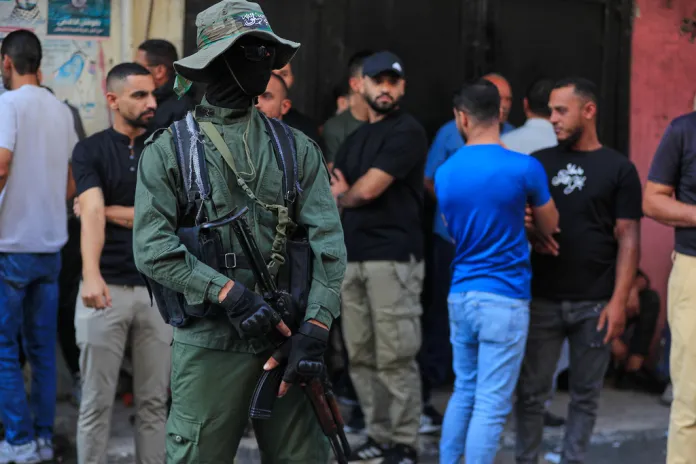
After the ceasefire was implemented, Hamas was quick to make overt shows of power to demonstrate its consolidation of control over the Gaza Strip. Fighters posted videos online showing the execution of Palestinian men described as Israeli collaborators.
Hamas can credit its survival with its authoritarian rule over the strip since 2007, wiping out all other rivals, and its extensive network of tunnels.
“The reason why is because there is no alternative power. When Israelis withdraw, [Hamas fighters] start reemerging from the tunnels and in the other areas. And you know we’ve seen all these public executions and means to terrorize the public into submission,” Sayegh said.
“Hamas overall survived, and it has the capacity to terrorize the public,” he added. “What do you need to run Gaza? From the perspective of Hamas, just enough Kalashnikovs and enough M-16s and enough terror so the public will fear you. And that’s all that it takes.”
Hamas faced the first significant domestic armed threat to its power since kicking out Fatah in 2007 in the final months of the war in Gaza. Sayegh broadly split Hamas’s opposition into two categories, the first being questionable armed groups, armed and supported by the Israel Defense Forces.
“These are small, relatively, obviously armed by Israel, but don’t have any legitimacy, do not have enough backing within the Palestinian society,” he said. “It’s very unlikely for them to challenge Hamas in any real way, except for the fact that the Israel Defense Forces are defending them.”
The groups are poorly disciplined and often represented little more than gangs. Many members have extensive criminal backgrounds and are viewed with hatred by wider Palestinian society due to their criminality and association with Israel.
“The main one, also called the Popular Forces, is the Abu Shabab Gang. So this Abu Shabab guy, this is a guy who has a history of drug dealings and criminal history,” Sayegh explained. “Suddenly, he was backed by Israel with weapons, and he surrounded himself with a few members of his clan, from other clans as well, and was supplemented with weapons from Israel and the control area located at the southern part of the Gaza Strip.”
“They’re not that big,” he added. “I mean, they’re less than 500 people, from what I understand. They’re not well-trained. They’re not sophisticated in any way, and I have doubts that they can do any actual fighting anytime soon.”
Sayegh explained that the group has not seen any significant combat against Hamas, and all of its controlled territory was only handed over by the Israel Defense Forces after its soldiers did all the fighting to clear it of Hamas. He effectively ruled out the group having any postwar role, saying it’s largely uneducated and does not have any useful knowledge outside of “shooting and weapons.”
A United Nations memo obtained by the Washington Post in November 2024 said Yasser Abu Shabab, the group’s leader, was “the main and most influential stakeholder behind systematic and massive looting” of aid convoys.
Sayegh said he suspects that Israel did not believe the small groups it helped arm could overthrow Hamas but that they could plant the seeds for a longer-term strategy within Gaza.
“Before the war ended, there was thinking in Israel that if we arm them, maybe they will topple Hamas eventually, this would create a new reality, or whatever,” he said. “Right now, it’s not clear what’s the Israeli strategy behind backing them. There are some talks, like on the Israeli side, about creating areas free of Hamas in Gaza, where I don’t know if it’s these gangs or who will rule them. And then, people can see the difference between areas controlled by Hamas versus areas controlled by other people.”
Abu Shabab was killed last week, after the interview was conducted, purportedly as a result of an internal dispute. Hamas celebrated his death but didn’t claim responsibility. Consistent with Sayegh’s characterization, Palestinians in Gaza were seen celebrating his death, laughing and handing out sweets alongside a printed-out picture of his face with an “X” over it. Ghassan al Duhaini, a Bedouin and former lieutenant in the Palestinian Authority security services, took over as leader after the group’s namesake’s death.
The second category is Palestinian clans with long-standing grievances against Hamas.
“They are just Palestinian families who had historical grievances with Hamas, who refused to submit fully to Hamas. And these are the families that were mostly targeted by Hamas right after the ceasefire. These are families that have refused to work with the Israelis,” Sayegh said of the first category.
One of the largest and most influential is the Doghmush clan, which has clashed with Hamas since the group seized control of Gaza. However, clans such as these have no ambitions of ousting Hamas from power, Sayegh explained.
“These people are not interested in governing — the families who are not related to Israel, the clans. They’re interested in governing their own neighborhood,” he said. “They’re interested in their, what’s known as, a traditional clan system, that they lived as part of. And they don’t want to see Hamas controlling their neighborhood, but if Hamas controls other areas, they don’t care. But once Hamas starts coming to their neighborhood, that’s where they feel threatened, and that’s why this whole thing happens.”
The desire for autonomy clashes with Hamas’s authoritarian goal of exerting control over the entire strip, leading to clashes. These conflicting visions exploded into clashes during Hamas’s consolidation period in 2007, leading to battles that in some cases involved the group firing mortars against clan neighborhoods.
For now, Sayegh said he believes that although Hamas is more unpopular than ever, there’s scant chance of an uprising anytime soon.
“Among the factors is that the people are extremely tired,” he said. “They just came out of a very destructive war that destroyed everything. Their means of living are not all fulfilled. They’re looking for food, for water, for basic necessities. And if we know anything about history, when people are that tired, revolutions or uprisings are unlikely to happen.”
Manipulating the peace process or a return to form?
While Hamas can be confident that its domestic front is safe from opposition, nearly 60% of the Gaza Strip remains occupied by Israel. The only thing stopping the IDF from moving back in is U.S. support for the ceasefire, a position that could change if Hamas is viewed as noncompliant. The United States has so far stood by Israel as it has carried out extensive strikes within Gaza after accusations of Hamas breaking the ceasefire, demonstrating the pressure the group is under.
The second phase of the Gaza peace deal calls for the disarmament of Hamas and the handing over of governorship to an apolitical, technocratic entity — two moves that would deal a colossal blow to the militant group. Opinions within Hamas are split on how to proceed.
“Hamas has been clear that they wouldn’t be disarming, and they’ve made it very clear they wouldn’t be leaving Gaza completely,” Sayegh said. “They’re looking for other means of staying and use different terminology to justify their existence in Gaza.”
“What’s likely to happen is that Hamas is looking for a way to make it seem that there is a technocratic government, or whatever, governing Gaza, when they are in the shadows, trying to control at least the security aspects of administering Gaza,” he added.
Sayegh said he believes Hamas began setting up its excuse not to disarm almost as soon as the ceasefire went into effect.
“They are creating facts on the ground where Hamas rules, and they are filling the security vacuum,” he said. “And what they are communicating, obviously, to the Americans and others, ‘Listen, there is a security vacuum. We have to fill it.’ And then when they’re asked to disarm, probably to bring up the excuse that there will be a security vacuum. Who else will fill it, etc.? So that’s what would be the Hamas approach.”
Beyond the ceasefire, a wider debate is taking place within Hamas regarding whether or not to change the entire structure of the organization. Shaban laid out the possibility that Hamas’s leadership could choose to abandon governing altogether for the time being, returning to its roots to focus on being an advocacy and social works network that gained it popularity in the 1990s. It could use this time out of the spotlight to rebuild itself and its credibility. He estimated that it could take three to five years to resolve the existential crisis the group is currently experiencing.
Palestinian journalist Abu Bakr Bashir, speaking with NPR, took Hamas at its word in agreeing with the U.S. peace proposal, believing it will take the path outlined by Shaban.
“Hamas has agreed to be out of the government and play no political role in Gaza,” he said. “Hamas believes it can go back to playing the role it did before it took power in Gaza almost 20 years ago. That role was more about providing charity, welfare, and education services to Palestinians. That is where they historically gained popularity.”
Other militant groups, such as Hezbollah, are also known to have welfare organizations to provide benefits for members and increase their popularity in communities. In Hamas’s case, its welfare and charity works were carried out alongside suicide bombings and other terrorist attacks, so a return to charitable works would not proclude giving up terrorism.
HOW ISRAEL’S CEASEFIRES WITH HAMAS AND HEZBOLLAH ARE HOLDING UP
Bashir also speculated that Hamas interpreted the U.S. directly communicating with it to form a ceasefire as a sign of significant credibility, giving it hope for the future.
“Even though the U.S. wants Hamas to give up its weapons and its control of Gaza, Hamas interpreted these meetings as recognition that the Americans see a role for them in Gaza’s future,” he said. “This means Hamas’ ideology will have a safe environment to grow again.”
