

In Focus delivers deeper coverage of the political, cultural, and ideological issues shaping America. Published daily by senior writers and experts, these in-depth pieces go beyond the headlines to give readers the full picture. You can find our full list of In Focus pieces here.
In politics and in spirituality, President Donald Trump has never been one for hierarchy unless he’s at the top.
Raised as a Presbyterian by his mother, Trump told religious reporters in 2020 that he now considers himself a “non-denominational Christian.” It was a shift from a traditional church known for its structured polity to a choose-your-own theology approach.
That affiliation does not seem to have changed. Trump’s closest faith advisers remain firmly planted in the evangelical tradition, and his signature line of Bibles boasts the “trusted King James Version translation” much beloved by that stripe of Protestants.
Yet, it has become impossible to ignore that the Catholic Church, once shunned from U.S. politics by nationalists fearful of the Vatican meddling in U.S. affairs, has become one of the main ideological engines of the second Trump administration.
Trump has surrounded himself with Catholic politicians who cite the tradition as fundamental to their worldview. He has issued presidential messages so dripping with Roman theology that it would make the protestant founders’ heads spin, and shared artificially generated images of himself as pope.
The Catholic Church, meanwhile, seems to be drinking from a firehose as it reacts to this unexpected prominence in U.S. politics — with the laity, bishops, and the pontiff out of sync.
The American laity’s rightward shift
Catholic Americans, a historically divided voting bloc, were a critical demographic in Trump’s second electoral victory in 2024.
Approximately 55% of Catholics cast their vote for Trump, compared to just 43% who voted for former Vice President Kamala Harris, according to the Pew Research Center. It was a major shift after 2020, when Catholics broke solidly in favor of President Joe Biden, who made his Catholic faith a fundamental part of his campaign and public image.
Kelsey Reinhardt, the President and CEO of CatholicVote, the nation’s largest Catholic political advocacy group, told the Washington Examiner that opposition to policies enacted under Biden and the prospect of their escalation under Harris were the main drivers for Catholics to flip.
“Probably the largest thing [Trump] has delivered is the alternative to a Kamala Harris administration,” Reinhardt said. “I mean, what Catholics were considering under a Harris administration — continued ignoring of violence against Catholic churches, weaponization of the FBI versus Catholics, … the jailing of pro-lifers for peacefully protesting, the imposing of gender ideology, the undermining of parental rights with the full force of the federal government through every institution of the executive branch, the financing of Planned Parenthood with taxpayer dollars.”
Trump’s support has largely held over the past year. Catholic news outlet EWTN published a poll this month showing a majority of Catholics in the United States still hold a favorable opinion of the president (52%), compared to those who have an unfavorable view (37%) and those who are neutral (11%).
Following his election, Trump stacked his Cabinet with a staggering number of Catholics at the highest rungs of power.
His two closest confidants and consultants, Vice President JD Vance and Secretary of State Marco Rubio, are a convert and a cradle Catholic, respectively. Border czar Tom Homan self-identifies as a practicing Catholic and Mass-goer, as does White House press secretary Karoline Leavitt.
Secretary of Education Linda McMahon, Secretary of Health and Human Services Robert F. Kennedy Jr., Secretary of Transportation Sean Duffy, Secretary of Labor Lori Chavez-DeRemer, CIA director John Ratcliffe, Social Security Administration Commissioner Frank Bisignano, and many other officials are self-identified Catholics.
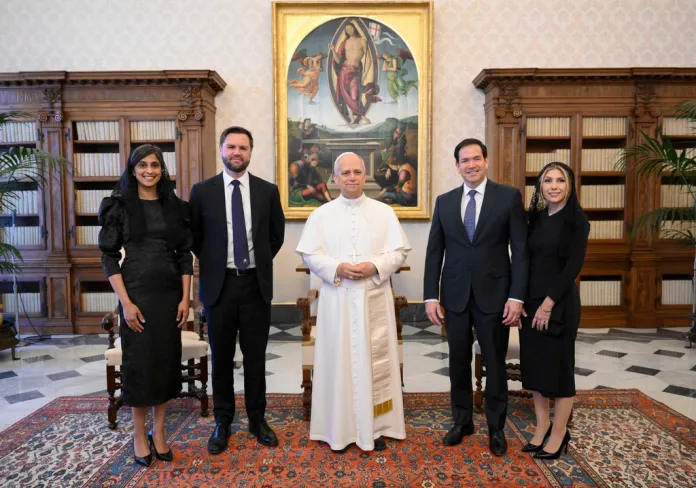
White House communications have built out their rhetoric to reflect the growing papist representation among staff and supporters.
On Dec. 8, the White House issued a presidential message on the Feast of the Immaculate Conception — the commemoration of the Virgin Mary being saved from original sin by God to prepare her for the Incarnation in adulthood.
It was the first time such a message had ever been issued by the president, and its language was so packed with veneration that many Catholics saw it as a watershed moment of integration into the historically Protestant country.
“For nearly 250 years, Mary has played a distinct role in our great American story … In her honor, and on a day so special to our Catholic citizens, we remember the sacred words that have brought aid, comfort, and support to generations of American believers in times of need,” the message read before printing the “Hail Mary” in full. The president previously released a similar statement on the Feast of St. Michael.
IVF and abortion drug stumbling blocks
The most fundamental stumbling block the administration has faced with Catholics, particularly practicing and mass-going Catholics, is Trump’s varying support for in vitro fertilization procedures.
According to the anti-abortion principles adhered to by the Catholic Church, IVF is held in the same contempt as abortion due to its frequent termination of fertilized embryos and tampering with the creation of human life. For similar reasons, Catholics have expressed disappointment with the administration’s approval of generic mifepristone, an abortion-inducing drug.
“I would say those two areas are probably the most outstanding,” Reinhardt said. “We shouldn’t discount the real work that has been done in other spaces — the appointments that overturned Roe v. Wade, the defunding of Planned Parenthood this year, the pardoning of the 23 pro-lifers who were imprisoned by the Biden administration … but again, if you understand IVF, you understand that the numbers that we’re dealing with there in terms of abortions are extremely high — very concerning.”
Large pockets of opposition to Trump exist within the U.S. Catholic voting base. However, it is fair to say that the administration has made massive gains with the demographic compared to past elections, and Catholics have gained unprecedented representation in the nation’s highest offices.
Bishops vs. Border Enforcement
Trump’s relationship with the nation’s episcopacy, however, remains somewhat fraught.
Some prelates have taken a friendly approach with the president, aiming to emphasize common ground and work together to further the cultivation of shared values.
Cardinal Timothy Dolan of New York and Bishop Robert Barron of Winona-Rochester, for example, were appointed to the White House’s “religious liberty commission,” tasked with creating a “comprehensive report on the foundations of religious liberty in America, strategies to increase awareness of and celebrate America’s peaceful religious pluralism, current threats to religious liberty, and strategies to preserve and enhance protections for future generations.”
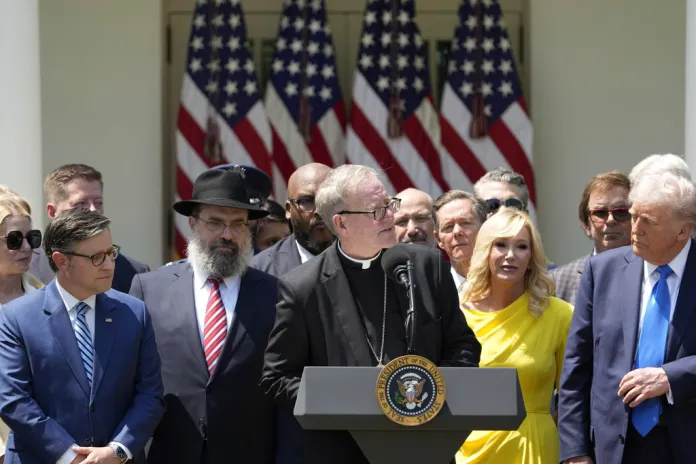
But the bishops have picked one point of divergence on which to make a firm stand — the White House’s mass deportation of illegal immigrants.
“The most public display of differences between the bishops and Trump has been on the issue of immigration. I do think that both have acknowledged that the country has a right to control its borders and regulate its borders — and you could say in one sense that they have a similar understanding of that,” Reinhardt said. “But maybe that the bishops diverge on the question of how dignity is respected, the manner of arrest.”
A Vatican insider who is regularly in communication with both prelates in Rome and officials in the White House told the Washington Examiner that the fundamental conflict rests in each side’s responsibilities.
“[Republicans] believe that if you’re here illegally, you’ve got to go home and come back the right way,” the source explained. “If you’ve been here for 20 years and you did a lot of good, but you’ve been here illegally all of these 20 years — OK, you gotta go home, and then you come back. And if you don’t have a home, because you know, everybody [in your family] is here, that’s not my problem.”
He continued, “The ecclesiastical side says everybody is in ‘Imago Dei’ [Latin for ‘image of God’] — we need to understand that there are a lot of constraints generated by administrative inefficiency, and so it’s dehumanizing that we penalize somebody that’s been here 10 years.”
The insider expressed frustration that these positions were being presented as opposing concepts instead of reconcilable perspectives on the same issue. “I think that the administration is remaining in the ‘reason’ spectrum and the bishops are staying in the ‘faith’ — and so this is faith and reason, church and state, right?” he said. “Everybody should stay in their corners, but try to figure out as grown-ups, as adults, how to march toward the common good.”
The immigration issue came to a head in November, when the U.S. Conference of Catholic Bishops voted to issue a “special pastoral message” about the Trump administration’s handling of deportations — accusing officials of creating “a climate of fear and anxiety around questions of profiling and immigration enforcement.”
“We are saddened by the state of contemporary debate and the vilification of immigrants. We are concerned about the conditions in detention centers and the lack of access to pastoral care. We lament that some immigrants in the United States have arbitrarily lost their legal status,” the document stated.
The actual content of the message took an even-handed approach, affirming that “nations have a responsibility to regulate their borders” but also to “establish a just and orderly immigration system.”
“We bishops advocate for a meaningful reform of our nation’s immigration laws and procedures,” the bishops said. “Human dignity and national security are not in conflict. Both are possible if people of good will work together.”
The document was not unusual — the USCCB has published a variety of documents offering moral guidance on issues ranging from abortion to the death penalty. However, the bishops took the extra step of releasing a video of various prelates reading the message into the camera, a component that observers interpreted as an unusually direct and personal rebuke.
“I said, ‘What the heck is that s***? Why did you do that?'” the insider told the Washington Examiner. “There is no need for you to do such a thing. You did a letter as bishops — as shepherds of 80,000,000 Catholics … That’s it! You don’t need to do a stupid video. Who’s the jackass within the USCCB that told you that that was a good idea?”
Homan rebuked the USCCB’s statement, telling the prelates that he thinks “they need to spend time fixing the Catholic Church.”
“We’re going to enforce the law, and by doing that we save a lot of lives,” he said. “I wish the Catholic Church would understand that.”
Despite the bishops’ protests, the laity seems to be aligning more with the president than with their shepherds. According to the EWTN poll conducted last month, 54% of respondents said they support “the detention and deportation of unauthorized immigrants on a broad scale.” Approximately 30% said they oppose the policy, while 17% were neutral.
The pope and the president
The final dimension of Trump’s relationship with the Catholic Church is the Holy See itself.
Earlier this year, Robert Francis Prevost became the first American cardinal in history to be elected pope, taking the name Pope Leo XIV. Trump celebrated the occasion, saying, “To have the Pope from America is a great honor.”
Pope Leo XIV has tried to be diplomatic in relations with his home country — at times saying he prefers “not to comment … about choices made — political choices — within the United States.”
At other points, he was dragged into the fray. When the USCCB-Trump feud was at its height, an American reporter pressed the Holy Father for comment. The pontiff came to his fellow bishops’ defense, offering a similar perspective to that expressed in their message.
“If people are in the United States illegally, there are ways to treat that. There are courts. There’s a system of justice,” the pope responded, acknowledging that “every country has a right to determine who and how and when people enter.”
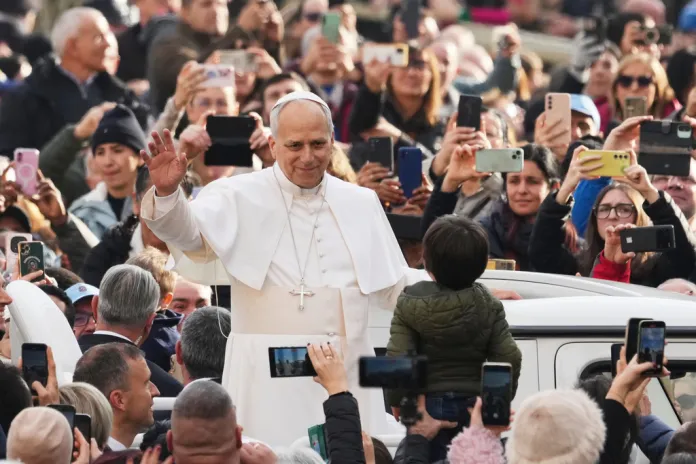
He continued, “But when people are living good lives, and many of them for 10, 15, 20 years, to treat them in a way that is extremely disrespectful, to say the least. And there’s been some violence, unfortunately — I think that the bishops have been very clear in what they said.”
Some media outlets have tried to portray moments like this as the pontiff conclusively condemning Trump’s presidency, but Leo usually couches his criticisms with acknowledgements of practical realities of the United States and a pastoral tone.
“When the pope got tricked by the silly American interviewer, and he basically expressed his opinion, I don’t think that he crossed the line,” the insider, who works with both the Vatican and members of the Trump administration, told the Washington Examiner. “I don’t think that he went from the ecclesiastical position and trashed the administration. I think he just spoke as a shepherd.”
The press remains committed to finding points of conflict between the White House and the Holy See, and Leo seems to struggle with turning down their questions even when he doesn’t want to answer.
Reporters pressed the pope earlier this month for comment on Trump’s proposed plan for peace between Russia and Ukraine. “I’d rather not comment on that, I haven’t read the whole thing,” the pope replied sheepishly.
“I think, unfortunately, some parts of it I have seen make a huge change in what was, for many, many years, a true alliance between Europe and the United States,” he explained. “The remarks that were made about Europe, also in interviews recently, I think, are trying to break apart what I think needs to be a very important alliance today and in the future.”
The pontiff was referencing Trump’s contemporary comments in the press about European nations becoming “weak” and their global influence “decaying” due to misplaced priorities on critical issues such as defense and mass migration.
White House spokeswoman Anna Kelly responded diplomatically to the pope’s comments by affirming that the president “has great relationships with many European leaders, but he never shies away from delivering hard truths.”
The relationship between the U.S. government and all levels of the Catholic Church has entered uncharted territory.
Catholics are not only throwing their support behind the administration, but are being elevated and catered to more comprehensively than they have under any previous government.
US BISHOPS VOTE TO BAN TRANSGENDER SURGERIES AT CATHOLIC HOSPITALS
Some bishops have affirmed their willingness to work with the administration when the views of the Church and the White House align, but messaging between church and state has been contentious, to say the least.
At the top, the institutions are being captained by a president known for his big mouth and a Midwestern priest who sometimes seems too nice to tell the press to kick rocks.
