

German Chancellor Friedrich Merz called for a revival of the U.S.-European relationship, warning Washington against going solo on the world stage.
“In the era of great power rivalry, even the United States will not be powerful enough to go it alone,” the German leader said in a speech to NATO members during the high-profile Munich Security Conference.
Merz sought to appeal to Washington this week, arguing that keeping a strong relationship with Europe is in line with the U.S.’s increasingly transactional philosophy on partnerships. Although he acknowledged concerns about “difficulties” in the relationship, he said calls to write off the U.S. as a partner are unrealistic, warning that critics “ignore hard geopolitical realities” and “underestimate the potential that our partnership with the U.S. continues to have.”
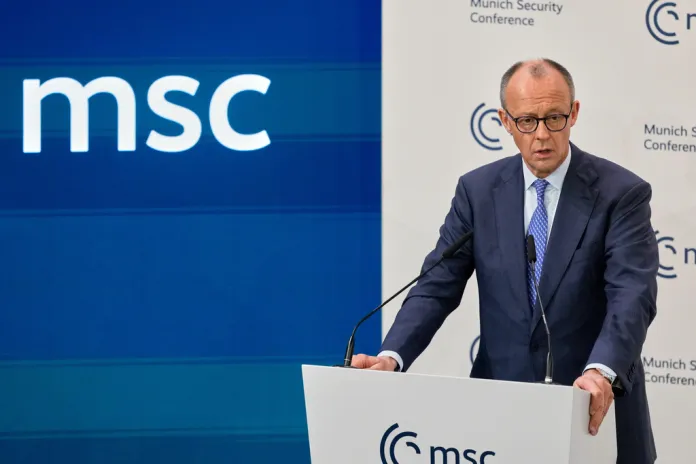
“Being a part of NATO is not only Europe’s competitive advantage. It’s also the United States’s competitive advantage. So let’s repair and revive trans-Atlantic trust together. We, the Europeans, are doing our part,” Merz said in remarks seeking to “repair and revive trans-Atlantic trust together.”
At the same time, the chancellor urged Europe to step up internal partnerships and decrease “excessive dependency” on the U.S.
Merz revealed he is speaking with French President Emmanuel Macron to create a joint European nuclear deterrent, stating that “in the long run, we will only be successful if we take the other Europeans on board.” And he warned the U.S. claim to global leadership “has been challenged and possibly lost,” arguing that the world order as NATO has known it “no longer exists.” While he urged the U.S. not to write NATO off, the chancellor also urged partners to build “a strong, self-supporting European pillar within the alliance.”
“Partnership is not an absolute term here — it doesn’t require full convergence of all values and interests,” he said, naming Canada, Japan, Turkey, India, Brazil, South Africa, the Gulf states, and others as opportunities to expand alliances in place of the U.S.
Merz’s statement comes as the long-standing relationship between the U.S. and European partners has undergone a realignment under the Trump administration, with Washington approaching alliances from an increasingly mercurial, noninterventionist standpoint. That approach was detailed in the Trump administration’s 2025 National Security Strategy, which said “the days of the United States propping up the entire world order like Atlas are over” and that it is “far from obvious whether certain European countries will have economies and militaries strong enough to remain reliable allies.”
ARIZONA SHERIFF DENIES REPORT HE BLOCKED NANCY GUTHRIE EVIDENCE FROM FBI
Merz’s speech echoes similar comments he made after the White House released the NSS in December. At the time, he was among European leaders who warned that the foundations of the security order established after the Cold War are being splintered, as the U.S. splits alliances in favor of perceived national interests.
Parts of the document were understandable, but “some of it is unacceptable for us from the European point of view,” Merz said. “In my talks with the Americans, I say, ‘”America First” is fine,’ but America alone can’t be in your interest. You need partners in the world, too.”
