

President Donald Trump has stated repeatedly that Operation Epic Fury will only cease when Iran presents an “unconditional surrender.” What that actually means is vague at best.
The president — who previously said “unconditional surrender” could be either an explicit capitulation by the Iranian regime or “when they can’t fight any longer because they don’t have anyone or anything to fight with” — now seems to indicate that the latter option is already becoming a reality.
“There’s almost nothing left to strike in Iran,” Trump told Axios on Wednesday, going on to say that “the war will end soon.”
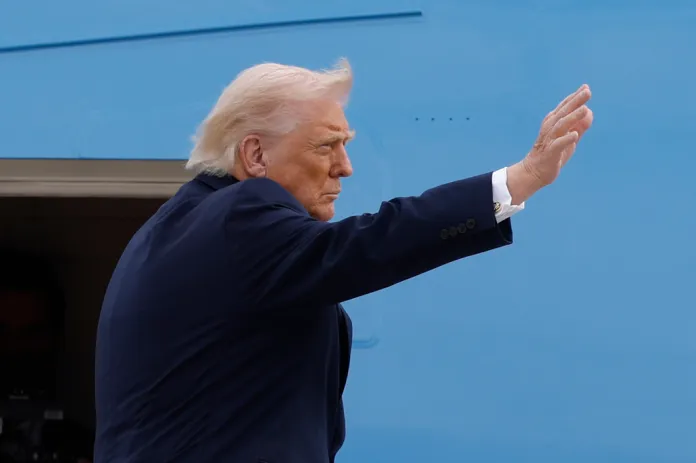
“It will end whenever I want it to end,” he added.
White House spokeswoman Anna Kelly told the Washington Examiner on Thursday the war will continue until the president “determines that the goals of Operation Epic Fury, including for Iran to no longer pose a military threat, have been fully realized.”
Trump’s nebulous temperature check on the conflict highlights increasing frustration among Democrats and members of the president’s own party as the winstate conditions that would end Operation Epic Fury, which is approaching its second week, remain undefined.
Sen. Richard Blumenthal (D-CT) described himself as “dissatisfied and angry” following a Tuesday briefing given to the Senate Armed Services Committee, saying he left with “more questions than answers.”
Even among Trump’s allies and supporters of Operation Epic Fury, there is a question mark hanging over the next phase of the conflict.
Sen. Josh Hawley (R-MO), asked by Fox News on Tuesday what goals are yet to be achieved in Iran, responded: “What is there really that’s left to do that we haven’t already done?”
Annika Ganzeveld, the Middle East portfolio manager for the Critical Threats Project at the American Enterprise Institute, told the Washington Examiner, “It all depends on what the ultimate goal of this campaign is, and that will determine the likely length of it.”
She added: “If those objectives are, for example, to degrade Iran’s nuclear and ballistic missile programs, that will take a much shorter time than if, say, the ultimate objective is setting conditions to change the regime.”
White House press secretary Karoline Leavitt previously told Fox News that the hypothetical “unconditional surrender” that would end the conflict could mean the president has found “Iran can no longer pose a threat to the U.S. and our troops in the Middle East.”
But whether that includes regime change, total destruction of all Iranian nuclear and ballistic missile capabilities, or even the disarming of the entire Islamic Revolutionary Guard Corps remains unanswered.
Additional questions are raised by the president’s assessment that there is “almost nothing left to strike” in Iran. That seems to contradict the most recent update provided by War Secretary Pete Hegseth, who has characterized American strikes as not only numerous but growing in quantity.
“Today will be yet again our most intense day of strikes inside Iran, the most fighters, the most bombers, the most strikes, intelligence more refined and better than ever,” Hegseth said on Tuesday.
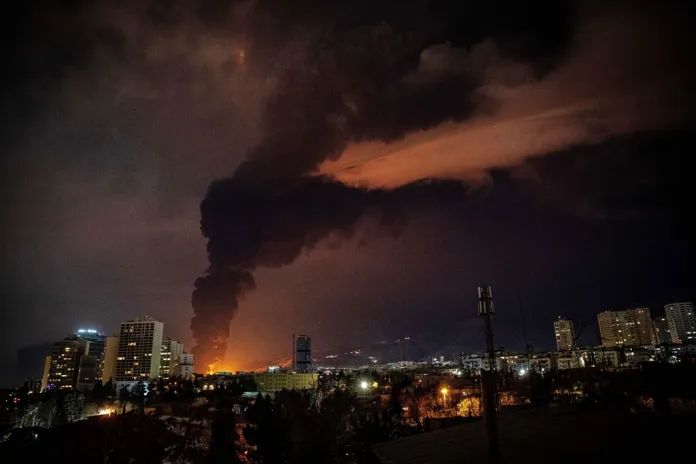
There has also been a heightened awareness of the Iranians’ closure of the Strait of Hormuz, a vital waterway that had roughly 20% of the global oil demand transiting through it prior to the start of the war. Since the war began, traffic has dropped by roughly 97%, according to data compiled by the United Nations, sending international and domestic benchmarks soaring.
Administration officials have discussed the possibility of having U.S. Navy vessels escort ships through the strait to intercept a possible attack, though that hasn’t occurred yet.
On Monday, at the time, Trump said he was “thinking about taking it over,” though it’s unclear what that would look like, and what kind of military presence would be required to make it happen.
Iranian President Masoud Pezeshkian noted over the weekend that “some countries have begun mediation efforts” to quell the conflict, but rebuked anyone expecting unconditional surrender from the regime.
“We are committed to lasting peace in the region yet we have no hesitation in defending our nation’s dignity and sovereignty,” Pezeshkian wrote in a social media statement. “Mediation should address those who underestimated the Iranian people and ignited this conflict.”
The Iranian regime’s disinterest in catering to the U.S. was displayed by its decision to appoint Mojtaba Khamenei, the son of the deceased Ayatollah Ali Khamenei, as the new supreme leader.
The selection of Khamenei to replace his father is “a dangerous development at this time, because if Trump is seeking a quick exit from this conflict, as what happened in June, this will absolutely complicate things,” Spencer Faragasso, a senior fellow with the Institute for Science and International Security, told the Washington Examiner.
Not only does Mojtaba Khamenei’s selection signal a refusal to change political trajectory, but the younger Khamenei is believed to be even more radical than the deceased ayatollah. Passing the torch from father to son — an arrangement that violates the Islamic Republic’s foundational opposition to hereditary monarchy — indicates that the regime is going out of its way to avoid appearing flexible.
“This is a group of individuals that is, first off, we have to remember, what is their state of mind, they’ve been humiliated. They have no ability to save face at the moment. Their country is being decimated by the two states that they’ve been speaking death and damnation about for about 50 years,” Faragasso told the Washington Examiner.
He added: “For them to bend the knee and kiss the ring and choose unconditional surrender is essentially just capitulation in every regard and destruction of their own legitimacy.”
Trump himself has already dismissed the notion of pulling out of Iran with the former ayatollah’s son in power, saying he is “not going through this to end up with another Khamenei.”

The Israeli military has promised to assassinate the new supreme leader and any replacements that step up in his place.
TRUMP SAYS IRANIAN SOCCER TEAM ‘WELCOME’ AT WORLD CUP DESPITE TEHRAN OPPOSITION
There is some reason to doubt that Mojtaba Khamenei is in any condition to lead — he has been reported as wounded in previous strikes, according to Iranian state media.
“His condition has not been reported as critical,” secretary of the supreme national security council Ali Larijani said of Khamenei. “Despite this incident, he continues to provide full authoritative guidance and oversight of the operations, and all actions and attacks are carried out with his direct permission and orders.”
The new ayatollah has not appeared in public or provided any proof of life since his election as supreme leader earlier this week.
Supporters onstage at a rally in Tehran produced a makeshift cardboard cutout of the ayatollah to appear in his place, seemingly taped together and undecorated except for a printout of his face stuck to the head.
