
Andy Burnham appointed Britain’s new prime minister

Published July 20, 2026 8:29am ET | Updated July 20, 2026 10:02am ET


Andy Burnham was sworn in as the United Kingdom’s new prime minister, taking over from the historically unpopular Keir Starmer.

The former Manchester mayor has taken the country’s top elected office just four weeks after entering parliament, having been floated as Starmer’s most likely successor since his premiership entered its existential danger phase earlier this year. Burnham became prime minister after a meeting with King Charles III in Buckingham Palace, as per U.K. procedure, shortly after the king accepted Starmer’s resignation. A statement from Buckingham Palace said the king had “requested him to form a new Administration.”

Burnham
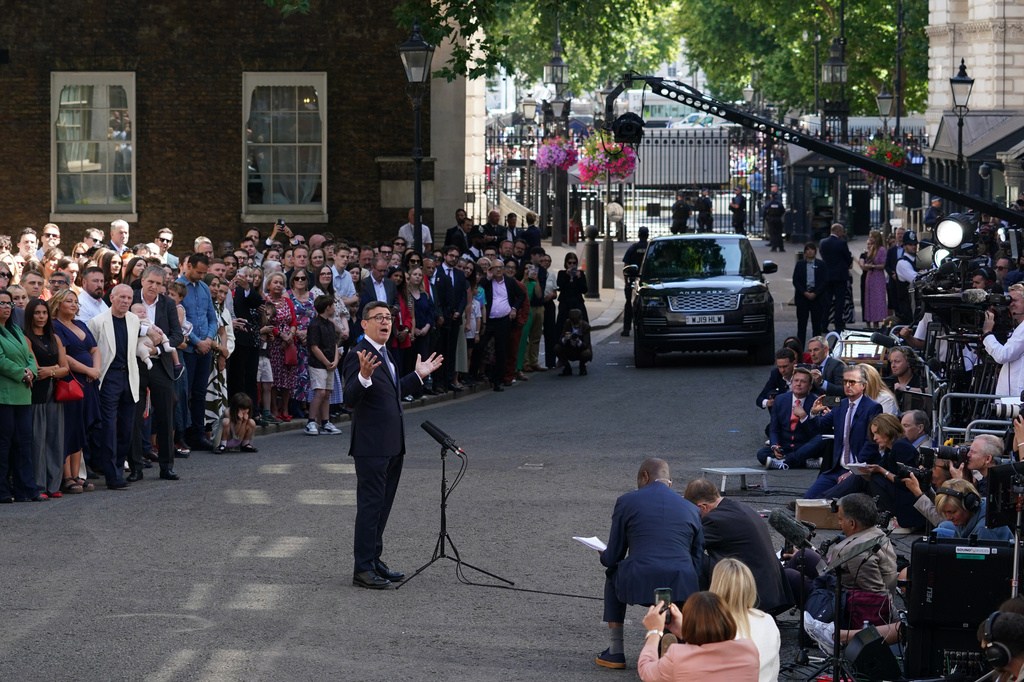
Britain’s new Prime Minister Andy Burnham speaks to staff and media at 10 Downing Street in London, Monday, July 20, 2026.(AP Photo/Alberto Pezzali)

The Labour Party leader “accepted The King’s offer and kissed hands upon his appointment as Prime Minister and First Lord of the Treasury.”

BURNHAM ‘FINALIZING’ CABINET PICKS AHEAD OF APPOINTMENT AS UK PRIME MINISTER

The appointment is a historic one — Burnham is the first Catholic to lead the country since the death of Queen Mary Tudor in 1558, in a country that long distinguished itself in its opposition to Catholicism. Catholics were long persecuted and barred from office, and some laws still in the books barring certain Catholic influence may trigger some awkwardness.

Hopes are high within Labour that Burnham can revive their fortunes, after repeated scandals and record low popularity. The new prime minister has projected an image of vigor, claiming the party’s problems can be traced back to its departure from its founding philosophy. He has pledged to refocus the party on the working class, public-private cooperation economically, and a boost in social spending.

This message was central in his first speech as prime minister outside 10 Downing Street, promising that his premiership would be a “circuit breaker” for the U.K., “bringing forward the biggest changes in the last 40 years.”

“Britain needs to show the world that we can regain our stability once again, and that is our challenge: to make politics work, to make it work better,” Burnham said, admitting that, “We have not been good enough, and we need to be better. We will be.”

He bemoaned the “wrong turns” the country had made since the 1980s.

“Political power was centralized, economic power privatized,” Burnham said. “Large parts of the country deindustrialized, and they still haven’t recovered. Many feel as though they’re still in decline, and they don’t have the ability to turn things around. And that’s why we will change politics to make it more collaborative, more about problem solving than point scoring.”

Starmer pledged his full support to his successor in his own final speech in the same spot less than an hour before.

EUROPE’S DEMOGRAPHIC TIME BOMB IS KILLING ITS LEADERS’ POPULARITY

“He has my full support,” Starmer said. “I go with good grace, I go with a smile, and I go proud of everything we have achieved.”

Though Burnham’s taking of the reins has sparked a groundswell of hope from Labour members, he faces major challenges. The U.K.’s six prime ministers since Brexit have all left office despised, largely due to structural economic issues associated with an aging population. His peers in Western Europe have failed to overcome these issues and now grapple with some of the lowest approval ratings in their respective histories.

The fall of Starmer

Burnham’s rise directly coincided with Starmer’s fall, as the now-former prime minister was able to resist pressure to bow out until the popular Burnham’s by-election victory in the constituency of Makerfield. Burnham had been out of parliament since 2017, serving as the Mayor of Greater Manchester.

Starmer also entered office with high hopes, after Labour crushed its Tory rivals in an electoral landslide in the summer of 2024. His honeymoon lasted only a few weeks, with his first of many crises being the handling of the U.K.’s Winter Fuel Payment, a subsidy paid to pensioners since 1997.

Just weeks after taking office, his Chancellor Rachel Reeves announced that the subsidy was being narrowed from all 11.6 million pensioners to around 1.5 million who met special criteria. It was acknowledged as a “tough choice” that Reeves “didn’t want to make, or expected to make,” but the rising deficit made it a needed fix.

Couching the move with a preemptively apologetic statement didn’t satiate the rage of pensioners and the public, who savaged Starmer’s government in the press. Critics didn’t shy away from directly accusing Starmer’s government of essentially killing pensioners. Despite rolling the reform back in the spring, the damage had already been done, and Starmer’s popularity never recovered. The Telegraph credited the saga as sealing Starmer’s fate.

“If headlines of freezing grannies dominate the first year of your premiership, it may not be destined for greatness,” Telegraph senior money writer Maya Wilson Autzen wrote.

The misstep would prove to be only the first of many. Starmer appointed Lord Peter Mandelson ambassador to the U.S. in February 2025, then fired him in September after his relationship with convicted sex offender Jeffrey Epstein came to light. The trickle of documents concerning Epstein was released over several months at the urging of U.S. lawmakers, ensuring the scandal would remain in British headlines for months.

The worst batch of correspondence between Epstein and Mandelson was released in late January, including emails indicating that he received approximately $75,000 from Epstein and offered the convicted sex trafficker insights on political affairs while serving in former Prime Minister Gordon Brown’s Cabinet. Epstein also made multiple payments to Mandelson’s romantic partner, and a photo emerged showing Mandelson without pants interacting with a woman whose identity was redacted. The first surge of calls for Starmer to resign coincided with these releases in January.

Starmer struggled to handle the scandal and was forced to admit that the government was aware of Mandelson’s association when he was appointed, but decided to go through with it anyway.

While the Mandelson affair was the most high-profile killer, Starmer’s inability to turn the U.K.’s stagnating economy around was the main culprit. Successive governments have been crippled by chronic economic stagnation and an inability to lower the cost of living. The U.S.-Israeli war with Iran and ensuing blockade of the Strait of Hormuz had a disproportionate impact on the U.K. and obliterated any chances of a quick recovery.

The writing on the wall became evident on May 7, when Labour suffered an electoral bloodbath in the country’s local elections. Labour lost more than 1,100 seats that it began the day with, winning just over 1,000 seats that were up for grabs. It lost control of Wales after a century in power, and saw its worst turnout yet in the Scottish elections.

By May 11, more than 60 Labour MPs called upon Starmer to resign. Four Parliamentary private secretaries, junior members of the government, resigned and used the opportunity to call upon Starmer to step down. The prime minister had accepted responsibility for the May 7 losses but vowed to hold on in a May 11 speech.

By the time of his resignation, Starmer had made history as the island nation’s most unpopular premier, with an Ipsos poll finding just 13% of voters were satisfied with him, compared to 79% who were unsatisfied.

Labour’s last hope

The unenviable task of handling all of these lingering issues now falls to Burnham. The new leader said he was “acutely conscious” of the scale of the task before him in his first speech.

Wary of the main issue that sunk his predecessor, Burnham focused much of his first speech on affordability, saying his government would “build a new economy, where we put life’s essentials back under stronger public control to make them affordable to you again, reindustrializing Britain using public procurement to back British industry.”

He promised to put forward a 10-year plan for the U.K.

Burnham also touched on his signature approach of decentralization, delegating more power to local governments, as was his approach as mayor of Manchester.

Part of Labour’s hope in Burnham lies in his broader popularity. He’s one of the most popular politicians in the country, but in an indictment of U.K. politics, this high approval rating stands at just 34% as of June, according to a YouGov poll, with a -4 point net approval rating. The same poll had Starmer at -45.

Burnham’s popularity within the party also has to do with his handling of dissent. Starmer was known for his intolerance of diverging voices within the party, while Burnham has pledged to listen to backbenchers. He is also viewed as having an intellectual foundation for his overhaul of the party, working closely with Labour adjacent think tanks such as Common Wealth, the New Economics Foundation, and the Institute for Public Policy Research.

His unique, decentralized approach and wider perception of a fresh approach to Labor have given rise to hope within the party that he could revive the party in a new direction in time for the next elections.

Whatever his challenges, Burnham has a fair amount of time to change the direction of the country. The Labor Party is not required to call a new general election until 2029.

This is a breaking news story and may be updated.