

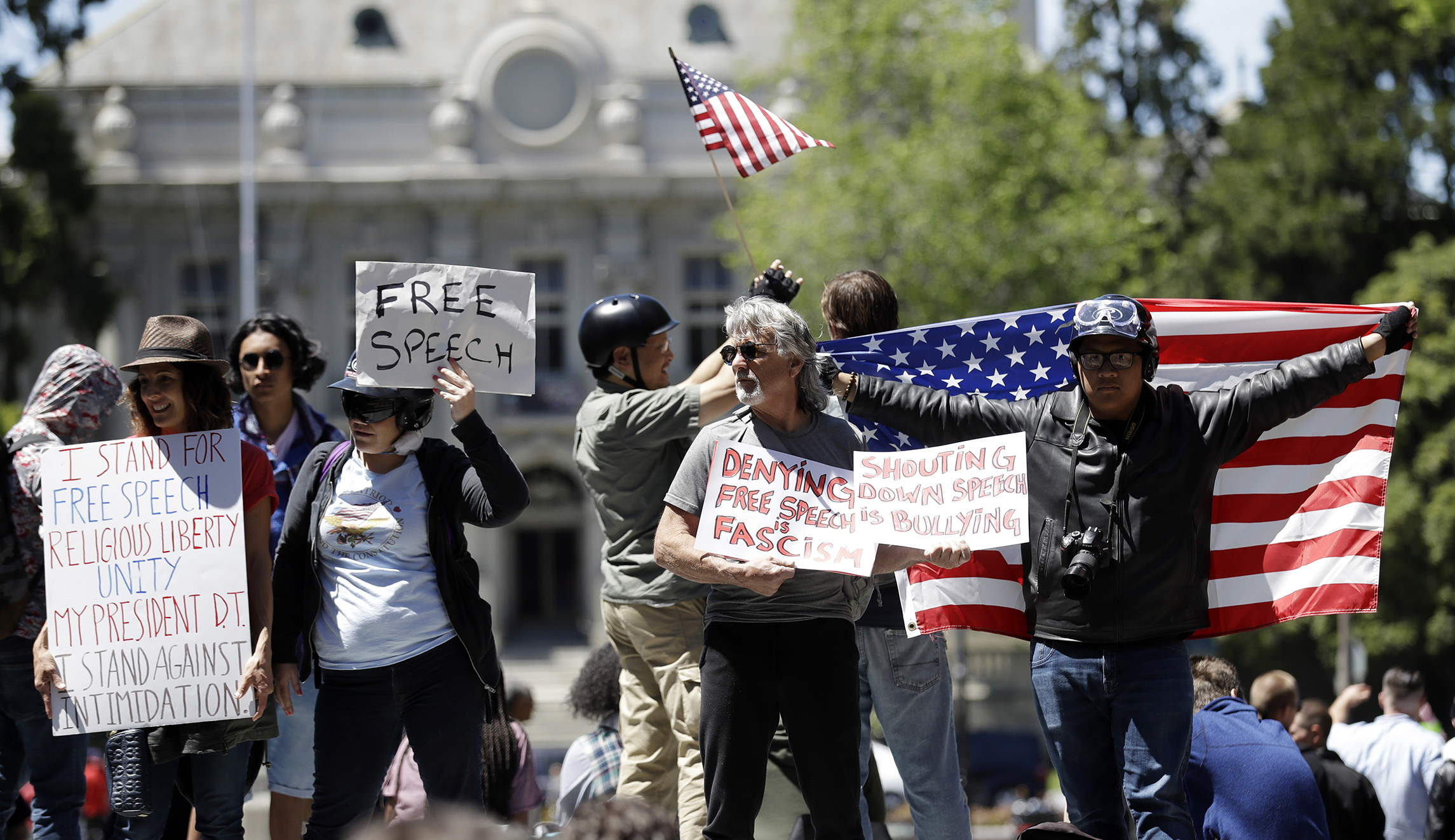
On Thursday, I was honored to participate in “Generation Next: A White House Forum,” which addressed various topics highlighting the work the Trump administration has been doing on behalf of America’s next generation. Included was a panel titled “The Crisis on College Campuses.” This panel addressed two emerging problems on college campuses: opiate abuse and suppression of free speech.
At first blush, this pairing may seem strange. Upon further reflection, though, the combination makes perfect sense. The abuse of opiates and the government’s suppression of speech accomplish the same result: robbing people of their identity and their dignity.
Recommended Stories


As director of the Alliance Defending Freedom’s Center for Academic Freedom, I defend the First Amendment freedoms of college students throughout this country every day. And I have seen firsthand the damage caused when the government tells a student his or her viewpoint is not allowed.
According to the U.S. Supreme Court, “the vigilant protection of constitutional freedoms is nowhere more vital than in the community of American schools.” This is true because, as another federal court observed more recently, “the core principles of the First Amendment ‘acquire a special significance in the university setting, where the free and unfettered interplay of competing views is essential to the institution’s educational mission.’”
Public universities and colleges pride themselves on being the most diverse places in the entire country. They spend millions of dollars on a multitude of diversity initiatives. They hire professors to teach it, bring in speakers to preach it, and institute quotas to reach it. And yet, the reality is, they are some of the most ideologically intolerant places in the entire country. Why? Because they fail to allow and foster diversity of thought. And uniformity of thought breeds intolerance.
Why do they lack intellectual diversity? Because true Liberalism is hard. It is much easier to shut down speech that you disagree with than to refute such speech on its merits. It is much easier to outlaw liberty than to struggle with the questions it raises and the risks it poses. It is much easier to prohibit than to persuade.
Sadly, most universities today choose to prohibit rather than persuade. Instead of allowing students to explore freely the vast marketplace of ideas, most shackle free thought and expression through an array of unconstitutional policies, but three types are very prevalent.
The first is speech zone policies. Speech zones limit where students can speak or distribute literature outdoors on campus. Many times these zones are limited to a tiny portion of campus—frequently less than one percent. Even worse, universities require students to get permission before using them.
We recently represented Michelle Gregoire from Kellogg Community College in Michigan. She was forming a Young Americans for Liberty chapter at KCC. So Michelle and several others stood on a large, open walkway on campus, peacefully handing out pocket-sized copies of the U.S. Constitution. KCC administrators and police approached them and said that they were violating KCC’s speech-zone policies. They were arrested, jailed, and charged with criminal trespass.
The second type of policies are speech codes that limit what students can say, usually prohibiting speech that colleges deem offensive, demeaning, uncivil, derogatory, or discriminatory.
We represent Chike Uzuegbunam of Georgia Gwinnett College. Chike was standing outside on campus talking with fellow students about his Christian faith. No bullhorn, no banners, no badgering. But officials still stopped him, saying he had violated GGC’s speech code, which banned any expression that “disturbs the peace and/or comfort of person(s).”
The third type of policies involves student activity fees. Most colleges require students to pay these fees to fund the speech of student organizations. But this results in forcing students to fund groups—and expression—with which they disagree. Even though the Supreme Court ruled that a public university can only require students to pay these fees if they allocate the funds in a viewpoint-neutral way, many universities selectively funnel money to groups that express views that the administration prefers.
We currently represent Nathan Apodaca and Students for Life in a lawsuit against California State University, San Marcos. That university collects $1.3 million in mandatory student activity fees from Nathan and all of its other students every year. The university allocates almost $300,000 to the Gender Equity Center and the LGBTQ Pride Center. How much does it allocate to the other 100 student groups on campus? $38,629. And each group is limited to a maximum of $500 per semester.
Countless other speech-suppressing and speech-favoring policies exist at colleges throughout this country. These policies fail to respect students’ rights protected by the First Amendment. These policies suppress and punish speech that school officials deem controversial or contrary to the university’s view. That is the essence of fear, and it is the opposite of freedom. This is contrary not only to the purpose of the university, but to the principle the First Amendment protects. Thus, these institutions are failing to prepare students for their roles as citizens in this great country.
When discussing the purpose of education, Dr. Martin Luther King, Jr., wrote, “To save man from the morass of propaganda, in my opinion, is one of the chief aims of education. Education must enable one to sift and weigh evidence, to discern the true from the false, the real from the unreal, and the facts from the fiction.”
Dr. King closed his essay with this warning: “If we are not careful, our colleges will produce a group of close-minded, unscientific, illogical propagandists, consumed with immoral acts. Be careful, ‘brethren!’ Be careful, teachers!”
That warning is just as applicable today as it was 70 years ago. We should heed it.
Tyson Langhofer is senior counsel with Alliance Defending Freedom, which is one of the world’s largest non-profit legal organizations devoted to defending civil liberties.
