Iran war reality check: Global markets still dictate American energy prices

If America is energy dominant, why is the shutdown of a strait thousands of miles away spiking our gas prices?

Following U.S. and Israeli strikes on Iran, shipping traffic through the Strait of Hormuz collapsed nearly overnight. Qatar declared force majeure on liquefied natural gas deliveries. Oil surged past $90 a barrel. Gas prices jumped at the pump.

And yet, America is producing more energy than at any point in our history. What gives?

WHY OIL AND GAS PRICES ARE UP DESPITE US ‘ENERGY INDEPENDENCE’

The answer is not a failure of the Trump administration’s American energy dominance policy. It is a structural reality of global commodity markets that no amount of domestic production can fully escape.

Oil and natural gas trade on global markets. When roughly 20% of the world’s daily oil supply and more than 20% of global LNG trade stops moving through a single chokepoint, prices spike everywhere — including at American gas stations. Energy dominance is real and worth defending. But dominance over production is not the same as immunity from price shocks. The Iran war has made that distinction impossible to ignore.

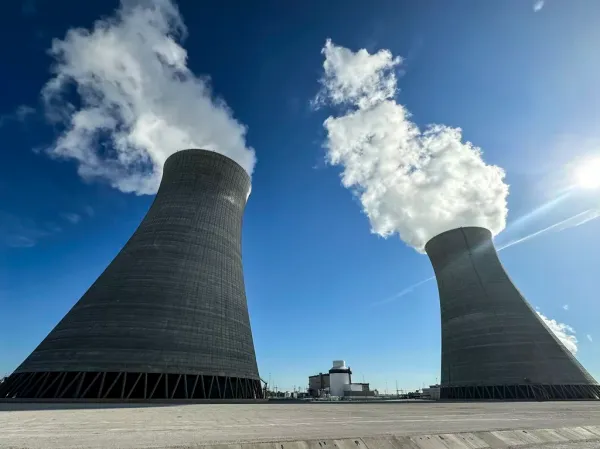
The good news is that America is already building the answer to transform our dominance into true independence. On March 4, the Nuclear Regulatory Commission (NRC) approved the construction permit for TerraPower’s Natrium reactor in Kemmerer, Wyoming — the first commercial-scale reactor permit in nearly a decade, and the first approval ever for a commercial non-light water reactor. The review was completed in 18 months, well ahead of the original 26-month schedule. Construction on nuclear-related portions of the plant begins in the coming weeks with a target operational date of 2030.

Novel small modular reactors (SMRs) are also branching out of prototype phase and will soon make the power of atomic energy portable, deployable, and localized in ways never achieved before. If AI makes nuclear fusion commercially viable, our energy problems begin to evaporate.

Advanced nuclear is not a solution to today’s energy crisis. A reactor or fusion technology that comes online in 2030 does not reopen the Strait of Hormuz. But it represents exactly the kind of long-term investment that structurally insulates America from the next one.

That’s because abundant nuclear power generates electricity that has precisely zero exposure to the Strait of Hormuz. Its fuel is domestic. Its production can’t be stopped by weather, war, or drones. And as America’s economy electrifies — driven by data centers, EVs, and the broader shift away from fossil fuels — the share of our economic activity directly exposed to global oil and gas price volatility shrinks with every megawatt of advanced nuclear capacity we bring online.

Nuclear already provides roughly 18% of U.S. electricity generation, more than any other carbon-free source, and runs at near full output more than nine days out of 10. No other clean energy source comes close to that combination of reliability and insulation from external shocks.

NRC has proven with the Natrium reactor in Kemmerer that it can compress nuclear approval timelines. Now, as Meta has signed agreements for deployment of up to eight additional Natrium reactors, the government should move even faster. We must safely grant permits to advanced nuclear energy at a pace that matches the urgency of our energy security needs.

Likewise, the administration should streamline small modular reactor (SMR) deployment and publicly track application processing times as a way to introduce accountability. 

Of course, nuclear energy isn’t entirely insulated from supply chain risk, as the U.S. imports most of its uranium. But over half comes from Canada and Australia, close allies whose supply routes are much more secure than the Strait of Hormuz. Coupling securely sourced nuclear power with the removal of barriers to every other available source of energy — solar, wind, geothermal, hydrogen — are the only way to protect Americans from global disruption.

FIRST WESTERN AND LNG TANKERS MANAGE TO CROSS STRAIT OF HORMUZ

Energy security isn’t an accomplishment. It is a diversified portfolio. Domestic oil and gas production gives us the production dominance that makes America the indispensable energy supplier to the world. Advanced nuclear and other energy sources give us reliable clean energy that ends our electricity grid’s remaining exposure to global commodity shocks. Both matter. Neither is sufficient alone. 

After the Iran war ends and the Strait of Hormuz opens, gas prices will fall. But when the next crisis comes, we’ll be happy for every reactor we have, large and small. So let’s build.

Drew Bond is the Co-Founder and Executive Chair of C3 Solutions.

Related Content