Venezuela is proving a rare successful intervention with Iran up in air

Published May 14, 2026 6:00am ET


More than two months after President Donald Trump’s decision to go to war with Iran, taken in the shadow of his military intervention in Venezuela, the contrast between the two is hard to ignore. One intervention is drifting into uncertainty, while the other is settling into something easily described as a success.

As the shaky ceasefire between the United States and Iran makes a lasting peace treaty seem like a distant dream, the idea that Iran might follow Venezuela’s path now feels slightly absurd.

For a moment, it was a compelling story of a quick intervention and a brittle regime collapsing under pressure. But this narrative has stalled. The popular uprising against Iran’s Islamic Republic, which Trump appeared to anticipate, has not materialized.

DELCY RODRIGUEZ SAYS VENEZUELA WILL ‘NEVER’ BE 51ST US STATE AFTER TRUMP REMARK

Meanwhile, in Caracas, the outcome is very different and looks remarkably durable. Polling carried out by AtlasIntel and Bloomberg shows that nearly 80% of Venezuelans think their country is the same or better off now than under former Venezuelan dictator Nicolas Maduro.

More than half view increased American influence as a positive force, which is a striking reversal in a region where such sentiment is rarely offered lightly.

That relative stability has not happened by accident. The U.S. administration’s three-stage plan of stabilization, recovery, and transition has, in its early phases at least, held together. 

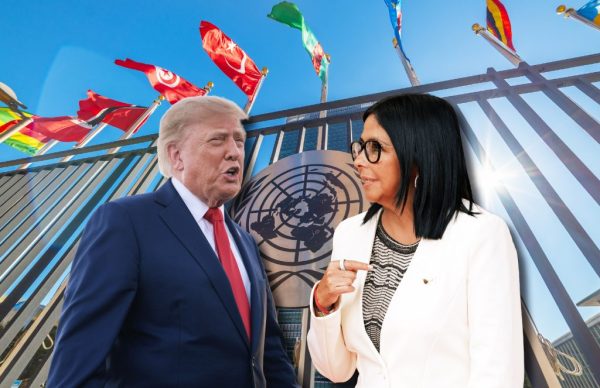
Crucially, the consolidation of power under acting President Delcy Rodriguez has avoided the kind of fragmentation and infighting that so often follows regime change. Washington, for its part, has moved to reinforce that stability, including lifting sanctions on Rodriguez herself, which has been seen as an unmistakable signal that the U.S. is prepared to back the new order, not just install it. 

Along with Rodriguez’s recognition by the U.S. government in a federal court filing last month, which acknowledged her administration as Venezuela’s legitimate authority, this has given her position both political and legal weight.

The U.S. promised Venezuelans economic prosperity after removing Maduro from power, and the Central Bank, silent for years, has resumed publishing inflation data. 

What is emerging is a more deliberate attempt to rebuild the machinery that makes investment possible. The Rodriguez administration has moved to overhaul the legal framework governing oil and gas, rolling back the most restrictive elements of the Hugo Chavez era and allowing foreign firms greater operational control and more viable tax terms. 

Deals that once seemed politically impossible are now being openly discussed by foreign oil executives in Caracas, including arrangements that would allow Venezuelan crude to flow back into U.S. markets at scale. 

Venezuela’s monthly oil exports rose 14% to 1.23 million barrels per day in April, the highest figure since the U.S. imposed sanctions back in 2018. This historic increase has been driven by a supply pact between the U.S. and Venezuelan governments, alongside increased trading from companies like Vitol and Trafigura. The trading firms’ sales rose to ​some 691,000 bpd in April, while Chevron’s exports of Venezuelan crude also increased ​to 308,000 ⁠bpd, from 267,000 in March.

Rodriguez’s government has also taken steps in the direction of a negotiated political opening. These include the presidential Program for Democratic Coexistence and Peace, a body that includes a group of opposition members, as well as a political reform commission under National Assembly President Jorge Rodriguez. Additionally, a cross-party parliamentary commission is overseeing the amnesty law. 

This broader economic and political transformation provides an opportunity for coordination with U.S. institutions. Cooperation and information sharing with departments including Treasury, Energy, Homeland Security, and more will be essential to driving Venezuela’s progress in the post-Maduro era. 

Those involved in Venezuela’s energy sector understand the importance of stability. Investors are not just looking for opportunity; they are looking for assurance that agreements reached today will still hold tomorrow. 

Yes, none of the changes implemented since 6 January guarantee a lasting outcome given the country’s infrastructure remains degraded, the sanctions policy is still contingent on politics, and the broader question of democratic legitimacy is far from resolved. 

However, there’s no doubt the framework is shifting to something closer to a functioning system: from one defined by contested authority, legal ambiguity, and political risk to one where decisions are made by a recognized government, contracts are structured through established legal channels, and oil exports can once again move through predictable commercial arrangements.

TWO WEEKS TO STOP THE WAR: TRUMP’S TREPIDATIOUS IRAN TIMELINE

While Iran remains a problem that is still unfolding, Venezuela is looking like a successful case of intervention.

Caracas, buoyed by Washington’s support, must double down on what it has achieved so far to guarantee Venezuela’s recovery.

José Chalhoub is an independent political risk and oil analyst.