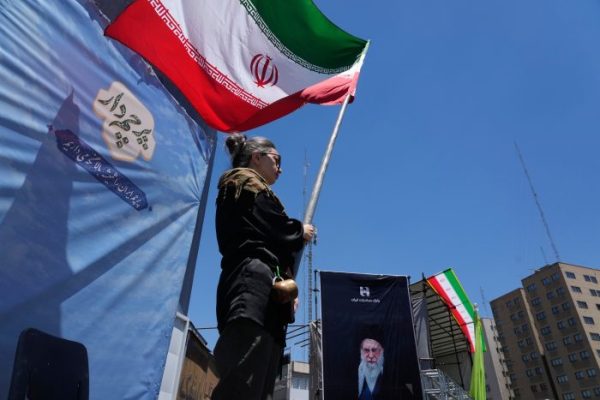
For years, the United States has relied on economic sanctions to constrain Iran’s ballistic missile program, unmanned aerial vehicle production, and support for proxy forces. Iran has adapted rather than collapsed. It has built a decentralized architecture that converts sustained sanctions pressure into a strategic advantage, sustaining military production, financing proxies, and enabling deniable operations through global supply chains, illicit finance, and criminal partnerships.
In February 2026, the U.S. Treasury sanctioned more than 30 individuals, entities, and vessels tied to Iran’s illicit petroleum sales and procurement networks for ballistic missiles and UAVs. Twelve shadow-fleet tankers transporting hundreds of millions of dollars in Iranian oil were designated. Additional actions in April and May targeted procurement networks across China, Hong Kong, and the Middle East, supplying components for Iranian Shahed-series drones and missiles.
Recommended Stories
These steps remove nodes. They do not dismantle the network.
Forensic examinations of Shahed-136 drones recovered in Ukraine found that roughly 82% of critical components originated from manufacturers in the U.S. and allied countries. These dual-use items moved through ordinary commercial channels before Iranian networks acquired them.
The same systems have reached Houthi forces in Yemen, whose attacks on commercial shipping sharply reduced Suez Canal traffic and pushed freight rates on major Asia-Europe routes more than 140% above pre-war levels. Procurement resilience directly enables the disruption of maritime corridors vital to the U.S. and its partners.
Iran has also built operational relationships with transnational criminal organizations that provide logistics, forged documentation, money laundering, and operational cover. In return, these groups gain access to revenues from oil smuggling and narcotics trafficking. U.S. authorities have linked the Irish Kinahan cartel to Iranian oil and aviation operations. Networks connected to the Mocro Mafia and Swedish criminal figure Rawa Majid have supported procurement while carrying out attacks on American, Israeli, and Jewish targets in Europe. Iranian operative Naji Ibrahim Sharifi-Zindashti has used criminal contractors for assassinations launched from Turkey.
European security services have documented more than 100 Iran-linked plots since 1979, with a sharp increase between 2021 and 2024. Many recent operations relied on local criminal intermediaries rather than Iranian personnel. In 2023, individuals tied to the Mocro Mafia attempted to assassinate former European Parliament Vice President Alejo Vidal-Quadras in Madrid due to his anti-Ayatollah stance. British authorities have disrupted more than 20 Iran-directed kidnap and assassination plots since 2022, several involving organized crime figures.
These cases show how Iran exerts coercive influence into Europe, but also the West in general, while obscuring direct attribution.
Iran’s criminal and procurement networks intersect through ports, finance, and logistics, forming one adaptive system that powers military production, sanctions evasion, and covert operations. Some experts argue that traditional sanctions fail against Iran’s redundant front companies, cryptocurrency, and criminal partners that regenerate after hits, while others insist they raise necessary costs but require stronger backing.
Fragmented Western responses let Iran slip across boundaries with ease.
THE IRAN TALKS: HOW THE ADMINISTRATION SEES THINGS NOW
Effective policy must treat the nexus as a single intelligence target, mapping disruptions and pairing sanctions with deterrence plus allied coordination. Saudi Arabia, the United Arab Emirates, and Israel already lead combined sanctions, cyber, and intelligence efforts against these networks. The U.S. must therefore lead a unified strategy or risk ceding critical leverage to Tehran’s resilient networks.
With over 180 attacks on American forces since October 2023, Washington can no longer treat these proxies as separate problems. Only bold U.S. leadership of a full coalition strategy can restore deterrence before Tehran ignites wider regional war.
Jose Lev Alvarez is an American–Israeli scholar specializing in Middle Eastern security policy. A multilingual veteran of the IDF special forces and the U.S. Army, he holds three master’s degrees and is completing a Ph.D. in Intelligence and Global Security in the Washington, D.C., area.