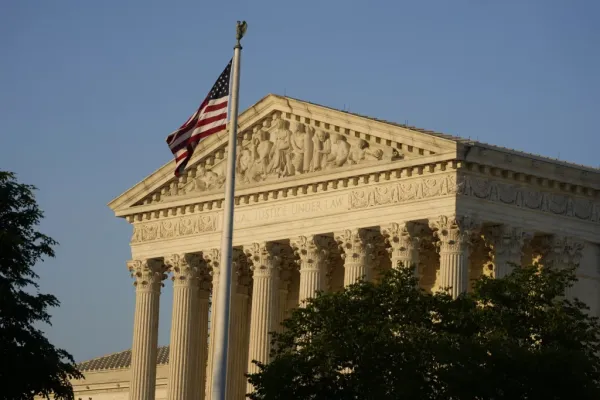
The Supreme Court has finally issued its highly anticipated decision in Monsanto v. Durnell, and the result is a major setback for consumers. People are right to be frustrated by the court’s decision, which will make it much harder to hold pesticide manufacturers accountable when their products cause harm. But even as the legal implications of this ruling dominate the headlines, we shouldn’t lose sight of the issue at the heart of this case: the unresolved and credible concerns about the impact of glyphosate on our health.
Monsanto v. Durnell is just one of thousands of lawsuits filed by consumers and cancer patients who believe that the glyphosate-based herbicide Roundup has made them sick. In recent years, Americans across the country have brought claims against Bayer, formerly Monsanto, for its failure to warn consumers of possible hazards. These lawsuits have played an important role in uncovering risks associated with widely used pesticides and ensuring companies provide adequate warnings to the public. Evidence uncovered as part of the Roundup litigation exposed corporate misconduct and undue influence, ultimately leading to the retraction of a widely cited study that concluded glyphosate was safe for human health.
Recommended Stories
In Monsanto v. Durnell, Bayer had asked the court to clarify whether federal pesticide laws, specifically the Federal Insecticide, Fungicide, and Rodenticide Act, preempt consumers from bringing lawsuits over harms caused by Monsanto’s glyphosate-based herbicide, Roundup.
The court has now answered that question. In a 7-2 opinion, the justices held that current federal law prevents Americans from bringing state-law ‘failure-to-warn’ claims against pesticide companies when the Environmental Protection Agency has not required a warning on the product label. This decision closes the courthouse doors to countless consumers seeking accountability and reverses the verdicts issued by juries across the country in favor of cancer patients who sued the pesticide company.
The court’s opinion is final, and it is now the controlling interpretation of the law. As a result, Americans have lost an important legal pathway for holding pesticide manufacturers responsible for failing to warn consumers about possible dangers. But the story does not end there.
For one thing, Congress wrote FIFRA, and Congress retains the authority to amend it. Lawmakers can restore consumers’ ability to seek justice and strengthen protections against dangerous pesticides. But it is up to the public to make clear that weakening corporate accountability is unacceptable and that stronger pesticide laws are needed to protect American families.
At the same time, the issue at the core of Monsanto v. Durnell, and the thousands of cases it represents, remains unresolved: glyphosate and questions around its safety. Glyphosate is the most widely used pesticide in the United States, with nearly 300 million pounds of it sprayed across the country each year.
Numerous scientific studies have linked glyphosate to non-Hodgkin’s lymphoma and other cancers, and in 2015, the International Agency for Research on Cancer classified glyphosate as “probably carcinogenic to humans.” Yet, more than a decade later, the EPA continues to maintain that glyphosate is safe when used as directed.
SUPREME COURT BLOCKS ROUNDUP CANCER LAWSUITS IN BLOW TO MAHA
That conclusion is far from settled. In fact, the EPA has been reevaluating its glyphosate determination since 2022, after a federal appeals court found significant errors and inconsistencies in its previous human health assessment and ordered the EPA to revisit its analysis.
The Supreme Court may have narrowed consumers’ legal options, but it did not answer the fundamental question of whether glyphosate is safe. Until that question is resolved, Americans should not be expected to bear the risk. With accountability severely curtailed by this decision, it is more important than ever for the EPA to fulfill its responsibility to protect public health. The EPA should pause the use of glyphosate until and unless it can be shown to be safe. Americans deserve nothing less.
Dina Akhmetshina is a federal legislative advocate with U.S. PIRG.