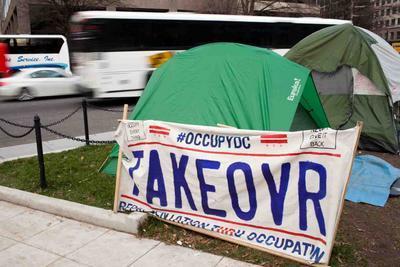
Occupier protesters and encampments in every other major city in America were broken up weeks ago, some after violent clashes with police in which numerous demonstrators and law enforcement officers suffered injuries. In several cities, local laws against camping on public property were broken, the encampments were becoming public health problems because of a lack of even minimal sanitary standards and substantial property damage was inflicted on nearby businesses by occupiers. More than a few violent crimes (including rape and assault) were committed by occupiers, and drug dealing and use in their midst was rampant. So local officials in Boston, New York, Los Angeles, Oakland, Denver and other cities put a stop to the nonsense and lawbreaking. But not the Department of Interior’s National Park Service, which, for reasons only it knows, has allowed the Occupy DC squatters to remain in McPherson Square and Freedom Plaza (both of which are federal property) in the nation’s capital since October. Though initially viewed as something of a novelty, the charm quickly wore off as the encampments extracted a heavy toll on their immediate environments, nearby businesses, and the patience of District of Columbia officials and law enforcement personnel. Last week, Greater Washington Board of Trade President and Chief Executive Officer Jim Dinegar spoke for many when he told WAMU-FM listeners that he is especially concerned about McPherson Square, which he said the occupiers have turned into “a toxic waste dump.” Dinegar also said he fears that “we’re a flash point away from real trouble.”
Congress and the White House have looked the other way as the Occupy DC situation has deteriorated, but that could end Jan. 17 when the flash point feared by Dinegar could well be reached. The Occupiers are promising to field thousands of protesters for Occupy Congress activities on that day. As The Washington Examiner’s Aubrey Whelan reported earlier this week, the Occupiers plan sit-ins to block the offices of individual senators and representatives and those of congressional committees and administrative departments.