
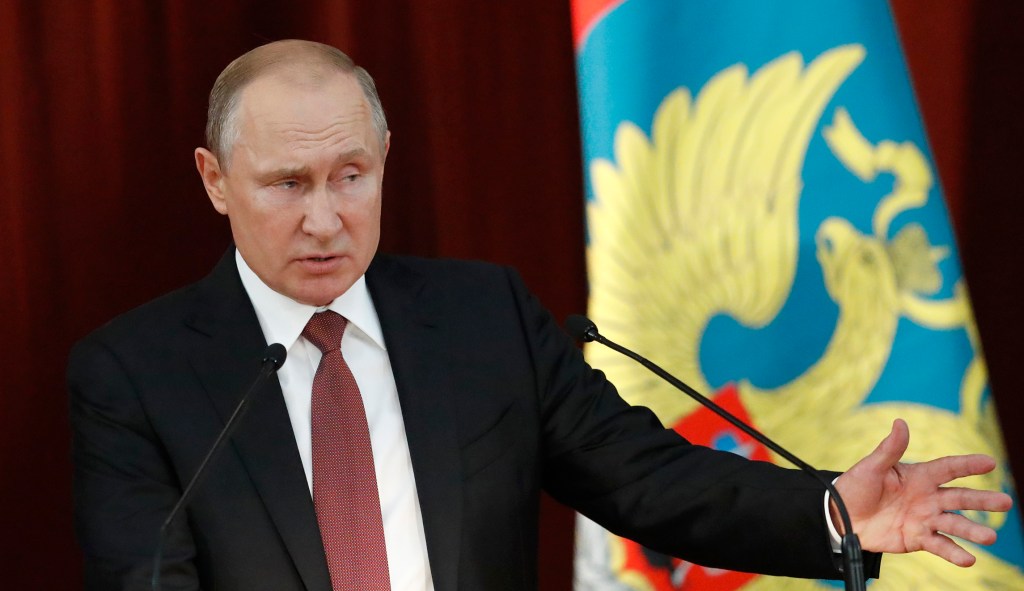
How Vladimir Putin works, and how to stop him

Published July 23, 2018 6:55pm ET


Want a front-line perspective on Russian security challenges to the West and President Vladimir Putin’s strategic intent? Well, here you go. Below is my interview with Molly K. McKew. Molly is an expert on information warfare and a narrative architect at New Media Frontier. She advised the Georgian President Mikheil Saakashvili from 2009-2013 and former Moldovan Prime Minister Vlad Filat from 2014-2015.

1) What is your takeaway from President Trump’s Helsinki summit with Putin? What happens next?

The president of United States spent a week trying to weaken the alliances that have made the U.S. more secure and more prosperous over the last 70 years, while deferring to an adversary that has attacked our nation and continues to do so with impunity. His desire to maintain a secret relationship with Vladimir Putin leaves control of the narrative in the hands of the Russian state. Putin’s confirmation of secret agreements made with the US president – of which Trump’s advisers, Cabinet, and military commanders are unaware — inflames fears among our allies.

The president’s apparent lack of belief in NATO founding principles is problematic enough; when combined with his championing of an illiberal political ideology that aims to break apart the EU, the president is eroding the relationships — economic, intelligence sharing, and more — that are most important to our nation. Add in his information assault on the American public, and he is disarming our nation against a hostile adversary.

2) How will Putin and NATO respectively read Helsinki?

Putin understands that he has a blind partner in the White House, and sees that he has a tremendous green light to take more terrain: real and virtual. And he will. Trump has created an environment where security risks are now more real: Putin is always the most dangerous when he feels successful.

NATO knows that underneath the White House the partnerships with the U.S. military, intelligence agencies, diplomats etc remain strong, and that the U.S. is still the backbone of NATO. But they also understand that Trump has signaled to Putin that he has an open battlefield, and in doing so created extreme danger for the alliance even while challenging its ability to act. This uncertainty makes the alliance more fragile.

3) You are very focused on Russian active measures, cyberactivity, and covert operations. What do people most need to know about these activities?

That, by design, you are not supposed to see them, and you are supposed to think this all sounds like paranoid crap but that they are highly effective tools of modern full-spectrum warfare, and we are under attack. If these tools were not, Russia would not be so heavily invested in leveraging them against their adversaries.

4) Critics of robust deterrence against Russia warn that such action would risk an escalatory curve in Putin’s favor. How do you respond to those assertions?

Putin only stops when it runs out of open terrain. For eight years we saw the fruit of the Obama administration’s hand-wringing about how anything you do to respond to Russian aggression will only make it worse. Russia is entrenched in Georgia; Russia changed the borders of Europe by force; Russia has an expanding footprint across the eastern and southern Mediterranean; Russia arms and coordinates with terrorist organizations like the Taliban to shoot at American soldiers; Russia has empowered Iran and North Korea, including by supporting their nuclear and missile programs and their money laundering; Russia has soft-seized much of the Arctic; Russia runs expanding cyber and intelligence operations against the United States and all our allies; Russia has attacked America with little response. This is what we have lost by doing nothing. Russia loves to play this narrative: “you can’t fight hybrid tactics, and you don’t want nuclear war, right???” But this is a false choice. If we don’t defend our values against a revanchist adversary, within a generation we will be operating in a very different global order where we have significantly less advantage. There’s a lot that can be done to defend ourselves and deter the Kremlin.

5) What do you regard as Putin’s top medium to long term foreign policy priorities?

Until this summer the goals remained: break NATO, break the EU, weaken the possibilities of American power in the world, set the rules for whatever comes next to replace the liberal world order. But now, because of the many gifts delivered by President Trump, I believe this has evolved. Now I believe Putin thinks he can capture some of the United States into a new, completely messed up kind of “new realist” alliance. He is cautious about it, because the United States is vastly more rich and powerful than Russia, and he still needs the American enemy. But he is contemplating how to create new structures where we meet as equals, and dictate downward. This should be absolutely unthinkable. But Trump is eroding the will of the American public and changing their beliefs, and this gives Putin too much hope.

6) We have seen increasing Russian military and intelligence activity illustrative of shaping operations for an invasion of NATO held Europe. How likely is it that Putin will invade? And how ready in military terms is NATO to defeat him?

Putin is trying to shape the “what comes next” at home as much as he is abroad. It’s like running across breaking ice: if you stop, you know you will fall through, so you have to keep going. His appetite for risk is vastly greater than our own, and his mindset is antithetical.

Putin will find a way to show that Article 5 is hollow. He will continue to attack the seams and the gray areas, using proxies and subversion and hidden means, spreading money and other means to political forces he views as favorable, trying to act in the spaces where that activity is harder to identify and react to. This is the most likely course, but it is no less a threat than tanks rolling over the border. In many ways, the lack of a boom is almost worse, because it means he believes he is already getting what he wants. But if he starts to feel more successful, he will take greater risks, and then no-holds-barred.

These gray spaces are where the NATO response can be slowest, so they are most dangerous. It’s why countries like Estonia — and NATO partners like Sweden — are focused on how to react to and build resilience against these hybrid attacks. In hard military terms — NATO is more ready than it was. We have deployed new resources to weak points, which Russia doesn’t like at all. But fighting Russia is like fighting a terrorist insurgency armed with tactical nuclear devices. We will never have seen anything like it, if it comes to a military conflict. We may be physically ready; I’m not sure anyone is mentally ready for this. Nonetheless, we must prepare. Preparation is the only deterrence.

7) Do you believe the west and aligned states have untapped soft power means of countering Russia?

Yes. We suck at the shadow war because we aren’t cynical and manipulative enough (basically), so we disbelieve what is being done to us and what is possible. The Kremlin promotes a lot of narrative — and the people who champion it — about how there’s no such thing as full-spectrum warfare/the Gerasimov doctrine, and if there was, you couldn’t fight it anyway, plus everything you do to counter Putin proves his point and makes him stronger — and other such bullshit. It sounds sophisticated and informed until you look at it and realize that full spectrum warfare is how Russia fights, and cultivating the belief that it is nonsense gives them a serious strategic advantage. We need to develop more defensive and offensive capabilities in these spaces, and stop believing in the virtual iron curtain Putin has wrapped around Russia. Putin is not untouchable; Russia should not be off limits. Below the line of conflict, there is a lot that can be done.

8) You are president. When it comes to Russia what immediate actions do you take?

Things are bad. Extreme transparency is needed to bolster our defenses and inform our public and lawmakers alike. We need to develop a culture of risk-taking that encourages innovation, the same way our adversary has done. Here’s a few.

  • Prioritize the repair of relations with our allies; lay out a plan to counter Russian full-spectrum warfare and defend the rules-bases international order; and enlist everyone into this effort.
  • Speak clearly to the public about the narrative and purpose of Russian information warfare, and what it has achieved. Speak clearly about what Russia is and what they do. Stop using the language of proxies and deniability.
  • Expose the Russian human assets that operate in gray spaces, moving money and information, and cultivating relationships for Russian intelligence.
  • Seize the money/revoke the green cards of the oligarchs and their family members who have bought their way in to the U.S. This money is a weapon.
  • Identify information that can be released on what Putin’s Kremlin is, what it does, what it has stolen from its own people, etc.
  • Analyze how Kremlin-linked investment has been used to infiltrate our critical systems and industries, our academic and research institutions, and launch a commission to analyze the impact and risks.
  • Develop clear proportional responses to Russian cyberattacks and hacks; make it clear that all future such measures will be met with a response. These should also be creative.
  • Have a serious conversation about the world of big data analytics, how social media became the greatest tool of disinformation, and how all that + AI is screwing up human cognition. Make as much of the research showing the impact of information/memetic/narrative warfare public as possible. People should know what they are up against.
  • Have a serious come to Jesus about the data economy.

9) Do you believe western governments should declassify more evidence of Russian covert action or are sources and methods too important?

Yes. In some cases, there will be things where it is better to watch and wait. Bit we’re at a tipping point and it’s time to shutdown some of these networks and expose them. At least enough to demonstrate patterns of behavior and actors and remove the patina of disbelief that cloaks it all right now.

10) Anything you wish to add?

We need to stop believing anything we do will “provoke” Russia. We are ceding them control of the battlespace.