

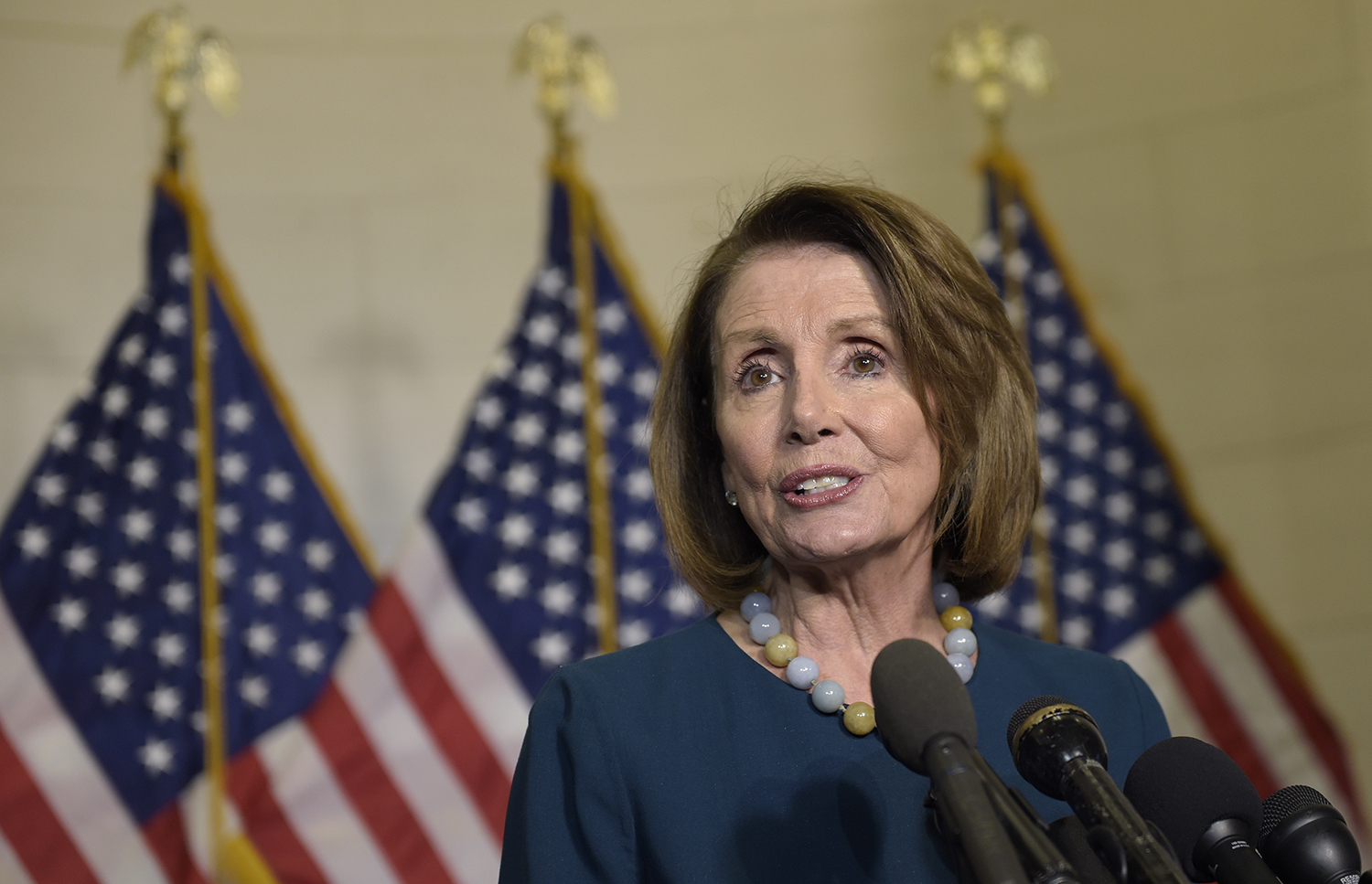
Rep. Nancy Pelosi won re-election as House Minority Leader last week, warding off an effort to change the party’s direction. This is an odd choice for a party that has just suffered a humiliating defeat at the hands of voters and has no foothold on much of the country.
Pelosi comes from San Francisco, where wealthy liberals use big-government rules to exclude new entrants. So maybe it’s fitting that she appears set on turning the House Democratic Caucus into a bubble of the like-minded.
Recommended Stories


Maybe she’s less interested in building a majority than in having a safe space.
“My heart is broken that we didn’t win the White House this time,” Pelosi told CNN recently. “We know how to win elections. We’ve done it in the past and will do it again.”
Under Pelosi’s watch, though, there hasn’t been much Democratic winning.
The party has lost more than 900 state legislative seats and 69 House congressional seats since former Vermont Gov. Howard Dean left his post as chairman of the Democratic National Committee, the Washington Examiner‘s Salena Zito noted.
“After Nov. 8, they only control the governorship and both houses of the state legislature in six states,” she added.
The Dems’ six-seat gain on Nov. 8 fell far short of the 20 or more Pelosi was counting on.
Democrats have been tossed out of the White House, and they’re the minority in both chambers of Congress. They also control only 13 state senates, 18 state house chambers and 18 governor’s mansions.
The veteran leader said she viewed Wednesday’s vote as a chance to start winning again. But is it really?
Pelosi’s argument against her opponent, Ohio Rep. Tim Ryan, was “he didn’t even carry his own district for Hillary.” In other words, Pelosi declared Ryan unfit to lead the party because he’s from outside the party’s base.
She’s uninterested in reaching out to Middle America, and it shows. More than one-third of the Democratic caucus comes from three states — California, Massachusetts and New York — which make up only a fifth of the U.S. population. Fewer than one in ten House Democrats come from a district that Trump won.
The top two House Democrats, Pelosi and Linda Sanchez, are from California. A Marylander and a New Yorker round out the leadership. (Republicans, in contrast, have a speaker from swing-state Wisconsin and a majority leader from California.)
Some Democrats argue today that the party must rethink its electoral strategy. Dems “need a bottom-up, 50-state strategy here for sure,” former Obama campaign manager David Axelrod told the Washington Examiner. “I say that not as an endorsement, but as a fact of a way to go forward for the party.
“There are a whole series of things that the party should be concerned about, and you cannot abandon any of it. There has to be that recognition that even if the Democrat Party isn’t going to carry a state in a presidential race, it is still important to be competitive at other levels. That is how you build capacity.”
One of the lesser-known stories of the 2016 election is that former President Bill Clinton begged the campaign to focus more time and energy on courting white rural and working-class voters. His concerns were brushed aside by millenial campaign strategists who argued that young Latino and African-American voters were the key to victory.
Axelrod insists Democrats need to court all voters.
“One of the things that happened in this election was there were whole parts of the country that were largely written off, and writing off the party actually accentuated Trump’s message to those voters [that they] have been disdained and forgotten,” he said.
Whether Pelosi, who campaigns happily in a dark blue district, understands the Trump phenomenon well enough to carry her party back from crushing defeat is yet to be determined.
Her view and the Clinton campaign’s view were identical: Let’s limit this party to people like us. Let’s not invite any deplorables inside.
Exclusion is en vogue on the Left these days. Look at college campuses, where dissenting voices are silenced as hate speech. Look at the liberal media, where last week BuzzFeed tried to chase a Christian couple off the air by targeting their pastor.
This cleansing campaign has had some success, on its own terms. Liberals are protected from opposing views and icky culture in academia, the media and now even in the Democratic caucus. This “success” comes with the price of tuning out and turning off half the country.
By sticking with Pelosi, Democrats may have hurt their chances of expanding. On the upside, though, they’ve provided coastal liberals with a safe space on Capitol Hill.
