

Voters like Barack Obama. Gallup pegs his current approval rating at 57 percent, the highest point since just after his re-election in 2012. Even on the day they chose Donald Trump as their next president, 53 percent of voters (including about six million Trump voters) said on their exit poll questionnaires that they approved of the job Obama was doing as president.
The voters also backed Obama twice in convincing victories. And when they backed him, they tended to back other Democrats as well.
The problem Democrats have had lately, though, is that they can’t seem to win when Obama isn’t on the ballot alongside them. The Obama Curse has afflicted them in three of the last four elections.
Even if Hillary Clinton did win the popular vote this year, voters did not show up for her or her party in the places where they needed them. This didn’t just result in her loss, but also in the loss of critical Senate races they needed to win in states like Pennsylvania, Wisconsin, Indiana, and (although initial expectations were lower) North Carolina. It meant that House seats they needed to take over to gain a majority remained in Republican hands.
But nowhere has the Obama curse hit Democrats harder than at the state level. And given that parliamentary procedurees in most state legislatures are much more majority-friendly than they are in Congress, this shift has already resulted in major policy changes, and will continue to do so.
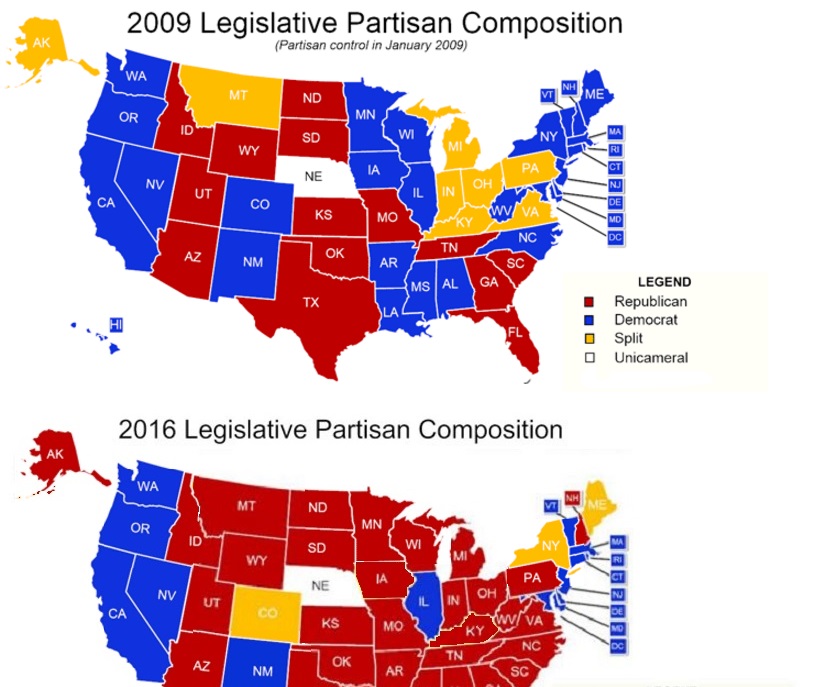
These maps, from the National Conference of State Legislatures, have been modified to reflect this election’s result. Since January 2009, Democrats have gone from holding 55 percent of the roughly 7,400 state legislative seats in the 50 states to just 42 percent, and from controlling 62 of 99 chambers to just 30.
The Obama years have seen the completion of several long-in-the-works realignments of state legislatures. With the loss of the Kentucky House this year, they have no majority in any Southern legislative chamber, having already lost control in Alabama, Mississippi, Louisiana, North Carolina and Arkansas in the preceding six years. Democrats also lost West Virginia’s House and Senate in 2014 for the first time in 80 years.
Democrats in the Obama era have also seen legislatures in nearly all of the competitive states flip (or flip back) to Red. These shifts will not be as permanent, but after Republicans won many of them in 2010, they in many cases replaced Democrat-drawn redistricting maps with their own maps that give them an edge.
Both chambers are now majority-Republican again in Iowa, Michigan, Pennsylvania, Ohio, Wisconsin, New Hampshire, Alaska, Montana and Minnesota. Republicans also acquired control of one chamber each in Colorado and in Maine (where they briefly held both chambers). The New York Senate, always on the knife’s edge, will be narrowly back in Republican hands come January.
Nebraska’s officially non-partisan, unicameral legislature is controlled by a veto-proof Republican majority.
