

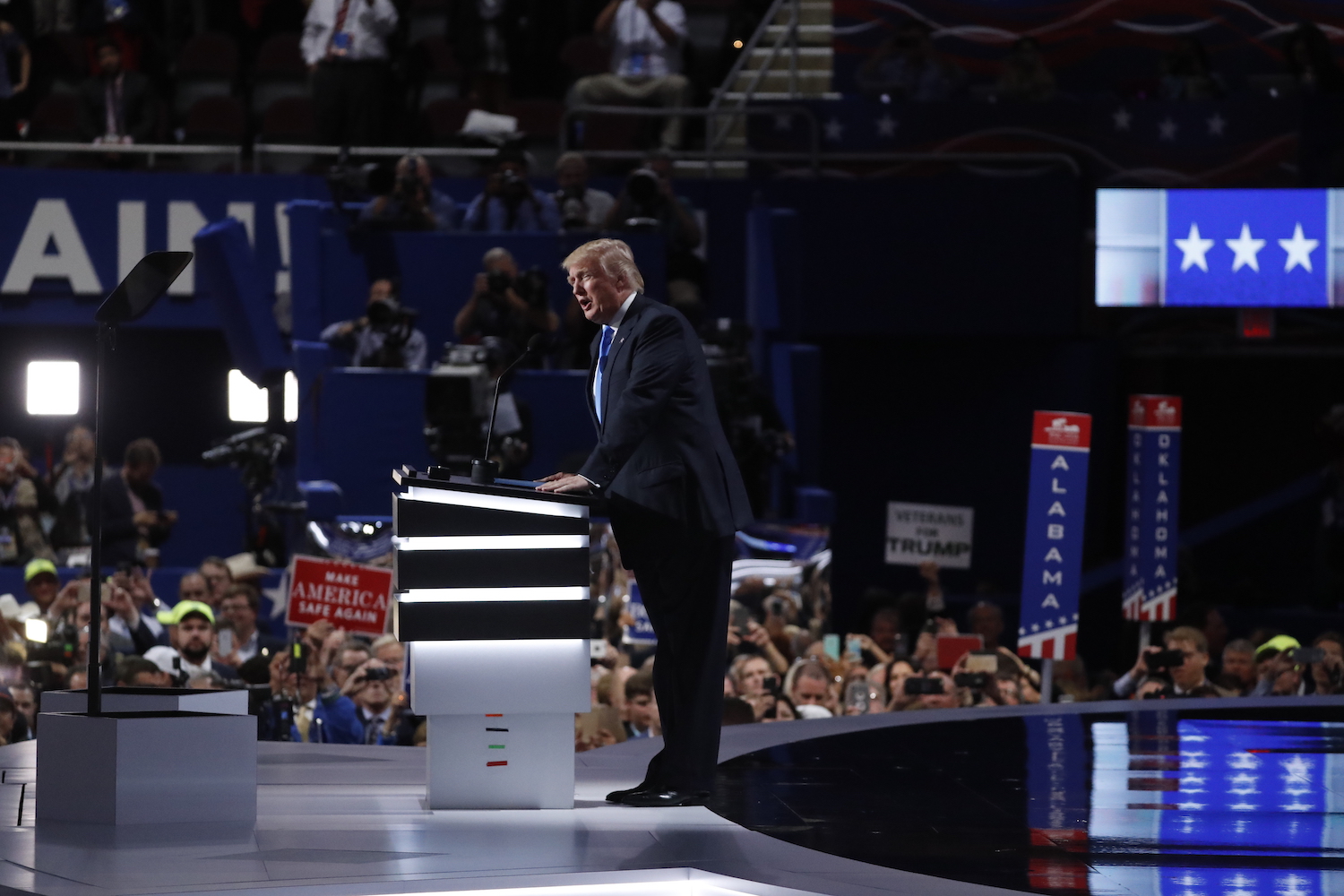
CLEVELAND — Moments after announcing the nomination of Donald Trump for president, House Speaker Paul Ryan, the GOP’s leading policy voice for years, delivered a speech that didn’t vary a word from what he would have delivered had Jeb Bush or Marco Rubio or Ted Cruz won the nomination.
But Trump hasn’t run as a conservative. Trump opposes to Ryan and most conservatives on entitlement reform and international trade.
Recommended Stories


How will an economically conservative party deal with a nominee — and perhaps a president — who has given no signs of conservatism on many key issues?
“There’s going to be a mighty, ongoing debate,” Rep. Mark Sanford, S.C., told me on the convention floor Tuesday evening, “over what comes next in the Republican Party as it relates to a whole host of issues… You’ve got a real tug of war between a populist faction within the party and those of us who believe in some of the more traditional themes that the Republican Party has been about.”
“He’s against regulation. He’s for tax reform. So there’s a lot of areas of commonality,” Oklahoma Rep. Tom Cole said at a panel sponsored by the Atlantic Wednesday morning. “The real clash is going to be on deficit-related issues.”
Trump has rejected Republican ideas of cutting Medicare or Social Security benefits, although those programs are currently paying out more than they bring in, and the gap will only widen in the future.
“You know how people talk about the two parties never agree on anything?” Republican congressman-turned-lobbyist Vin Weber said at the same panel, “Well, Trump and Hillary both agree we should not do anything about the long-term budget situation.”
Utah Sen. Orrin Hatch, chairman of the Finance Committee, which has jurisdiction over entitlement programs, predicted Trump will come around. “I think it won’t take him very long to realize that unless we do [entitlement reform], this country could be gone,” Hatch said on the convention floor Tuesday night. “But it’s going to take him a year, a year and a half to figure it out… But he’s a smart guy, and he doesn’t want to leave this country in worst shape than when he came in.”
Weber expressed some optimism, “I have to believe that … if it’s a part of a broader deal, the dealmaker, will go along with it.”
Hatch went further, and said Trump’s brash personality would enable him to tear up these third rails of American politics. “I expect Trump may be the only” 2016 candidate “who can do something about the national debt,” Hatch said. “He’s got the guts to do it, and he doesn’t care….”
Some Republican policy hands saw hope in Trump’s lack of interest in most policy areas. “What we’re likely to see in the Trump presidency,” former Utah Gov. Mike Leavitt said, “at least in the first 200 days, is the agenda will be driven by the House.”
As Tom Cole put it: “It’s a lot easier to take off the shelf sometimes than think it up yourself. And what Paul Ryan has done is put policy on the shelf. It’s the president’s choice if he wants to pursue it.”
Timothy P. Carney, The Washington Examiner’s senior political columnist, can be contacted at [email protected]. His column appears Tuesday and Thursday nights on washingtonexaminer.com.
