More government debt is generally viewed as a bad side-effect of public policy. But rarely discussed is the way government debt affects the everyday lives of the general public.
“Every dollar that’s taxed, and every dollar that’s borrowed, isn’t just a number on a page,” House Budget Committee Chairman Tom Price, R-Ga., said Saturday at the Conservative Political Action Conference. “It’s a dollar that can’t be used to buy a home, to pay your rent, to buy a car, to pay education fees. All of the things the American people want to do are harmed by an increasing federal debt.”
Whatever it may be that someone is saving for, whether it is as cheap as groceries or as expensive as college tuition, government debt makes it more difficult to achieve financial goals. In turn, that harms quality of life.
“Both taxes and debt are forgone consumption,” Michael Tanner, a senior fellow at the libertarian Cato Institute, told the Washington Examiner. “Taxes are forgone consumption today. Debt means forgone consumption in the future. … Almost all government investment is really transfers — subsidizing current consumption at the expense of future consumption.”
The everyday harm of government debt is widespread, but much of it goes unnoticed.
“In the immediate term, the impact of government spending can be harder to feel than taxes or regulations, but it is just as insidious,” Jonathan Bydlak, the director of the Coalition to Reduce Spending, told the Examiner. “When you take government debt, its impact is mostly a pass-through. The effects of higher government debt can be seen through inflation, it can be seen through higher interest rates. Government spending can have a crowding-out effect on the private sector, so sometimes it can have a jobs impact.”
Higher inflation raises prices, making it harder to purchase basic goods and services like gas or car repair. Higher interest rates make it difficult to afford a loan, whether that loan is to launch a small business or to buy a house. But when these indicators are marginally higher, government debt typically escapes blame.
Government debt is especially hard on younger generations, who are projected to live under a government with a much higher debt burden and larger interest payments due.
“Massive and growing debt hinders economic growth and opportunity by discouraging investment and threatening higher future taxes to pay interest on the debt,” Romina Boccia, a Heritage Foundation fellow in federal budgetary affairs, told the Examiner. “This is especially harmful to younger, working generations who would experience the effects of too high spending debt directly through lower personal incomes and fewer opportunities for job advancements. If lawmakers want to get the economy going and keep it going, they must contain both spending and debt.”
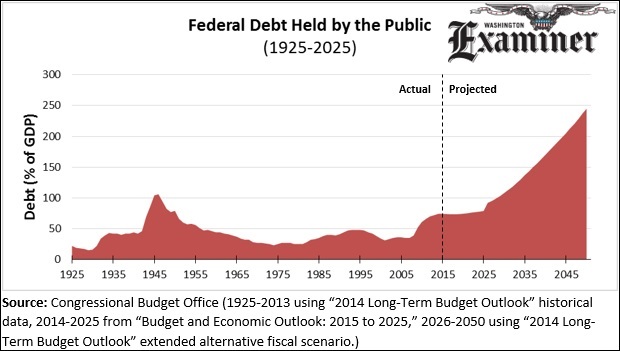
Growing federal debt is already under scrutiny, but its effect on the public warrants even more concern. With federal debt as a percentage of GDP projected to surge past WWII levels within 20 years — and that’s without a war — Congress and President Obama’s budget decisions will affect future Americans, one way or another, as they try to get by.