

How will the standoff over funding President Trump’s proposed border wall end? Possibly the same way previous immigration impasses have ended: with a flood of money, celebration of whiz-bang technology, and little new in the way of actual physical barriers to stop illegal border crossings.
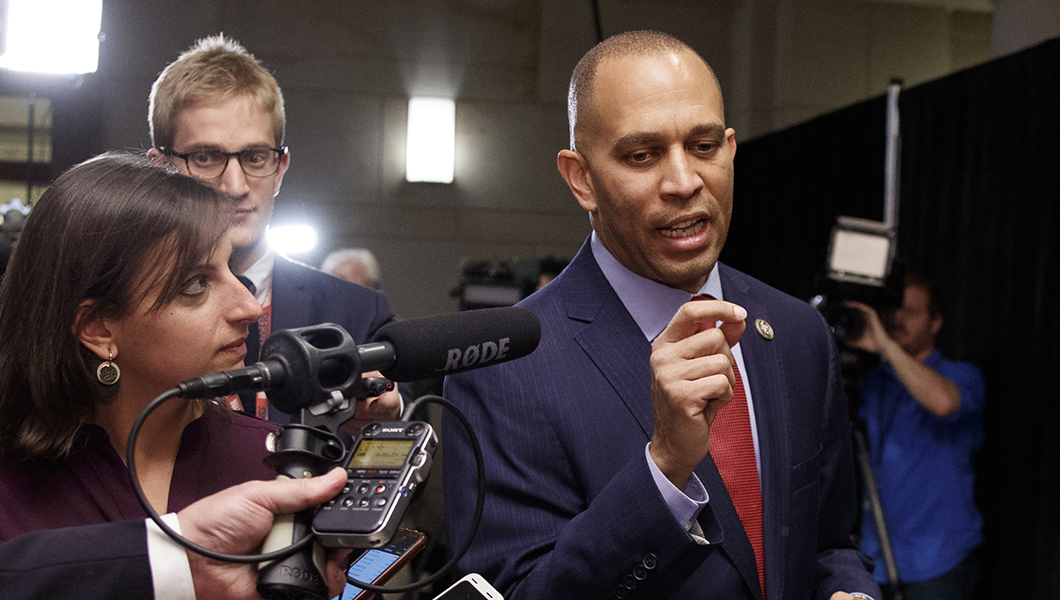
The latest clues come from Rep. Hakeem Jeffries, the four-term Democratic congressman from New York who will become chair of the House Democratic Caucus starting Thursday.
Recommended Stories


Jeffries appeared on CNN Wednesday morning and was asked what border security measures Democratic leaders would approve, given their opposition to spending $5 billion on a wall.
“Well, in the bill that we’re going to put on the floor tomorrow,” Jeffries responded, “we’re going to allocate $1.3 billion in additional funding to allow for enhanced technology, cellphone towers, satellites, drones, enhanced fencing, increased communication capability, the things that the experts have said are necessary to improve border security.”
CNN anchor John Berman pursued Jeffries’ mention of “enhanced fencing.” What did that mean? “If you are willing to have, you know, smart, big fences with all kinds of technology, isn’t there room to negotiate between that and concrete?” Berman asked.
“Well, there are areas along the border where there are currently fences that are put up, or barriers that are put up that need to be enhanced, and consistent with what the policy experts have said are helping to improve our security along the border,” Jeffries answered.
“Could you support any new fencing?” asked Berman.
“Well, we will have to see what the particulars are as it relates to justification for enhanced additional fencing along a 2,000-mile border,” Jeffries said. “But in terms of a political promise that Donald Trump made during the campaign and is trying to now extract from the American taxpayers, that’s completely unreasonable.”
To summarize: Jeffries, a member of the House Democratic leadership, said his party could support “enhanced fencing” that would replace or upgrade existing fencing — say, changing a vehicle fence into a pedestrian fence, or making existing pedestrian fences harder to jump. Jeffries also pointedly declined to say that Democrats would oppose any new fencing.
So Democrats passionately oppose a wall. Incoming Speaker Nancy Pelosi, D-Calif., even called it “immoral.” But “enhanced fencing” is OK. There could be a lot in that distinction for the White House to work with.
Jeffries was careful to include “enhanced fencing” with a package of other border measures — satellites, drones, improved communications, etc. And when he said that, Jeffries, whether intentionally or not, pointed back to 2013 and the Gang of Eight comprehensive immigration reform bill. When the bill was coming up for a vote in the Senate, some Republicans were hesitant to support it. Two GOP lawmakers, Sens. John Hoeven and Bob Corker, solved the problem by introducing an amendment that threw tens of billions of dollars into border security, much of it devoted to high-tech bells and whistles along the border. From the announcement of the amendment on June 20, 2013:
In a frenzy of final negotiations, the Senate adopted the Hoeven-Corker amendment and passed the Gang of Eight bill by a big majority, 68 to 32. (Democrats supported the bill unanimously, joined by 13 Republicans.) The GOP leadership in the House prevented the bill from ever receiving a vote there.
A number of conservatives who favor strict border security and immigration restrictions saw Hoeven-Corker as exactly the wrong way to approach the problem of illegal border crossings. They dismissed the drones and cameras as less effective than a physical barrier at the border. Indeed, some suspected that proponents of a high-tech “virtual” wall embraced that position because they did not want to see barriers that would actually do a better job of stopping illegal crossings.
Jeffries’s remarks fit the Democratic strategy of proclaiming themselves strongly in favor of “border security” while opposing Trump’s wall. How far they will go — what “enhanced fencing” means and how many Democrats might support it — could well be a theme of the coming border talks.
[Related: White House meeting to end the shutdown gets nowhere]
