

On August 28, President Trump tweeted that Google search results are “rigged” against him, and that Google is “suppressing voices of conservatives.” Is this true?
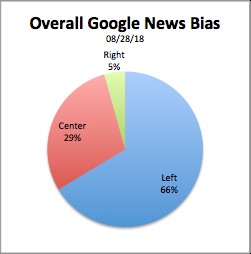
AllSides.com conducted an in-depth analysis of Google News on the day of Trump’s tweet. Our analysis shows Google News was heavily biased on that day, giving the Left 13 times more coverage than the Right and more than twice as much as the Center. But we saw no evidence Google News is intentionally rigged.
This should make everyone happy. Trump fans and conservatives can shout “Google is biased,” while anti-Trump folks and progressives can yell back “it’s not rigged.”
[More: Google to Trump: ‘We don’t bias our results’]
Now that the shouting is over, let’s look at the hard data.
Google News Shows Strong Preference for Left Media
Of the 21 ways we measured the bias of Google News search results on August 28, all showed a preference for Left media outlets.
The results were extreme. News media from the Left accounted for 66 percent of Google News results overall, while sources from the Right accounted for only 5 percent.
The credibility of all analysis like this comes down to what you consider Left, Center, or Right. Rather than rely on any one person’s personal opinion or a “scientific” algorithm that measures words that some researcher defined as left or right (a common method that is biased by the researcher), we let the people decide.
AllSides rates the media bias of hundreds of media outlets using a sophisticated bias rating system that includes blind surveys and more than 100,000 user ratings to reveal the average judgement of Americans.
Let’s dig deeper into the numbers. Our analysis looked at three things: the Google News homepage, results for Google News searches conducted on the five top news stories of the day, and news results for the word “Trump” alone.
Because the majority of traffic goes to the very first links displayed on Google, we first looked only at the top five results, then separately looked at the full first page of results.
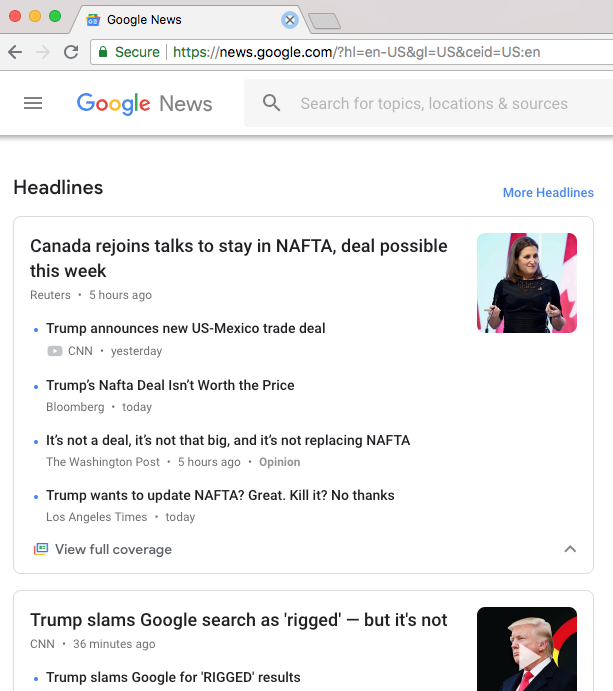
Not a single headline on the Google News homepage “above the fold” included a Right media outlet. Four were from the Left, two were from the Center, zero were from the Right.
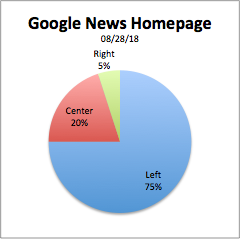
The top headlines and U.S. headlines on the homepage overall included 15 links from Left outlets, four from the Center, and just one from the Right. That means 75 percent of headlines on the Google News homepage were from Left-leaning outlets.
Google News searches returned slightly more balanced results, perhaps because some of the news topics we searched (like “high consumer confidence”) were covered more by Right media outlets. We also searched for John McCain, NAFTA, and of course, “Trump.”
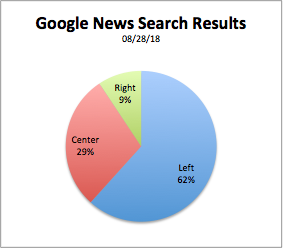
Results from Right media sources moved up to 9 percent, while Left results dropped to 62 percent – still a stunning contrast.
How Google News Can Be Heavily Biased, But Not Rigged
Google has been charged with bias before — such as censorship on YouTube. Biased Google News search results may be explained as an unintended consequence of the Google News search algorithm and the state of online news media overall.
In large part, the Google search algorithm determines relevance by popularity. It is a complex algorithm, but is heavily influenced by the traffic a page receives, the links going to that page, and click behavior.
U.S. media contains far more news sources from the Left than the Right, and individual journalists are much more likely to have views on the Left of the average American. Online news consumers are younger and lean farther Left than the rest of the country. Adding all these factors, we have a perfect storm creating Google search engine bias.
Google may not be intentionally rigged as Trump claimed, but it is still biased and problematic.
Whether Google cares if its news is balanced, or if it should, is a question for another day.
For now, we know that if media consumers want to get the full story or access different perspectives and opinions, they better not rely solely on Google News.
John Gable is president of AllSides.com, a website providing balanced news and media bias ratings. He is the author of a patent for measuring and displaying bias, and previously worked at Microsoft and Netscape.
