

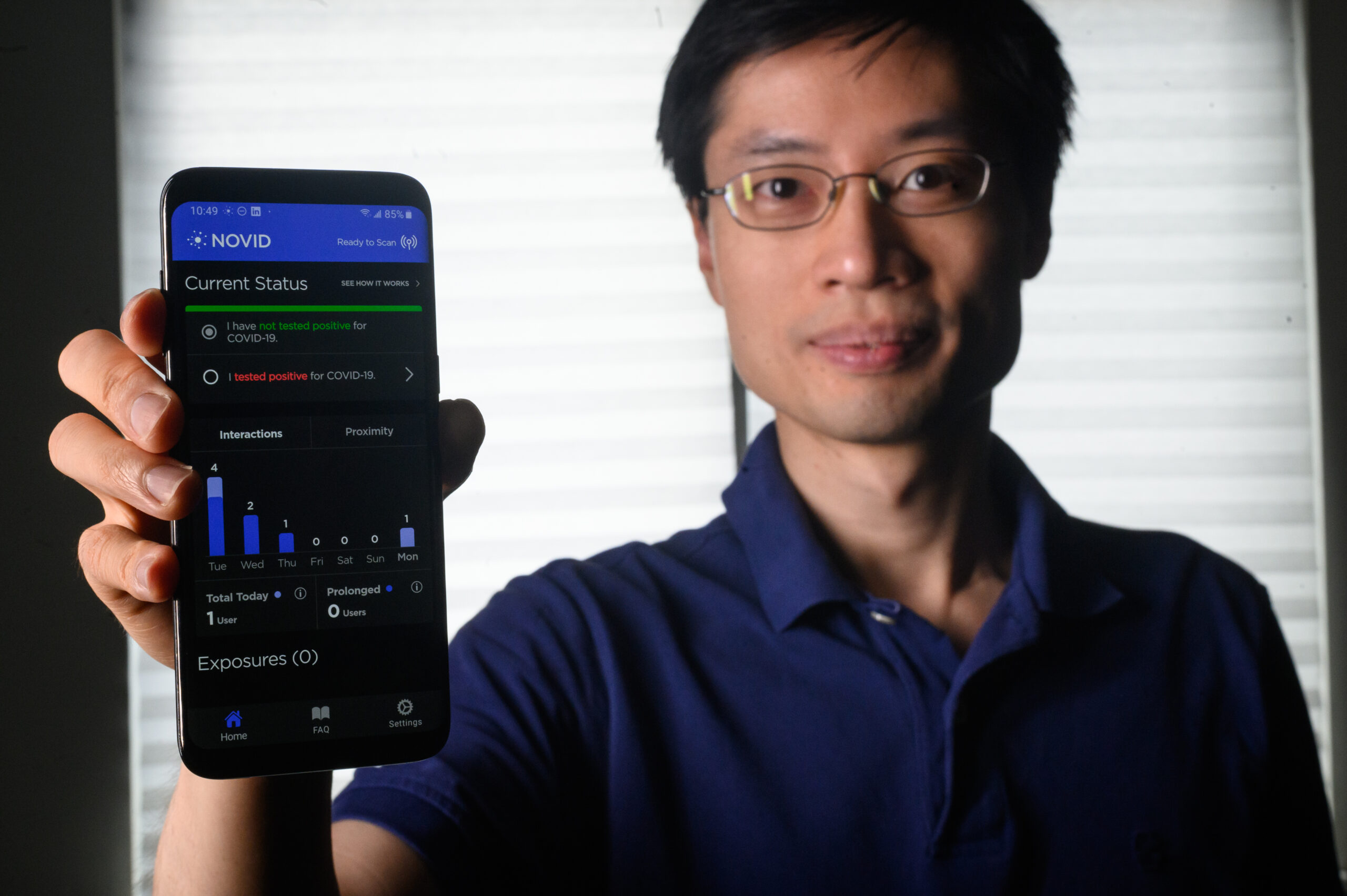
PITTSBURGH — The ideal COVID-19 contact tracing app would precisely state on your phone’s screen the distance, down to the inch, of your proximity to someone who is infected or who has come in contact with someone infected, though without sharing your, or that person’s, personal information.
Essentially, it would create a COVID-19 radar for individual users.
Recommended Stories


It would allow much more nimbleness for schools to open, churches to conduct regular service, families to visit loved ones in hospitals, as well as open doors to museums, zoos, restaurants, and bars, not to mention the resumption of big family wedding celebrations or your child’s baseball, soccer, or basketball games.
Carnegie Mellon University math professor Po-Shen Loh, who is also the national coach of the USA International Math Olympiad team, has developed such an app, called NOVID, and its technology is a game changer.
“We picked the name NOVID because we don’t want there to be any COVID,” Loh said in an interview with the Washington Examiner, adding that he also has a deep affection for five-letter names. “And once we came up with NOVID, we loved it because even if we didn’t tell anyone what the app did, I think you have a pretty decent sense of what’s going on.”
The NOVID app is the only such platform in the world to use ultrasound technology, providing significantly more precise (down to the inch) and legitimate contact tracing data than any other platform in existence.
Loh explained most contact tracing apps use only Bluetooth technology; NOVID’s use of ultrasound eliminates false positives associated with using just Bluetooth. “It is the world’s only platform that actually traces; other platforms do not state on the user’s device screens their actual distance from someone who has been infected or has been near someone who has been infected by COVID.”
NOVID states on your screen the distance, down to the inch, how far a user is from an infected or potentially infected user. It also provides such information up to 3 degrees of separation, showing graphically how close the virus is to a user.
The idea is that users check NOVID frequently, much like they’d check their weather apps, to see how their personal “COVID radar” is looking to determine whether they need to stay at home for a few days or can go out.
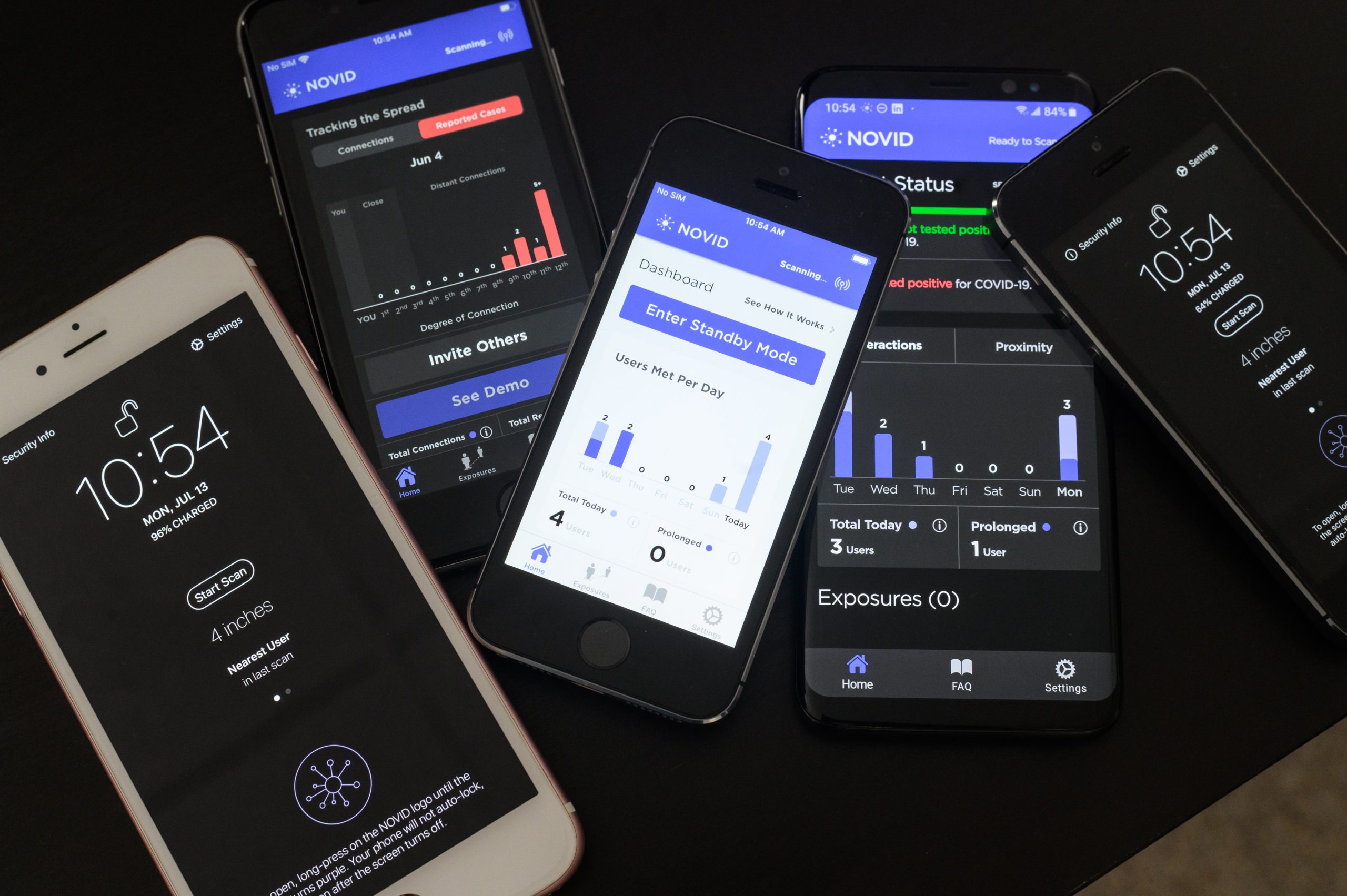
If their radar shows that they’ve interacted with someone who has COVID-19 or someone who knows someone who has COVID-19, they would have more information about how close the virus is to them personally in order to make social distance decisions for themselves.
Without this kind of information, everyone is essentially walking around blind, like we are right now, with little sense of the infection rate in their personal, day-to-day communities. In short, it doesn’t just let users know if an infected person is near them. It empowers them to protect themselves based on literally how close the virus is to them.
The app functions and shares data with users completely anonymously. The app is opt-in and only asks one thing: whether the user has been infected with COVID-19 or not.
You don’t enter your name, address, or anything.
It then connects you with servers that only know one device from another based on a random, anonymous code, and it is the interaction of those codes that trigger servers to transmit information to users about their proximity to COVID-19.
Loh, who admits, like many people, that he didn’t take the initial dire warnings of COVID-19 spread seriously, said the revelation came to him on March 14. “That’s a special day. That’s Pi Day,” he said of the annual celebration of the mathematical constant.
The Madison, Wisconsin, native said he felt a moral obligation to do something but that he just didn’t know how, as a math professor, he could contribute. It all came to him on Pi Day, when he was reading the thesis of one of his Ph.D. students.
“I got to the second sentence of introduction, [and] it just dawned on me like a flash. COVID-19 is actually a network theory problem. I’m a network theorist. That’s my area of research. And it just came to me that the problem with COVID-19 is that it spreads before you know you have it,” he said. “I wondered if it’s possible to completely anonymously, without knowing anything about the person, to map out the network so that if one of them has a positive COVID, we could show COVID is coming, and it’s this far away from you.”
He measured not in meters or inches, but how many relationships COVID-19 is away from you, meaning that you might hang out with someone who hangs out with someone who hangs out with someone who’s got it.
Loh said he immediately researched to find out if today’s smartphones can do this. “And about an hour later, I was like, ‘Oh, you know what? We actually can do this. We can do this anonymously.’ And then I immediately ran downstairs, and I asked my wife if there was an app that wouldn’t take any information about you but could tell you if COVID-19 is coming close to you, would you want this?’”
Of course, she said it would be useful. Within a few hours, he built a core team, and within three weeks, he released the app to anyone who wanted to download it on the Apple app store and the Google Play store.
“The people that came out the woodwork to join this were some of the most talented people I’ve ever had the chance to work with. And that’s because everyone was motivated.” Loh said. Loh is part of the Hertz Foundation, which finds about 15 people every year across the United States who are the best of the best in science, technology, engineering, or mathematics. The scholarship gives them free Ph.D. funding; they also sign a moral agreement that if there’s ever a moment of national emergency, they will come to help.
Loh came to help.
Loh started his mathematics education at the California Institute of Technology, holds a master’s from Cambridge, and earned his Ph.D. at Princeton. He eventually came to Carnegie Mellon University 10 years ago and is currently a mathematics professor.
He is essentially Sheldon Cooper from The Big Bang Theory, only funnier, and he says he gets the joke. “Honestly, I should say it’s not entirely inaccurate,” he deadpans of the comparison between him and Cooper, a fictional senior theoretical physicist at Caltech.
Loh said he met with several large companies about folding the app into their businesses but ultimately decided that doing so could lead to a larger emphasis on monetizing the app than actually getting as many users as possible to download and use it in order to support stopping the spread of the virus.
Loh said the NOVID app doesn’t necessarily need a huge goal number to be effective. “You really only need a large number in an area. So, for example, if there was [a] city with [a] population [of] 300,000, if 30,000 of the people in that city use the app, that would already make a dent,” he explained. “People generally only want to use something if they feel like it might be useful for them. And if you ever tell someone it’s only going to be useful if everyone downloads it, then everyone says, ‘Oh, but come on. It’s going to take forever for that. So, I won’t be one of the first ones.’”
The way the app solved that is that it doesn’t do only what the other apps do. That’s why this is a big deal. The traditional paradigm is called test, trace, isolate, and support. Essentially, you want to go and test to find out who’s already got it. Then you want to trace to see who those people are or who those people were around. Then you isolate those people, and you support them.
“That’s how most other apps work. They want to go and find people who are already possibly sick and then isolate them. We do something very different. Anyone who is part of the NOVID network will have a long-range, early warning radar.”
As schools struggle with reopening, people watch baseball games on television played in empty stadiums, and churches, community centers, and picnic groves remain unused because of the conflicting multitudes of unknowns coming from experts, this application may live up to the mission of the foundation Loh is part of: stepping up in a moment of national crisis to help solve the problem.
