

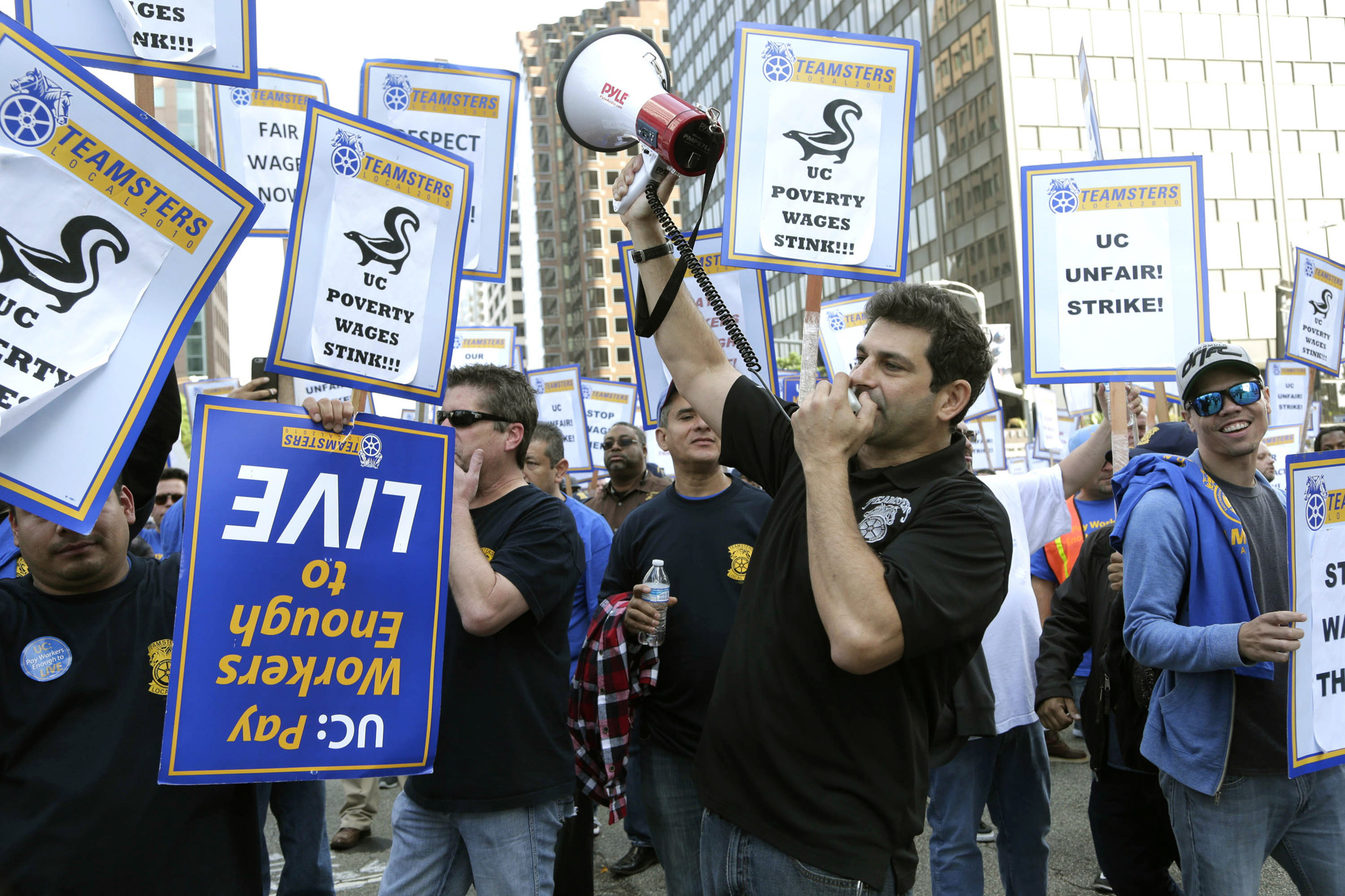
At the end of February, three dozen Teamsters Union members working at Noel Canning, a Pepsi distributor in Yakima, Wash., ended a week-long strike as the company finally agreed to resolve charges of unfair labor practices going all the way back to 2010.
But this was not your garden-variety labor dispute. This one became an occasion for the Obama administration to create a minor constitutional crisis that went all the way to the Supreme Court. And in ruling against Barack Obama, the justices unanimously upheld congressional powers against a flagrant executive overreach that typified Obama’s approach to executive power.
Recommended Stories


It was a rare victory for congressional power over the executive, and it may someday serve as a check on President Trump, or some other future president.
This crisis began in January 2012 when Obama recess-appointed three members of the National Labor Relations Board. The problem with these appointments was that the Senate (then controlled by Democrats) was in fact in session when he made them. The Constitution states that neither house of Congress can adjourn for more than three days without the consent of the other. House Republicans had prevented a Senate adjournment precisely in order to prevent recess appointments, which can be made without Senate consent.
Subsequently, the illegitimately appointed NLRB commissioners began issuing decisions — one of them pertaining to the dispute between Noel Canning and its employees. The company appealed the decision on the grounds that the appointees were not validly appointed.
The Obama administration defended the appointments in court, disingenuously arguing that the Senate was not doing any “real” business even if it was holding pro-forma sessions once every three days. Obama, they actually argued, could simply deem the Senate to be in recess and appoint at will.
Had this argument been allowed to stand, it would have effectively nullified the Constitution’s Advice and Consent clause, and changed the nature of presidential appointments to make the presidency immensely more powerful.
It’s fortunate that this decision came down before Senate Democrats invoked the so-called “nuclear option.” Now that senators no longer need supermajority support to confirm nominees, the recess-appointment power will probably be used less often to circumvent partisan opposition.
But looking back now, with Trump as president, this was another glaring example of short-sighted left-wing thinking. In their haste for what they consider progress, they wanted to bend the rules for Obama, and they didn’t think ahead to what the consequences might be later.
Fortunately, the justices were having none of it. In their landmark decision, all nine justices agreed that “the Senate is in session when it says it is.” They also agreed that, at a minimum, a true Senate recess that allows for a presidential recess appointment must be more than just the three days that either house of Congress can adjourn without the consent of the other.
Four of the justices — Scalia, Roberts, Alito, and Thomas — wanted to read the clause in a much stricter fashion, more faithful to both the text and the original intent (although Scalia did not rely on the latter) of the Recess Appointments Clause. This power was created for emergency use in situations where the Senate was out of session for months (as it once was frequently) in an era when senators could not easily travel to Washington to fill a vacancy.
The Recess Appointments Clause is obsolete today. It should probably be repealed through a constitutional amendment, or further limited with a requirement that it can only be exercised when a Senate quorum becomes impossible through death or incapacity. But the Supreme Court’s majority opinion at least limited the recess appointment’s constant abuse as a means of circumventing partisan opposition in Congress.
Someday, in the post-nuclear-option era, we will have a situation where a president from one party wants to fill a vacancy with a highly controversial appointment, but faces opposition from a Senate controlled by the other party.
When that happens, and when the president is blocked from filling the post, we will have the Teamsters Union and the management of an obscure company in Yakima, Wash., to thank for making this check on presidential power possible.
