

The seventh Republican presidential primary debate is in the books. Let’s take a look at who got the most speaking time:
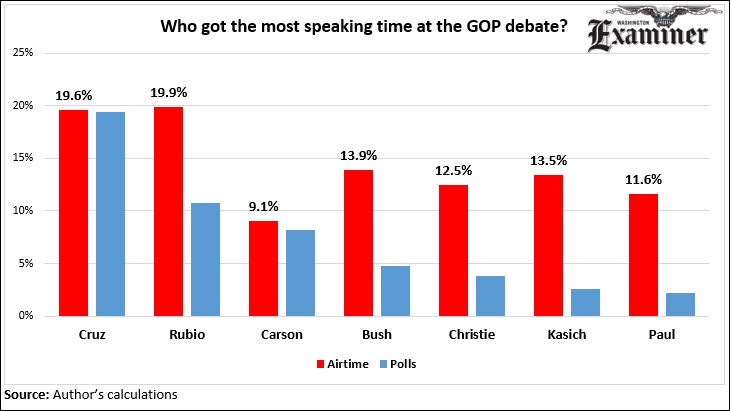
For the first time, Marco Rubio got the most speaking time, with more than 13 minutes. Ted Cruz had the most speaking time in the past three debates. In debates prior, Donald Trump and Carly Fiorina had the most speaking time.
Rubio had nearly one-fifth of the total speaking time. Cruz was a very close second, within 15 seconds of Rubio. Those two candidates were on a tier of their own, with each speaking for at least three minutes more than the other candidates. The next tier of speaking had everyone except Ben Carson, who spoke the least by far: only 6 minutes. Carson also had the least speaking time in the last debate.
Cruz and Rubio dominated speaking time well enough that they were the only candidates to get more than their fair share, assuming you believe each candidate should have had equal time.
Typically, I compare how a candidate’s polling figures compare with their portion of the speaking time. The absence of Trump complicates that comparison slightly. Cruz had speaking time about equal to his percentage of support in the polls. Carson did as well, though mostly because he spoke so little. Every other candidate spoke for a portion of the debate much higher than his support in the polls.
Kasich had the largest gap between speaking portion and polls, speaking for 13.5 percent of the debate but averaging only 2.6 percent in the polls.
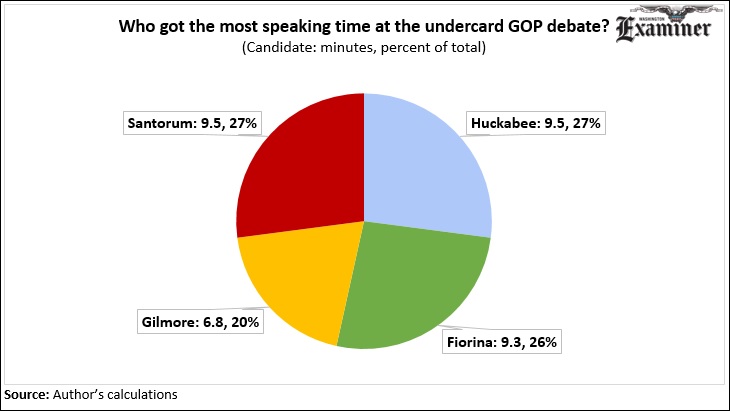
For the first time since Aug. 6, Jim Gilmore got to participate in the undercard debate. He went on to get very little screen time, speaking for just under 7 minutes in the hour-long debate. When Gilmore complained to the moderators about getting skipped over for questions, he had had less than half the speaking time Rick Santorum had.
Santorum and Huckabee ended up tied for the most speaking time in the undercard debate, each speaking for about 9.5 minutes. Thanks to Gilmore’s lack of speaking time, even Carly Fiorina still got more than her fair share of speaking time, at 26 percent of the total for the candidates.
Overall, this was one of the shorter undercard debates, with the candidates combining for 35 minutes of speaking in the hour-long event. Compare that to the Jan. 14 debate, where they had about 37 minutes combined, or the Dec. 15 debate, where the undercard candidates spoke for an hour and eight minutes.
Previous undercard debates have had so few candidates get so much speaking time compared to the main debates that an undercard candidate could actually speak longer than a main candidate. That was not a problem tonight, with a main debate twice as long as the undercard.
Jason Russell is a commentary writer for the Washington Examiner.
