

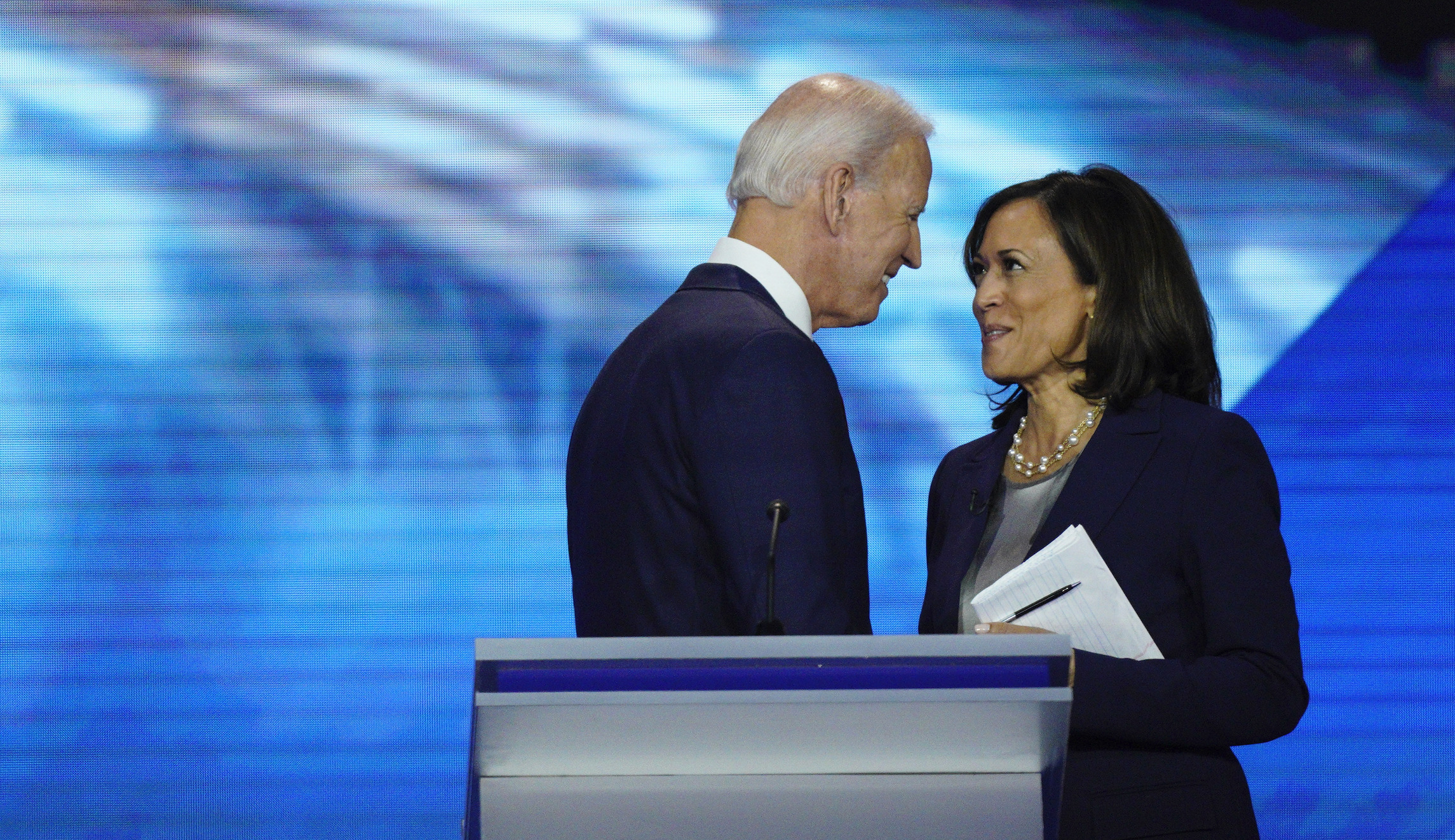
Just as Joe Biden announced Kamala Harris as his running mate and a week before the Democrats’ virtual national convention is scheduled to begin, the basement strategy he’s been pursuing, hailed as the political equivalent of the emperor’s new clothes, was starting to look tattered and torn.
The basement strategy was an obvious choice during a pandemic for a 77-year-old candidate who was prone to slip-ups even in his prime, particularly against an incumbent president capable of stepping on his own best lines and tweeting himself into trouble and perhaps even more with a ticket-mate whose own presidential campaign showed her chronically unprepared and undisciplined.
Recommended Stories



The New York Times has already run two columns, one by Thomas Friedman and the other by Elizabeth Drew, urging Biden to skip the fall debates. Stay in the basement!
But there’s one problem with that. Working as a political consultant long ago, I always shied away from any campaign strategy that included “Step 3: The other side screws up” as an essential step. Because sometimes it doesn’t, and that’s out of your control.
Recently, President Trump hasn’t seemed to be screwing up as expected. The insightful New York Times poll analyst Nate Cohn spies “a clear Biden lead but consistent with ‘tightening’ over the last month and heading into the convention.” Trump’s upward trend is apparent in both national and target-state polls.
Over his presidency, Trump’s job rating has been remarkably steady — never above 50% but never as low as Presidents Ronald Reagan’s or Bill Clinton’s sunk. His low points came between June and December 2017 (the Russia collusion hoax), in January 2019 (the Pelosi speakership), and in June and July this year (COVID-19 pandemic). In those last two months, Biden’s lead in the RealClearPolitics average of recent polls zoomed up to 10 points, a margin too large to be overcome by any Republican Electoral College advantage. As of yesterday, it was 6.9 points.
It’s not clear that San Francisco’s Kamala Harris will help increase that number. A March Echelon Insights poll that previously showed a Biden-Amy Klobuchar ticket leading Trump and Vice President Mike Pence by a 9-point margin (49% to 40%) showed a Biden-Harris ticket leading by only 5 points (47% to 42%). Those numbers are starting to look a lot like 2016 Democratic presidential nominee Hillary Clinton’s national popular vote plurality.
“For liberals, a dominant view is that, thanks to Trump’s mishandling of the COVID-19 pandemic and the economic crisis it unleashed, Republican and Trump-leaning independent voters are coming to their senses,” wrote Eric Posner, a University of Chicago law professor.
There are three problems with that analysis. First, it’s not obvious that anyone else would have responded to the virus better — deaths per million in the United States are well below those in Belgium, the United Kingdom, Spain, and Italy. Second, Trump continues to enjoy an edge on economic issues. Evidently, voters don’t seem to believe the COVID-19 shutdowns discredit Trump’s previous policies, which produced above-average gains for low-wage workers for the first time in decades and the lowest black and Hispanic unemployment ever recorded.
Third, that static analysis doesn’t account for Trump’s executive orders last weekend suspending the payroll tax and extending extra unemployment payments. Many critics, including conservatives, argue that these measures, especially the unemployment payments, aren’t authorized by legislation and that these orders go beyond the president’s powers.
Former President Barack Obama’s granting of legal and employment status to DACA recipients (illegal immigrants brought to the U.S. as children) was not authorized by legislation either, as he has previously acknowledged. But he got away with it. Last month, the four Democratic-appointed Supreme Court justices and Chief Justice Roberts ruled that, despite its illegality, DACA remains in effect because Trump’s attempt to overturn it was administratively deficient.
So both presidents acted without constitutional warrants and beyond constitutional norms. But Democrats are poorly positioned to complain. Harris, for example, has promised to act without Congress to ban “assault weapon” imports, to institute mandatory gun buybacks, and to abrogate drug patents.
Democrats are charging that Trump’s payroll tax suspension means abolishing Social Security. That’s not credible, and they’re not going to oppose sending money out to the unemployed. Meanwhile, Trump’s initiative may remind modest-income voters why they approved of his economic policies up until the pandemic hit.
The intensely partisan division on responses to COVID-19 may also help Trump. Democrats, who are much more likely than Republicans to support coronavirus lockdowns and teacher union refusals to reopen schools, are not registering to vote as much as Republicans. Democrats are also much more inclined to submit mail-in ballots, which increases the risk that their votes won’t be counted in states with histories of minimal mail-in voting.
So Biden-Harris remains the ticket to beat. But that’s looking more likely than it was a couple of weeks ago.
