

Our world’s “greatest deliberative body” becomes less deliberative by the Congress.
The Senate has been doing more with less for years: approving federal judges with simple majorities, approving Supreme Court justices with simple majorities, relying on budget reconciliation, which requires only 51 votes, to pass sweeping legislation rather than using regular order.
Recommended Stories



The erosion of cooperation owes itself to the continuing divergence of political ideologies, allowing for less and less compromise, as well as basic retaliatory politics. Then-Senate Majority Leader Mitch McConnell expanded the nuclear option on judicial nominees in 2017 because the majority leader before him, Democratic Sen. Harry Reid, had employed it first.
It must be said that the mechanisms that were put in place to ensure broad consensus, the legislative filibuster being the perhaps most prominent, earned the Senate its “deliberative” moniker, and their protection is a matter of first principles. They are the definition of the Senate, the rules of the game. That’s why Democratic Sen. Joe Manchin of West Virginia demanded that he would not be a part of “breaking the Senate” by supporting an end to the filibuster, though Democrats such as Rep. Ro Khanna of California and Sen. Ed Markey of Massachusetts do.
Even though the filibuster looks safe, at least for now, the pressure remains to put all the barriers to majoritarian freedom to bed, as more and more within the Democratic coalition insist upon it.
Today, as Democrats marshal through President Biden’s relief package through budget reconciliation, that means ditching deference to the Byrd rule.
The Byrd rule is a means for allowing senators “to block provisions of reconciliation bills that are ‘extraneous’ to reconciliation’s basic purpose of implementing budget changes,” as a Center on Budget and Policy Priorities summary reads. “Without such a rule, committees receiving reconciliation directives would be free to add a wide range of unrelated provisions to their legislative recommendations, including provisions that might have difficulty passing under normal procedures.” Think of the $15 minimum wage requirement that Democrats are pushing for in the relief package.
The Senate parliamentarian is the judge of a provision’s relevance, but the Senate is not properly bound by that judgment. So writes James Wallner, formerly of the Heritage Foundation: “Given this, the Presiding Officer is under no obligation to follow the procedural advice provided by the Parliamentarian in determining whether or not the budgetary impact of a particular provision in a reconciliation bill is ‘merely incidental’ to its underlying policy impact.”
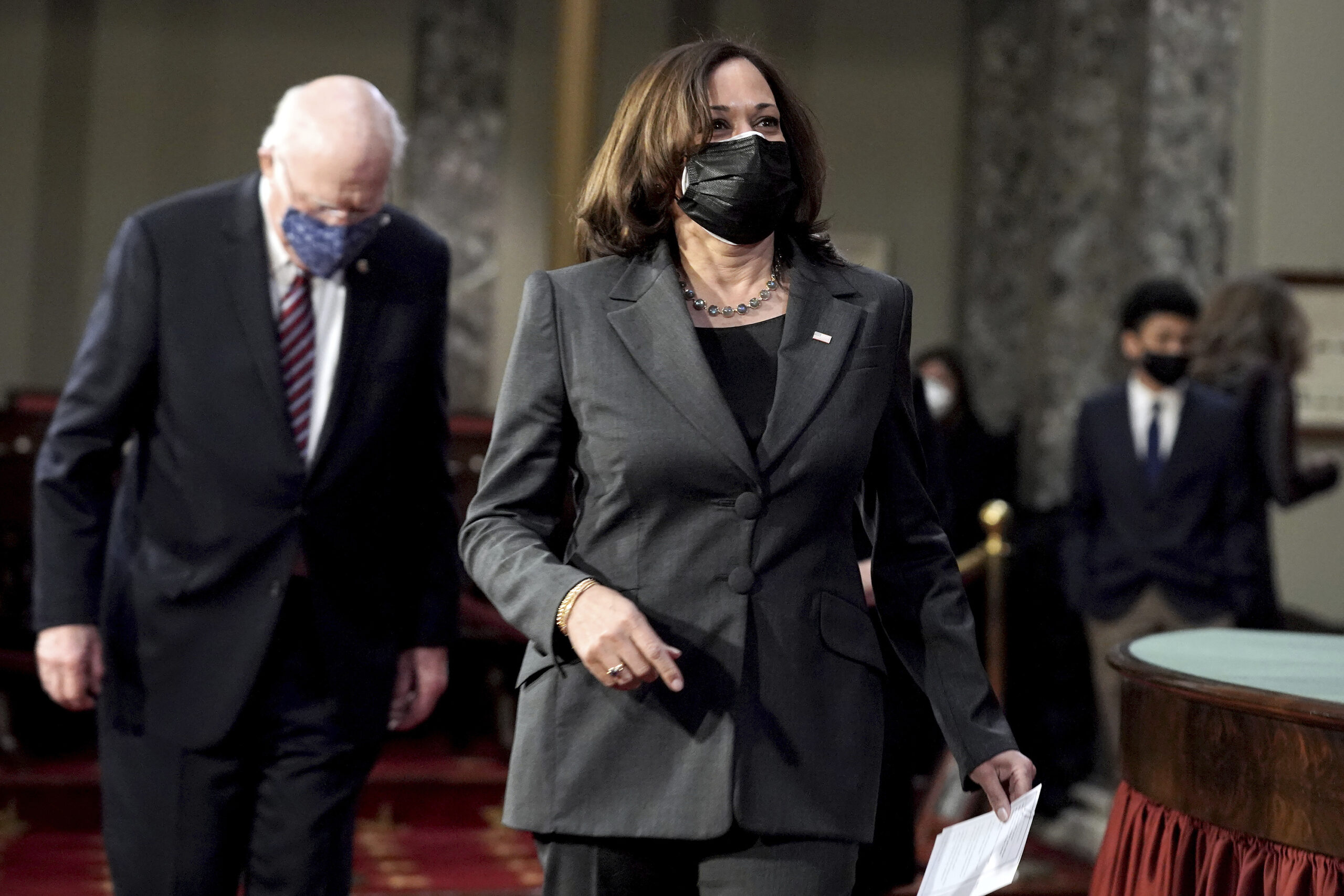
That means the presiding officer, Vice President Kamala Harris or Senate Pro Tempore Patrick Leahy of Vermont in her stead, could disregard it at will, an idea for which there are vocal supporters.
“If the Senate parliamentarian does not advise them that Congress can include the minimum wage in budget reconciliation, Harris or Leahy should exercise their constitutional authority to say that it can,” Bill Dauster, who was deputy chief of staff to Reid, wrote in an op-ed.
Now, Dauster also argues that the minimum wage provision wouldn’t be extraneous, as does Sen. Bernie Sanders. “I think we can absolutely make the case to the parliamentarian that what we’re doing is consistent with the Byrd rule,” Sanders said. But if the parliamentarian doesn’t buy it, Democrats can figure out another way to get approval for the minimum wage goal, such as by fiddling with the tax code (another suggestion of Dauster’s) or, again, simply overruling the judgment rather than deferring to it, as is typical.
“I think that the key here is that we’re going to keep every tool in the toolbox available,” Democratic Rep. Pramila Jayapal said of the idea, having reportedly been “in touch with Senate colleagues about the possibility,” according to the Hill.
It’s a bad metaphor because a sledgehammer doesn’t fit in a toolbox.
