

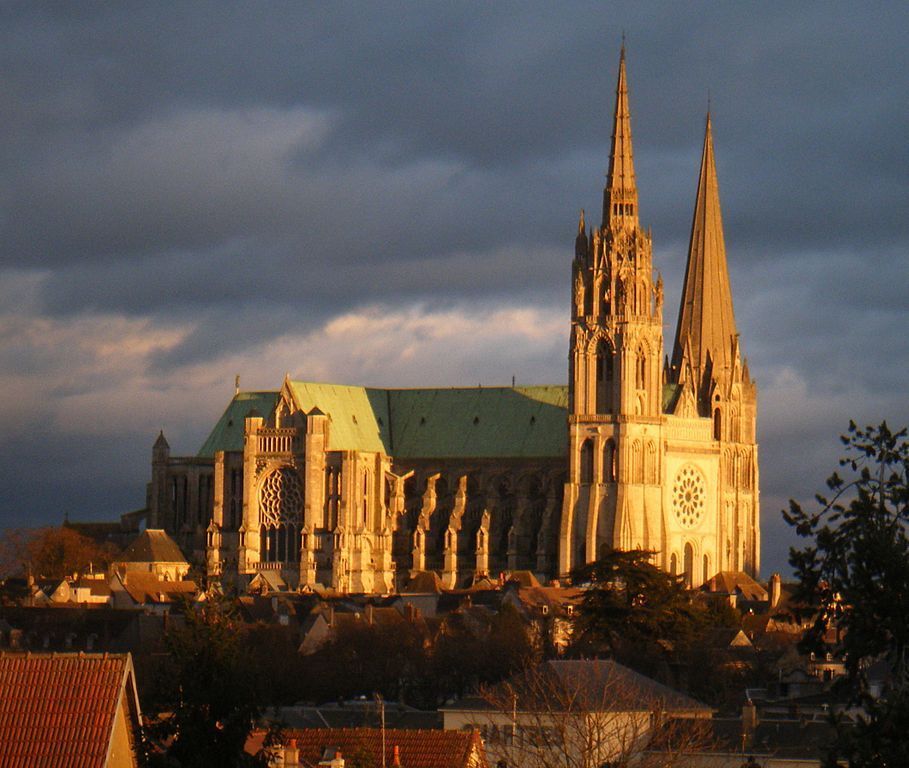
I don’t know how I got on the email list of the American Friends of Chartres, but I’m glad I did, for it made me aware of this inspiring story, of how an American military officer saved Chartres Cathedral from shelling in World War II, a story which I thought was worth sharing:
He died exactly 70 years ago, Aug. 16, battling in France against the Germans to save Notre-Dame de Chartres Cathedral from destruction.
August, 1944. Patton’s Third Army awaits orders — that would never come — to take Paris. Elements of the Third Army, including the XX Corps, were based just outside the historic town of Chartres. On Aug. 16, Col. Welborn Barton Griffith of Texas, logistics and liaison officer in the XX Corps, learned of orders for U.S. artillery to shell Chartres Cathedral, one of the most important monuments of medieval civilization, in order to eliminate suspected German snipers and observers in the tower.
Col. Griffith as a cadet at West Point(Photo: FindaGrave.com)
According to Eugene Schulz, author of The Ghost in General Patton’s Third Army, whom American Friends of Chartres recently interviewed, Griffith — on his own initiative — and his driver approached the forward American forces and obtained information on where the Germans were located in Chartres. They were able to evade the Germans, who still occupied the city, and entered the cathedral. Griffith searched the cathedral and climbed the bell tower. He found no Germans, and was able to rescind the order to shell the monument. Thanks to Griffith’s courage, the Cathedral of Notre-Dame de Chartres was saved from war damage, thereby preserving it for future generations.
Griffith then headed to Lèves, a small town just north of Chartres. He spotted a German machine gun nest, headed back to the American lines, climbed onto the turret of an American tank, and ordered the tank crew to head for the machine gun nest.
Griffith did not get into the tank because “he was a very large man and couldn’t get through the hatch,” said Schulz. Although the tank destroyed the machine gun nest, Griffith was killed in the fight. He was posthumously decorated with the Silver Star, Distinguished Service Cross, and the French Croix de Guerre. He is buried at the St. James World War II Memorial Cemetery in Brittany.
Griffith was born in Quanah, Texas. According to his daughter, Mrs. Alice Griffith Irving of Jacksonville, Fla., Griffith was a loving father who visited her whenever he was on leave from the military. In a recent conversation, Mrs. Irving also mentioned Schulz’s admiration for her father, as a man of great commitment, dedication, and integration — his mentor in the armed forces.
Stay informed.Stay ahead.
Join Washington Examiner for unlimited access to the news, analysis, and commentary that matter most.
Already a member? Log in
