

Mission, Texas — This is the thing about the pieces of wall barrier already built here along the Mexican border: By the time anyone coming up from Mexico makes it to the wall, they’ve already been walking in America for several minutes. Or if they get lost in the dark of night, maybe even several hours.
If they claim asylum, there’s a good chance they’ll get to stay and another good chance they’ll skip their court hearing, disappearing into the country for good.
More wall can’t stop this. Border agents know it and, even more pressing, everyone south of the border knows it, too.
The wall that’s in Texas now does not separate the U.S. from Mexico. It separates the U.S. from more of the U.S., an uninhabited vast space of brush, trees, and wildlife sanctuaries, until you get to the Rio Grande, which is split down the middle longways as our actual border.
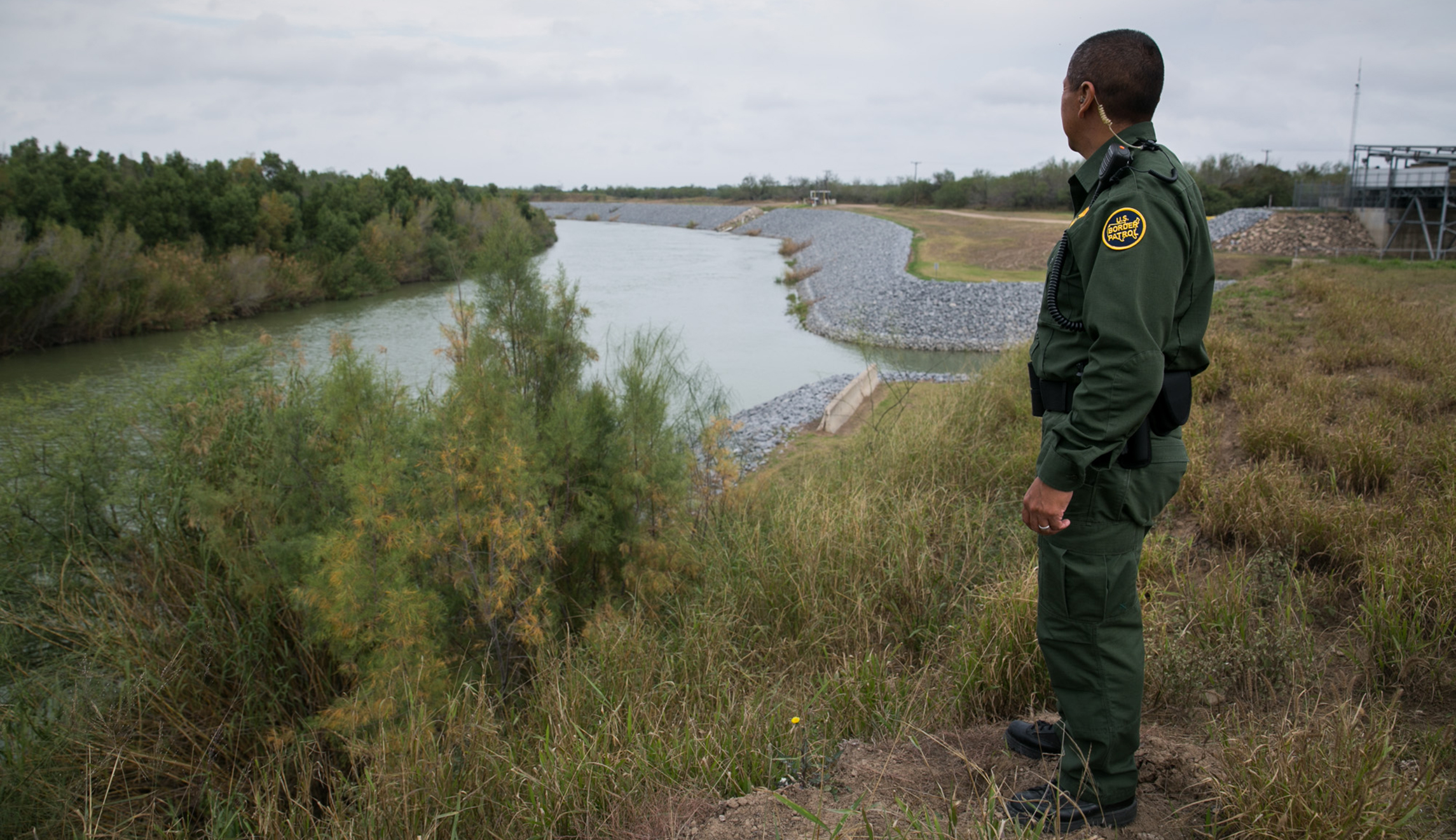
An endless flood of people, mostly from Honduras, El Salvador, and Guatemala, aren’t floating the short distance across the river and hitting a wall. They’re landing in South Texas where they walk up a short distance and tell a border agent they want asylum. If they don’t find an agent for a while, maybe they’ll approach one of the wall barriers and get stuck. But even then, when they’re finally apprehended, one easy word is all they have to say to automatically secure legal protection: asylum.
John Morris, the border patrol’s division chief of law enforcement for the Rio Grande Valley sector, the most illegally crossed sector in the U.S., told me that social media has rapidly pushed word out to everyone below the border on how to exploit our system.
“What might used to take weeks and months and years for messages to filter back out to these countries — ‘Oh, here, if you come and you say this, they have to let you go,’” he said. “And it’s instantaneous and it reaches millions of people.”
This isn’t how the system was intended to work. And it can be fixed, but not with a wall, which would be literally in the middle of a river if it were built on the border.
“Now that the credible fear or asylum claim has kind of gotten out, right, it’s been exposed as a loophole to the system,” Morris said. Asylum and refugee claims “were designed for people fleeing true genocide, if you will. So, you can talk about things in Africa or Asian or communist countries, what have you. It wasn’t designed just to let somebody come in the country just because you may not be rich, or have a lot of money, or you come from a less developed country, that kind of thing.”
During my visit to the border, I saw the pieces of wall, which agents say is an enormous deterrent to illegals, and they want any gaps in it filled with more wall. But after leaving the barrier, we drove a short ways down a road toward the river and saw a family of eight, all Guatemalans, simply waiting on the side of the trail for an agent to come so they could claim asylum.
The law right now says people with a legitimate claim for asylum must be “unable or unwilling to return to his or her country of nationality because of persecution or a well-founded fear of persecution on account of race, religion, nationality, membership in a particular social group, or political opinion.”
In 2016, the most recent year with data published by the Department of Homeland Security, 20,455 individuals who claimed asylum were permitted to stay in the U.S. Yet tens of thousands more illegal immigrants claiming asylum between 2012 and 2016 did not show up for their court hearings.
PolitiFact in 2018 estimated that in the 2012 to 2016 period, 30 to 40 percent of asylum seekers were turned loose into the U.S. and vanished among the rest of us without appearing for court.
Data provided to me Tuesday by the U.S. Citizenship and Immigration Services said that in 2018, nearly 70 percent of asylum claims were made by people from Honduras, Guatemala, and El Salvador, tracking with what the border agents in Texas said. That’s out of nearly 100,000 people claiming asylum total, according to USCIS.
And here’s something to help you sleep well tonight: Though just 10 percent of asylum seekers from Guatemala, Honduras, and El Salvador (countries ravaged by gang violence and poverty) were granted legal protection to remain in the country as a refugee, 90 percent of those who pass an initial first interview with authorities were simply released in the country after they promised to appear in court.
So 70,000 people from Central America applied for asylum last year with the risk that as many as 30,000 people could realistically be expected not to show up for their hearing.
This problem, as border agents repeatedly told me, is not new. It didn’t start when President Trump entered office.
Before the national media turned immigration into an issue about race, the New York Times reported in 2014 on the catastrophic border conditions brought on by the overwhelming number of asylum claims in Texas.
“The agents were clearly visible on that recent afternoon, but the migrants were undeterred. Mainly women and children, 45 in all, they crossed the narrow river on the smugglers’ rafts, scrambled up the bluff and turned themselves in, signaling a growing challenge for the immigration authorities,” a report in the Times said. It quoted Chris Cabrera, a border agent, who said, “Word has gotten out that we’re giving people permission and walking them out the door. So they’re coming across in droves.”
More wall is necessary, as any border agent will tell you. But in Texas, where most border crossings are taking place, it’s going to take something way bigger to fix the immigration problem.
