

BURLINGTON, Iowa — There are plenty of reasons to wonder whether a man who will be 75 on Inauguration Day is too old to be president. But watching Bernie Sanders speak in the livestock arena of the Des Moines County Fairgrounds on a hot night in early September suggests those doubts might not apply to him.
The temperature at sunset was around 90, and the humidity higher, when Sanders began to speak. Spots of sweat soon appeared on his shirt. Then large patches of sweat. Then the entire shirt was drenched. Thirty minutes passed, then 45, then an hour, and Sanders was still going strong — if anything, getting stronger. He knocked off after an hour and six minutes. It was his last event of a long day, after all, but he sounded as if he could go for hours more.
The crowd of several hundred probably would have stayed around. They loved it, and not for the entertainment. Bernie Sanders is all business; if anyone has ever suggested he begin a speech with a joke or a funny story, he rejected the advice. So in Burlington, Sanders offered the briefest of thanks to his introducer, and then to the local Democratic chairwoman, and began: “I appreciate your coming out, because we have a lot of very serious issues to discuss …” And he was off to the races.
There were the evils of super political action committees. (Sanders proudly doesn’t have one.) The “disastrous” Citizens United v. FEC decision. The disappearing middle class. The “incredible … uncontrollable greed” of the billionaire class. (In a word cloud of Sanders speeches, “billionaire” would loom large.) The real unemployment rate. Black unemployment. Youth unemployment. Workers’ pay. (“Too damn low.”) A $15 an hour minimum wage.
Women’s rights. “Our gay brothers and sisters.” Paid maternity leave. A trillion-dollar jobs program. Opposition to the Trans-Pacific Partnership trade deal. The fight against big banks. (“Break ’em up!” someone yelled. “Break ’em up,” Bernie responded.) More Citizens United. The Koch Brothers. American oligarchy. Public funding of campaigns. Republican voter suppression. Free college tuition. Student debt relief. Climate change. Single-payer healthcare. Ending institutional racism. Opposing the war in Iraq. Avoiding another war in the Middle East. Veterans’ care.
And finally, Sanders’ goal of a political revolution. “If we create this political revolution,” he concluded, “we can transform America in a way that finally, our government will be working for all of us and not just a handful of billionaires.”
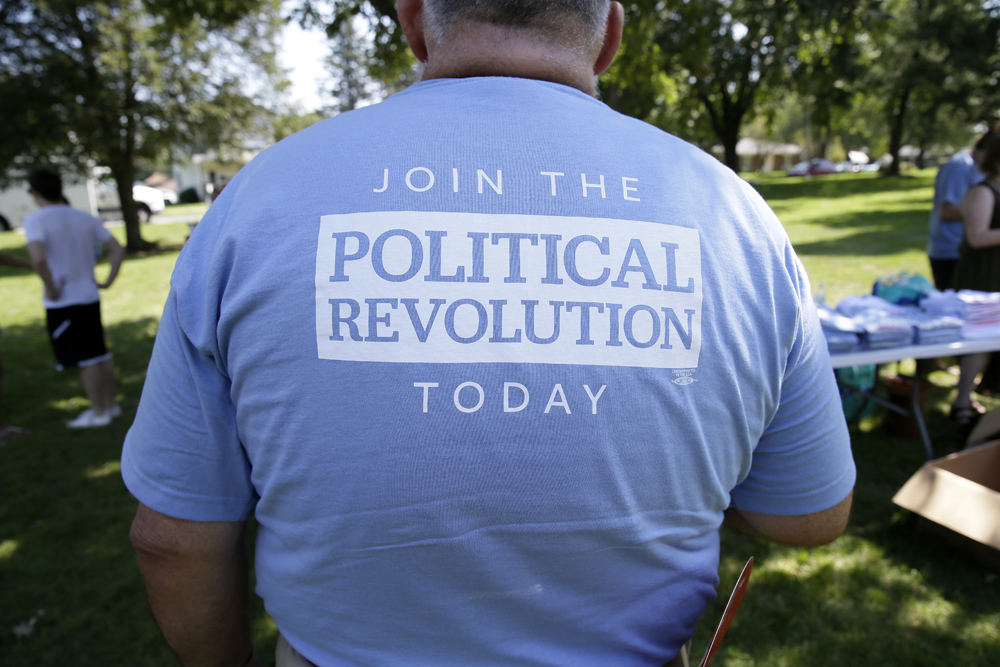
A supporter wears a shirt for Democratic presidential candidate Sen. Bernie Sanders, during a town hall meeting in Grinnell, Iowa. (AP Photos)
It would be an understatement to say the crowd was with Sanders. There were lots of cries of “That’s right” when Sanders went after Wall Street. There was one loud “You goddamn right!” when he discussed the disappearing middle class. And when he talked about Citizens United, someone yelled out “It’s un-American!” It’s a sentiment Sanders quickly adopted as his own. In Sanders’ gatherings, the Supreme Court campaign finance decision occupies a place roughly equal to that of Roe v. Wade at an Americans United for Life convention.
After the speech, more than one audience member said he or she couldn’t think of a single Bernie issue for which to disagree. But they supported him for reasons more fundamental than any particular issue. When I asked Sanders supporters why they chose him instead of Hillary Clinton, nearly everyone, with just a few exceptions, said some variation of: He’s not in the pocket of the big banks and corporations, and thus can’t be bought; and he’s genuine, saying the same things for many years, and thus hasn’t changed his message for political expediency.
The flip side of that, sometimes stated and sometimes not, was that Clinton is in the pocket of the big banks and corporations, and has changed her message for political expediency.
“Bernie has been consistent his whole career,” said Bob Griffith, a Democrat from Fort Madison, Iowa. “You know what Bernie stands for, you know what he believes in … Hillary’s as bought-and-paid-for as the rest of the politicians. She’s got her super PACs, and she’s definitely beholden to the big money interests.”
“He seems more genuine, you can tell he means what he’s saying,” said Allison Richerd of Burlington. “It’s real. You can tell it’s coming from his heart.”
“Hillary’s a corporate Democrat, in my view,” said Paul Schaefer, of Fairfield. “She’s taking money from super PACs. She’s going to answer to those people, just like you or I would answer to our employer. Bernie is not taking money from those people, and he recognizes the corrosive, destructive effect of big money essentially buying politicians, buying influence.”
“He’s standing up for the common man, and has been doing that for years, and he’s still doing that,” said Dennis Gerst of Mediapolis.
“I’ve never been a real political person,” said Kathy Schaefer, Paul’s wife. “I was always trying to vote for the least of evils. But with Bernie, the first time I heard him, it was like finally refreshing truth, not the same old, same old, same old.”
Each one of those voices represents a challenge to Clinton. Yes, nearly everyone said that as a loyal Democrat, they would vote for Clinton if she becomes the party’s nominee. But right now, and through the Iowa caucuses, they’re sticking with Bernie. And if the number of Bernie supporters continues to grow as it has in recent months, the result could be disastrous for Clinton.
The problem for Hillary is not only that Sanders’ base is growing, but that his supporters like him more than Clinton’s like her.
“Love for Sanders runs deep,” the Des Moines Register reported recently after a poll showed that Clinton’s once-huge lead over Sanders had virtually disappeared. “Thirty-nine percent of likely caucusgoers say their feelings about Sanders are very favorable, with another 34 percent saying mostly favorable. Only eight percent have a negative view of Sanders. Contrast that with Clinton: Fewer feel very favorable about her (27 percent), and twice as many view her negatively (19 percent).”
Indeed, not long after those words were written, Sanders pulled ahead of Clinton in Iowa for the first time, 41 percent to 40 percent, in a Quinnipiac poll released Thursday.
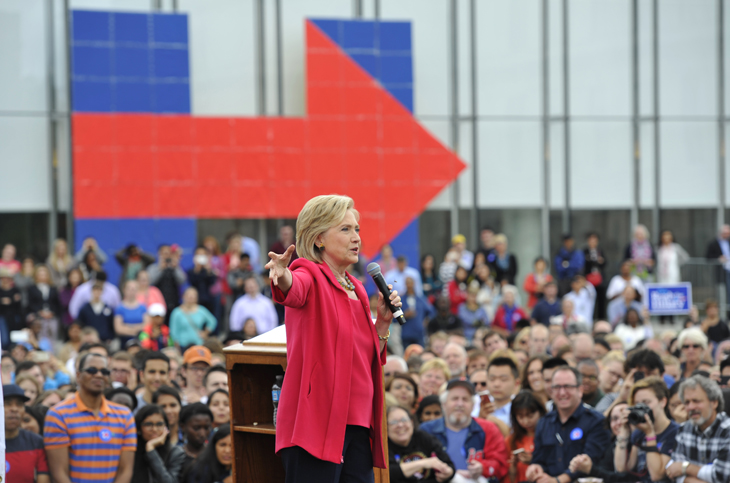
What was once expected to be a coronation for Hillary Clinton has become a competitive race due to Bernie Sanders’ popularity.
Credit for showing up
In a couple of days in Iowa, Sanders managed to connect with some constituencies — organized labor, young people, minorities, old hippies — who would be key to a victory over Clinton. The morning after the Burlington rally, he headed to a roundtable with Latino voters in Muscatine, and from there to the Meskwaki Indian Tribal Center, on what is known as the Meskwaki Settlement. The importance of that visit was that no one could remember any presidential candidate, Democrat or Republican, ever visiting before. Sanders scored a lot of points just by being there.
There are about 15,000 Native Americans in Iowa. Their poverty rate was 33.2 percent in 2013, versus 12.7 percent for the rest of the state. In the same year, 19.1 percent of Iowa’s Native Americans were on disability, compared to 11.7 percent for the rest of the state. Name any other economic indicator, and the situation is pretty much the same.
Sanders didn’t tailor his message to the audience. He gave the same Citizens-United-billionaires-super-PAC-middle-class-break-up-the-banks speech he gives everywhere. Before discussing this or that issue, Sanders might mention that the problem is particularly acute in the tribal areas, but he didn’t make any special pitch for the Native American vote. He’s not a panderer.
It worked. “He’s my number one,” said Ira Hayes, from the settlement. “I just like that he can’t be bought by millionaires or special interests.” When I asked Hayes about Clinton, he said, “She just doesn’t seem trustworthy, with that Benghazi stuff going on, and the questions — ‘Did you ever wipe your computer,’ and she says, ‘Oh, you mean with a cloth?’ — that kind of stuff.” Hayes was one of two people in the four Sanders events I attended who brought up Benghazi or the email scandal.
“I like Hillary,” said Susan Salisbury of Dysert, who came to the event wearing a Sanders button with the words “NOT FOR SALE.” “I like her a lot. If [Bernie] wasn’t in the campaign, I would be voting for Hillary.” But of course, Sanders is in the campaign, so Salisbury’s is another vote Clinton won’t get.
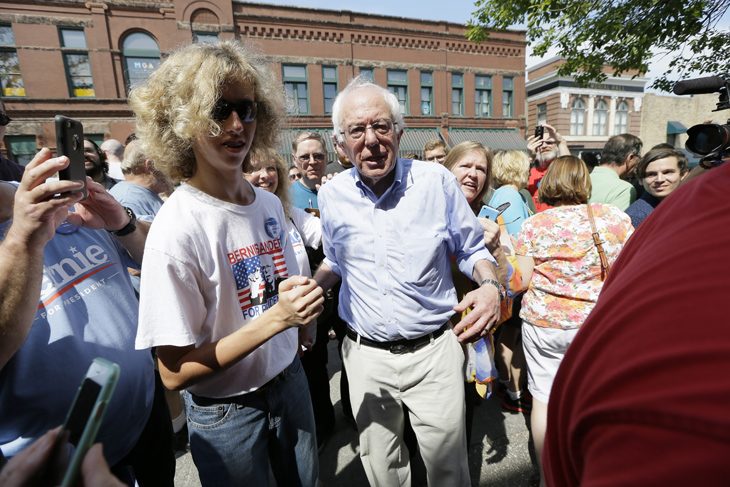
Sen. Bernie Sanders greets supporters during the opening of his Cedar Rapids field headquarters in Marion, Iowa.
Walking the line
From the settlement, Sanders went to an industrial area of Cedar Rapids, where he took part in what was called an “informational picket” in a labor dispute between the Bakery, Confectionery, Tobacco Workers and Grain Millers International Union and what used to be called the Penford Corporation, which makes various corn-based food products. This year, Penford was taken over by a company with the dystopian movie name of Ingredion, and a labor dispute began almost immediately. The heart of the problem was Ingredion’s insistence that the union accept cuts in wages and benefits.
Sanders heard of the dispute and offered to help. “They reached out and said was there anything we could do?” said Chris Eby, the union local president. “We said yeah, you could come down and speak on our behalf. The campaign is very thorough.” Eby was delighted to have Sanders on board to publicize the conflict with Ingredion. He said he has not heard from the Clinton campaign.
Sanders knows his way around a picket line. He often points out that he has walked hundreds of them in his time in public life. And by showing up like he did earlier at the settlement, he made a lot of friends.
“He’s consistent,” said Don Johnson, a Cedar Rapids machinists’ union member. “His message has been the same forever.” Johnson worried that Clinton didn’t have those qualities. “I think she’s too willing to make deals,” he said. “As Clintons throughout history, they’re quite the schmoozers, and they’ll go whichever side they need to, you know?”
“Bernie is talking about the issues that really affect people,” said Tom Carsner, a member of the American Federation of Teachers in Iowa City who has volunteered for the Sanders campaign. “And his solutions go deep enough, wide enough, broad enough to really move toward solving the problem.” Not so with Clinton, Carsner added, who “is content to play around the edges and not make commitments to the degree that will really solve the problem.”
Sanders got some good press coverage in Cedar Rapids that evening. Videos showed him carrying a sign in the line outside the plant as trucks and trains rolled by and union members shouted, “No contract, no peace!” By the end of the day, the sense was that, while Clinton would of course express her support for organized labor, it wouldn’t be a bad idea if she found a picket line to join sometime in the near future.
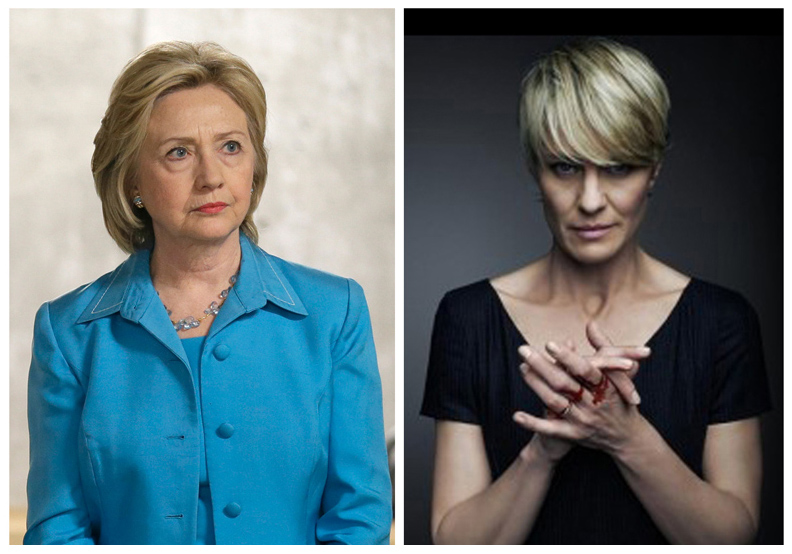
“Hillary reminds me of the character in ‘House of Cards,’ Claire Underwood, in that she seems like a terrible person on the inside,” John Weber said. (AP Photo and Wikipedia)
Defeating ‘Claire Underwood’
Sanders’ last stop of the trip was Coe College, a small liberal arts school in downtown Cedar Rapids. It was another hot night outside on the quad, but the crowd was big, and the organization was impressive. You couldn’t walk three feet without seeing someone with a clipboard ready to sign you up for Team Bernie.
“I think he’s got a really strong following with people in our age group,” said Lindsey Krotz, age 26, of Cedar Rapids. “Hillary is having a hard time communicating, I think, because she is so affluent.”
“[Hillary] is not super vocal about taking on the corporations’ control over the political process,” added her friend Dylan Lake, 24.
“Everything’s transparent,” Zach Schultz, 25, wearing a “Feel the Bern” hat over blue-dyed hair, said of Sanders. “We have a lot of problems, and he’s the white knight to fix them.”
As at other events, the crowd wasn’t necessarily anti-Clinton as much as pro-Bernie. But young people seemed less reluctant to say what they thought about the Democratic front-runner. “Hillary reminds me of the character in ‘House of Cards,’ Claire Underwood, in that she seems like a terrible person on the inside,” said John Weber, 28, of Cedar Rapids. “She seems very backstabby.”
“He seems more consistently progressive,” said Melissa Serenda of Iowa City. “He is less establishment, seems to be less business-friendly than she is —”
“Like big business friendly,” added Steve Smith, who had come to the rally with her. “Donors and money and money and money. I’d rather see less money in politics.”
“She seems more of a politician, more ‘see which way the wind’s blowing and make your decision from there,’ rather than staying with your principles consistently for 30 years,” Serenda added.
Sanders spoke for a relatively brief 51 minutes. When he left, students formed a long line to shake his hand before he got into a waiting white minivan. They sang “Happy Birthday” (Sanders would turn 74 a couple of days later). And when he passed by, one young woman clutched her phone and exclaimed excitedly, “I got a picture with him!” It wasn’t exactly Beatlemania, but there was something important happening.
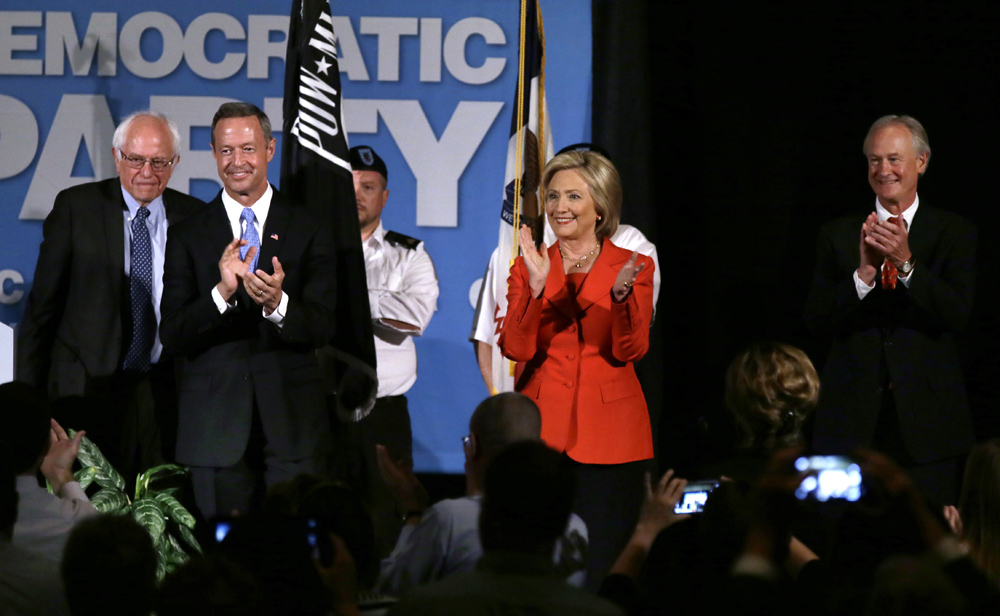
Democratic presidential candidates, from left, Bernie Sanders, Martin O’Malley, Hillary Clinton and Lincoln Chafee during the Iowa Democratic Party’s Hall of Fame Dinner.
The Democrats’ fresh old face
It’s been tempting for some commentators to portray Sanders’ followers as the most progressive of the progressive Democratic Left. Certainly there’s some truth to that. But in Burlington and Cedar Rapids, Sanders drew a lot of solid union Democrats; in Muscatine and the Meskwaki Nation, he connected with minorities; and at Coe College (and an earlier visit to Grinnell) he showed a lot of strength with young voters. That’s a fairly broad coalition in the Democratic world.
The reasons Bernie voters gave for supporting him are a direct threat to Clinton, because they are based on Sanders’ personal qualities; they don’t involve specific issues on which Clinton could change her views. Indeed, if Clinton adopted Sanders’ positions, it would only confirm to Sanders’ voters that she has no real core. Bernie’s independence and his steadfastness, as they see it, are two things Clinton simply doesn’t have, and can’t ever have.
And one other thing. As a member of the House, and now a two-term senator from Vermont, Sanders hasn’t exactly been a prominent player on the national stage. Clinton, on the other hand, has been famous for more than 20 years. For some, perhaps many, Democratic voters, the older man seems the fresher face.
“My own personal opinion is that she’s been around for too long, almost,” said Mark Smith, a machinist from Marion who was walking the picket line with Sanders in Cedar Rapids. “I’m not saying Bernie hasn’t, but I just look at Bernie as new blood. I like his attitude. He’s straightforward, and you don’t have to worry about where he’s heading.”
Clinton has mostly refrained from attacking Sanders. She’ll need his voters, should things work her way and she ends up the Democratic nominee. But lately, as Sanders has climbed in the polls, Clinton has shown signs of frustration. “You can wave your arms and give a speech,” she said recently on NBC, apparently referring to Sanders’ sometimes flailing speaking style. “But at the end of the day, are you connecting with and really hearing what people are saying?”
It’s a reasonable question. But even a brief time with the Sanders campaign suggests he truly is connecting with Democrats, and he really is hearing what they have to say. And as well as he is doing in Iowa, Sanders is doing even better in New Hampshire, where he has a solid lead over Clinton.
Yes, Clinton believes she has a firewall in later states, but the fact is, no one can predict the effect early losses might have on her campaign. And it would all start here in Iowa. So look for Clinton to go after Sanders more directly in the future, once she fully realizes the threat he poses to her ambitions.
