

President Obama’s re-election campaign launched an attack this week on presumptive Republican nominee Mitt Romney’s private sector career at Bain Capital. Its two-minute ad, paired with a longer video and an anti-Romney website, purports to tell the story of GST Steel, a company Bain acquired in 1993. The firm went on to declare bankruptcy in 2001. The video features interviews with steel workers blaming Romney for the closure of the Kansas City, Mo., plant and the job losses that followed.
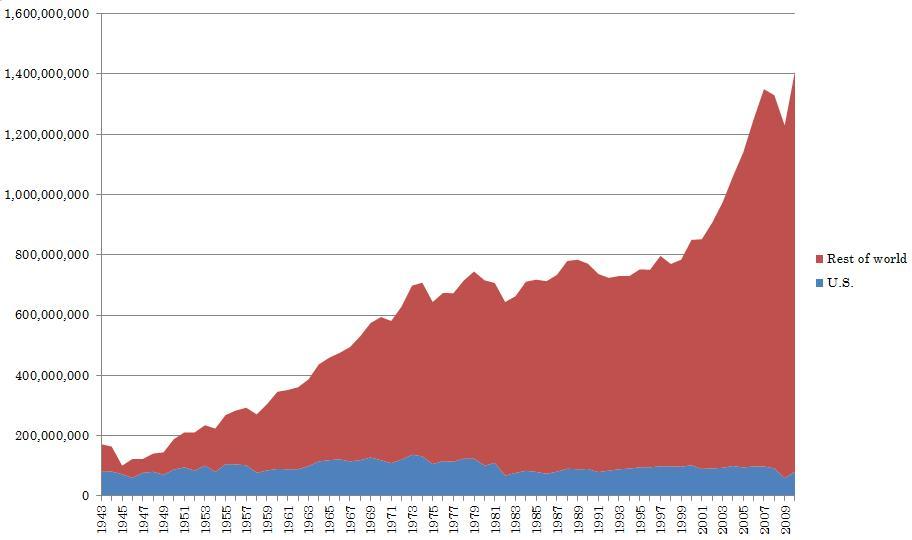
Putting aside the fact that by 2001, Romney had left Bain and was running the Salt Lake City Olympics, it is absurd to examine the collapse of one steel company without mentioning the broader context of the consolidation of the American steel industry in the preceding decades. The United States once dominated the steel market. The U.S. share of global steel production ranged from 28 to 46 percent in the 1950s, according to data from the U.S. Geological Survey. From there, it slipped to 20-26 percent in the 1960s, and below 20 percent in the 1970s. By 2001 — the year GST declared bankruptcy — that share had dropped below 11 percent. By 2010, it was less than 6 percent.
Recommended Stories


In addition to increased foreign competition from countries such as China, technological changes have made steel production a lot less labor intensive, allowing manufacturers to produce much more steel per worker. The result was a huge decline in the workforce and the closure of a lot of steel plants. In 1972, the steel industry employed more than 500,000, according to the American Iron and Steel Institute. Last year, that number had dropped to 151,000, even as the overall U.S. population grew by 50 percent during that time period.
The consolidation of the steel industry caused displacement and meant hard times for a large number of Americans who had difficulty finding comparable employment. But given the larger transition that was going on in the economy, there’s no basis to call Romney a “job destroyer” and a “vampire” for the failure of one company that was caught up in the midst of a gradual but massive industry-wide washout.
As a Romney follow-up ad highlights, Bain also invested in the Indiana-based Steel Dynamics, which currently employs more than 6,000 people. The Steel Dynamics success comes in addition to a number of other businesses that Bain helped jumpstart and expand, including Staples, Sports Authority and Domino’s Pizza.
Private equity investment is a high-risk, high-reward business by its very nature. It often involves rescues of struggling businesses that have already undergone significant downsizing — an accurate description of GST Steel at the time Bain took it over. Private equity produces many hugely profitable success stories, as well as many disappointing failures. This is par for the course. The failure of some companies is to be expected, and nothing for Romney to be ashamed of.
As long as Romney doesn’t let himself be put on the defensive by this new wave of economic know-nothing demagoguery, his private sector career should be both easy to defend and an asset to his presidential campaign.
