

If you don’t consider yourself an evangelical Christian, try to put yourself in their shoes for a moment.
In the 2016 election, the Republican nominee was a man of poor personal character. He bragged about sexual exploits outside of marriage, was twice-divorced, and loved to walk the fine line between exaggeration and outright lie in nearly every sentence. But he promised to expand religious liberty and nominate pro-life judges who would overturn Roe v. Wade. Perhaps even more important, he fought in the culture war against anti-religious fanatics.
Recommended Stories


Hillary Clinton had her character flaws too, though not as bad as Trump’s. Allegations of corruption were common, and her thirst for power was awfully self-interested, but overall her personal character was not as bad as Trump’s. Clinton, however, believed religious liberty just gave license to discriminate, voted in favor of allowing partial-birth abortions, and was cozy with Hollywood liberals and East Coast elites who look down on evangelicals.
Who do you vote for: The highly flawed candidate whose policies you agree with, or the less-flawed candidate whose policies you hate?
Polling makes the answer obvious: 80 percent of self-described white born-again or evangelical Christians voted for Trump. He won the protestant, Catholic, Mormon, and “other Christian” vote, and won with voters who attend religious services weekly or monthly. (Clinton barely won the vote of those who attend services a “few times a year” and, by 32 percentage points, “never.”)
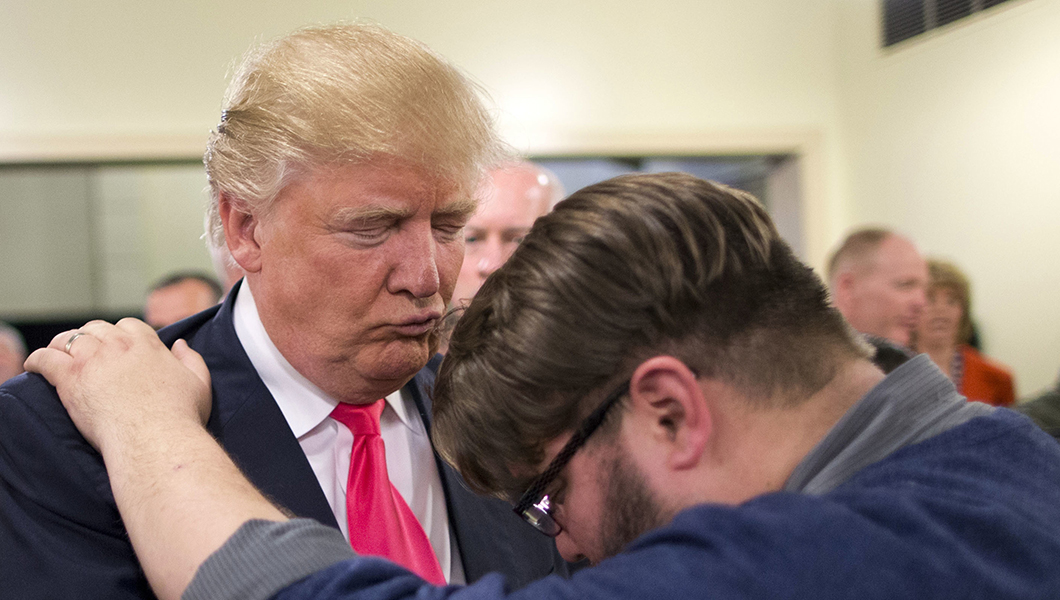
Washington Post reporter Stephanie McCrummen went to a Southern Baptist church in Alabama to see why evangelicals support Trump despite his numerous sins. Her interviews show a congregation that tolerates Trump’s sins and loves his policies.
“We rationalize the immoral things away,” one congregant, Terry Drew, said. “We don’t like it, but we look at the alternative, and think it could be worse than this.”
The alternative was Hillary Clinton. “She hates me,” Drew said. “She has contempt for people like me.”
In 2016 coverage, there was so much focus on Trump’s moral flaws, perhaps it was overlooked that everyone, politicians and presidents especially, is flawed. But those flaws haven’t held back past presidents. “George Washington had a mistress,” one woman told McCrummen. “Thomas Jefferson did, too. Roosevelt had a mistress with him when he died. Eisenhower. Kennedy.”
As Romans 3:23 says, “All have sinned and fall short of the glory of God.”
It would be nice if we could point to presidents as role models in all walks of life. If a politician can sleep around, get away with it, and still win an election, it’s harder to teach that actions have consequences.
But Trump’s flaws aside, it’s difficult to imagine evangelical Christians would prefer a world where the president is of good character but attacks their values and religious beliefs.
Thankfully, some moral flaws are too much. Just look at Roy Moore’s election loss in Alabama in December, after he was credibly accused of preying on teenage girls while he was in his 30s.
Perhaps smoking-gun proof of Trump infidelity would bring him down in 2020. But even if Democrats nominate a candidate as spotless as a lamb, it probably won’t matter to evangelicals unless the nominee supports their values and beliefs.
