
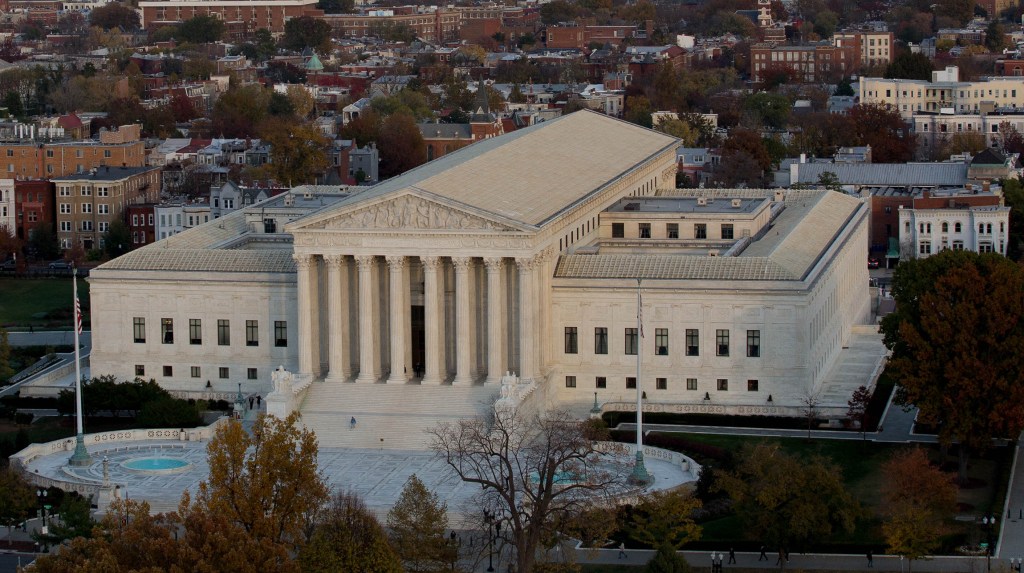
Today the Supreme Court heard oral argument in two redistricting cases, one challenging state legislative districts in Virginia and the other congressional districts in North Carolina. Both cases challenge choices made by redistricting state legislators in response to the prevailing interpretation of the Voting Rights Act of 1965. “The claim made by [lawyers purporting to represent] black voters in both states,” the Associated Press reports, “is that Republicans created districts with more reliably Democratic black voters than necessary to elect their preferred candidates, making neighboring districts whiter and more Republican.”
The prevailing interpretation of the Voting Rights Act has been that redistricters are required to maximize the number of “majority-minority” districts. The idea is to stop the spreading out of black voters into multiple districts where they would be outnumbered by whites; the theory is that whites would oppose the election of legislators who took positions favored by most blacks. The partisan effect, given that overwhelming majorities of blacks tend to vote Democratic and smaller majorities of whites tend to vote Republican, has generally been favorable to Republicans, because corralling blacks into a few districts tends to make the larger number of adjacent districts more Republican.
In-depth coverageas the midterms
take shape.
Follow the latest midterm news, analysis, and expert perspectives with unlimited access.
Already a member? Log in