

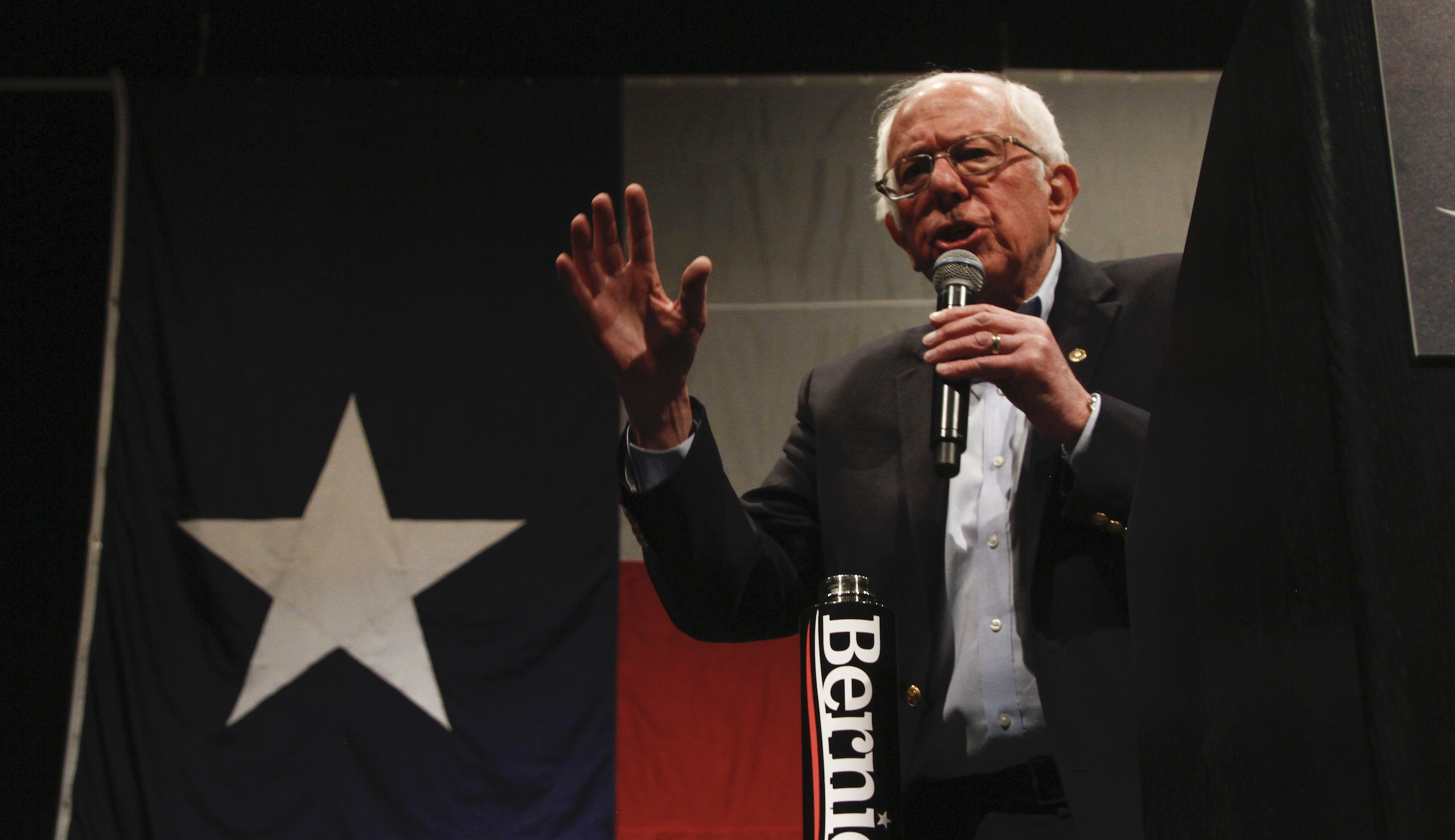
We know Bernie Sanders’s economic policies worry conservatives. But what about his effect on culture?
After Sanders won the Nevada primaries this weekend, it’s worth taking a look at what a Sanders presidency could mean for religious freedom. The senator himself has already given us some ideas.
Recommended Stories


Religious freedom does not feature prominently in the list of issues on Sanders’s website, but FeelTheBern.org assures readers that “Bernie Sanders supports people’s right to freely congregate, practice, and express their faith.”
Let’s see how that looks in practice. When Sanders was grilling Russell Vought, the acting director of the Office of Management and Budget, during his confirmation hearing, it became clear that Sanders respects people’s right to freely express their faith … until he finds that expression distasteful.
Apropos of nothing, Sanders brought up an essay Vought had written as an alumnus of Wheaton College. The Christian school had fired a professor for a Facebook post in which she announced that she would wear a hijab in solidarity with Muslims for a season. In an article in response, Vought wrote out a basic Christian tenet: that people cannot know God except through Jesus. “Muslims do not simply have a deficient theology,” he wrote. “They do not know God because they have rejected Jesus Christ his son, and they stand condemned.”
Sanders repeatedly read this passage back to Vought during his confirmation hearing, at one point accusing him of perpetuating Islamophobia.
“In my view, the statement made by Mr. Vought is indefensible. It is hateful, it is Islamophobic, and it is an insult to over a billion Muslims throughout the world,” Sanders said. “This country, since its inception, has struggled, sometimes with great pain, to overcome discrimination of all forms … we must not go backwards.”
Vought responded that the statement was not Islamophobic, saying, “I’m a Christian, and I believe in a Christian set of principles based on my faith.” He also clarified that he doesn’t take his theology as an excuse to mistreat those of different faiths.
Sanders shot back: “And do you think your statement that you put in that publication — ‘They do not know God because they rejected Jesus Christ his son, and they stand condemned’ — do you think that’s respectful of other religions?”
Somehow, it was lost on Sanders that any believing Muslim would have more or less the same thing to say about Christians.
Vought was eventually confirmed to his position, but no thanks to Sanders, who seemed unable to understand how someone could hold strong religious convictions without using them to discriminate against others. To make Sanders’s aggressive faith-based test worse, remember that Vought was named to the Office of Management and Budget, which is not particularly known for its theological relevance.
Nevertheless, Sanders maintained until the end of the hearing: “I would simply say, Mr. Chairman, that this nominee is really not someone who is what this country is supposed to be about.”
Sanders framed his argument as one in advance of tolerance, but as Emma Green at the Atlantic notes, this “pits acceptance of religious diversity against the freedom of individual conscience.” Never mind that religious litmus tests are prohibited by the Constitution. Sanders will support them anyway, and in doing so, he will prioritize politically correct ideals of religious pluralism even if doing so means trampling on religious conviction.
This isn’t the only instance where Sanders has promoted his idea of social justice over religious freedom. He also opposed the Supreme Court’s ruling in Burwell v. Hobby Lobby, which held that the craft store shouldn’t have to provide potential abortifacients in its healthcare plan if it was religiously opposed to doing so.
“Bosses should not be able to impose their religious beliefs on their employees,” Sanders responded in a statement. “At a time when tens of millions of women use birth control, there is no valid reason to restrict a woman’s access to safe, widely-used preventive services simply because her employer does not approve of what should be her private medical decisions.”
Sanders may not be much more radical than his contemporaries on this issue — at least, he never said the “dogma lives loudly” within anyone — but his record presents a precedent that should be concerning both to people of faith and to those who value religious freedom.
Sanders will support the rights of religious people — but only if they coincide with his own narrow conception of what beliefs they should be allowed to hold.
