

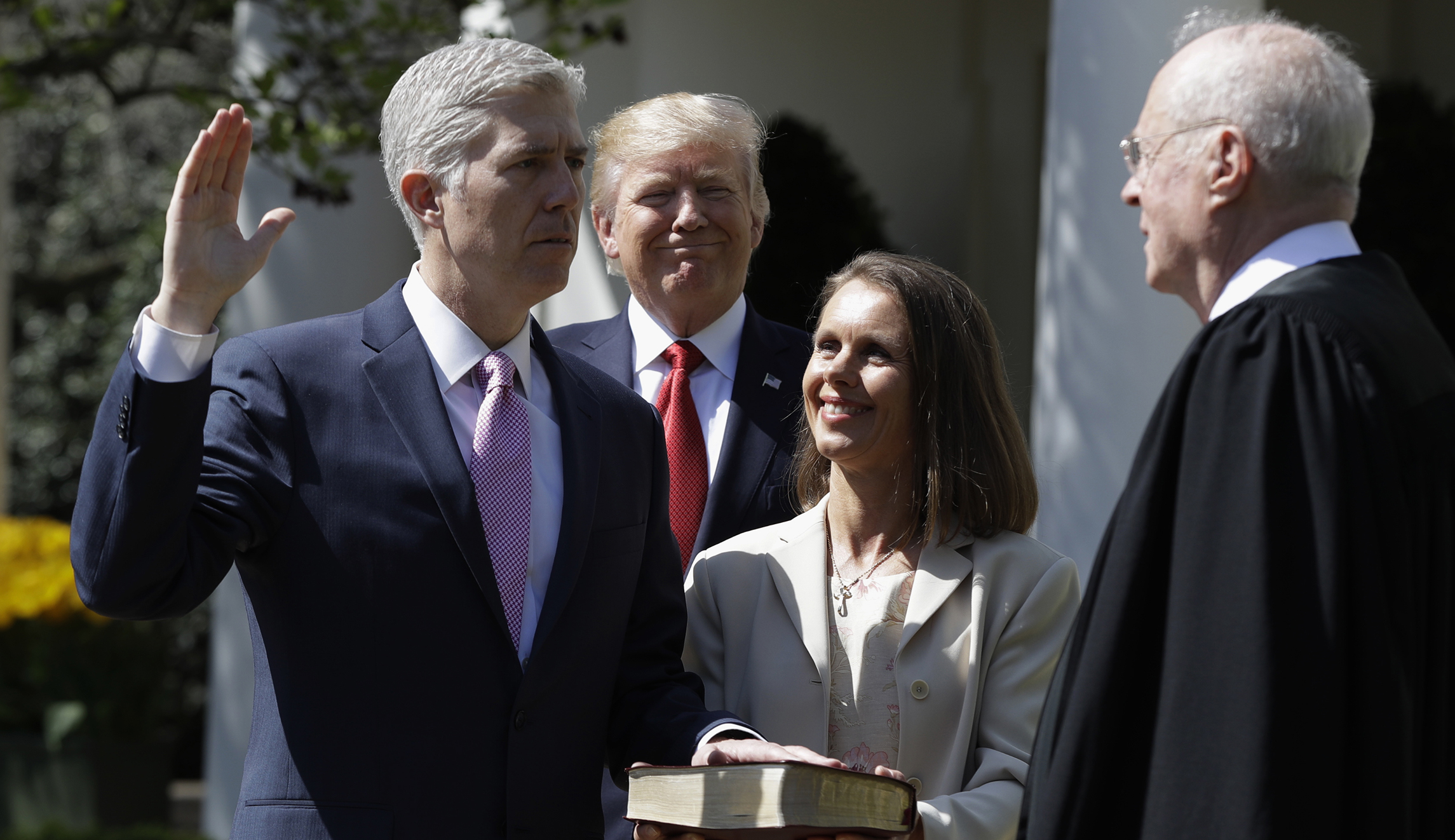
President Trump has received significant criticism, often justified, for shattering accepted norms of presidential behavior. But occasionally, his willingness to buck tradition has its benefits. His decision to release a shortlist of potential Supreme Court nominees is a prime example of an idea that should become the new standard for presidential candidates.
Trump released his list this week, adding 20 additional names to the Supreme Court shortlist he first unveiled in 2016. Just like four years ago, Trump is the only candidate to be so explicit about whom he would consider appointing to the high court. Democratic nominee Joe Biden has not yet released a list similar to Trump’s, even though liberal activists and establishment types have both encouraged him to do so.
Recommended Stories


But all Biden has said on the topic is that voters must stop Trump from filling another potential Supreme Court vacancy. When asked whether he would name individuals he thinks would be fit for the job, Biden said earlier this summer that his campaign was considering a number of African American women but that they would not say more until each candidate had been properly vetted.
Perhaps Biden thinks it is safer to avoid weighing in on judicial appointments, since doing so would inevitably further the ideological rift that exists between the Democratic Party’s left wing and its centrists. Or, maybe Biden is worried that releasing a Supreme Court shortlist would aggravate the culture war, thus pushing middle-of-the-road voters toward Trump.
But staying silent on this topic will not make it go away. The Supreme Court remains a top priority for a majority of voters, according to a recent survey. At least 64% of respondents said that future Supreme Court appointments are “very important” to their votes in this year’s election, Pew Research found.
Though we long for a day when the Supreme Court is less influential because it dispassionately interprets the Constitution, the reality is that it is a powerful institution with the ability to influence every aspect of American life by often arbitrary value judgments by justices.
The late Justice Anthony Scalia put it well in his dissent in the Planned Parenthood v. Casey case, arguing that in a world in which the court is not strictly adhering to the Constitution, it is perfectly logical that the process of choosing justices would become politicized.
“If, indeed, the ‘liberties’ protected by the Constitution are, as the Court says, undefined and unbounded, then the people should demonstrate, to protest that we do not implement their values instead of ours,” Scalia wrote. “Not only that, but confirmation hearings for new Justices should deteriorate into question and answer sessions in which Senators go through a list of their constituents’ most favored and most disfavored alleged constitutional rights, and seek the nominee’s commitment to support or oppose them.”
So, voters are right to care about the Supreme Court. Congress has all but abdicated its responsibility to legislate, and the president’s achievements, many of which came about through executive action, will last only until the next president decided to undo them. As a result, the judiciary has become more powerful than ever, weighing in on almost every policy debate, and, in some cases, using these debates to create new policy.
More importantly, though, the courts have the power to determine the ideological trajectory of the nation. It is impossible to look at decisions such as Roe v. Wade and not see the direct effect it has had on the culture. Voters understand this, which is why they care about the future of the Supreme Court and why they should have a say in determining the men and women who would be asked to sit on it.
By releasing his Supreme Court shortlist, Trump is giving voters an opportunity to do just that. They can choose to accept or reject his vision for the future of the court based on tangible names rather than on abstract statements.
Biden needs to give voters the same opportunity. They deserve to know where he stands on the cultural issues of today, and one of the best ways to find that out is by evaluating the men and women who would decide those cultural issues for him. After all, Biden’s judicial picks will be around long after his presidency would end, were he to be elected.
But we would go further. Given the importance of Supreme Court appointments, Trump’s transparency should become the new standard for all presidential candidates.
