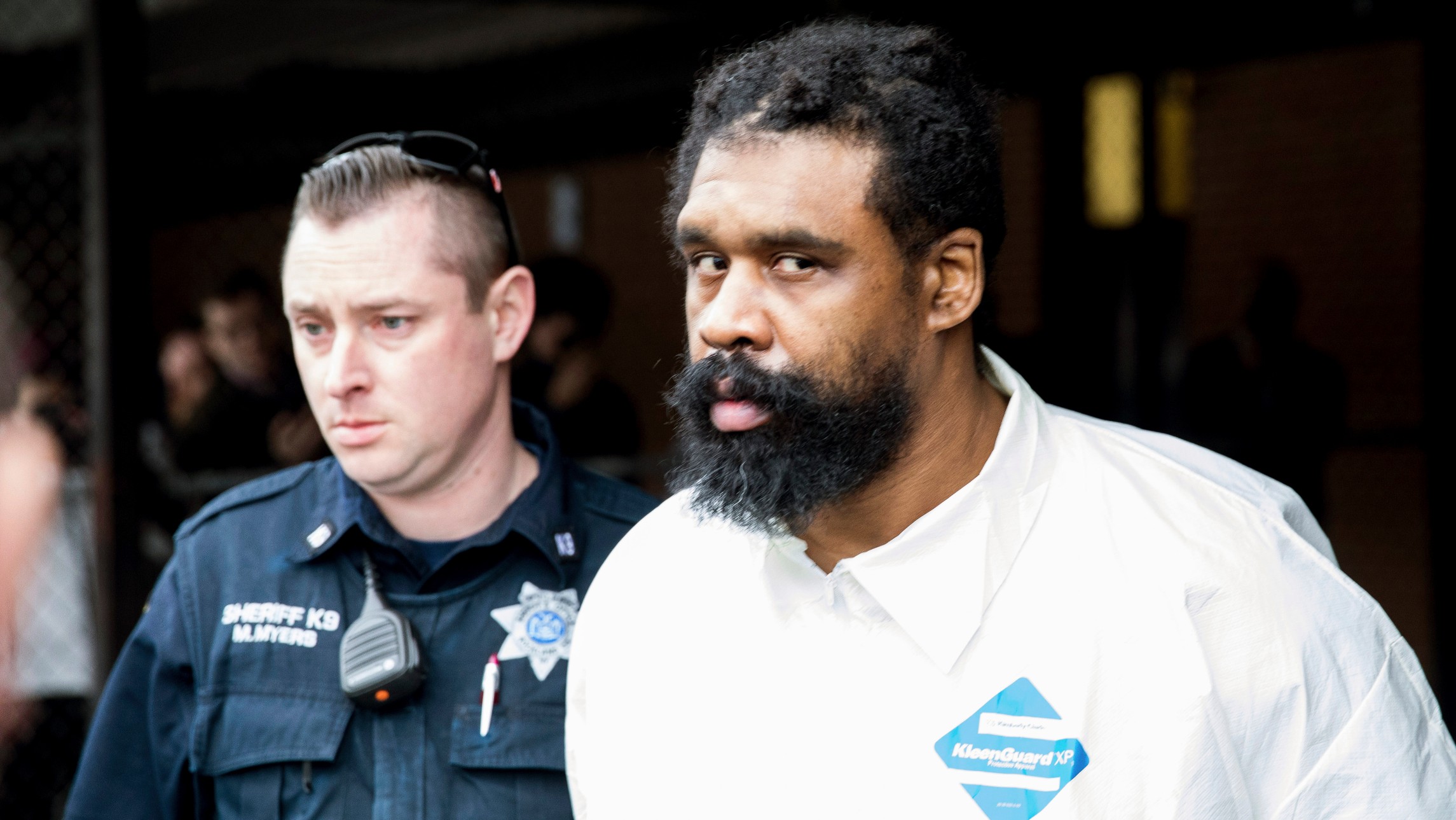
Immediately following the vicious machete attack at a Hanukkah party at a rabbi’s Monsey, New York, home, the suspect’s attorney, Michael Sussman, pointed to his alleged “long history” of “mental illness and hospitalizations,” depression, and psychosis.
Sussman claimed the attacker heard a “voice talking to him about a piece of property that he understood was in that house,” and the requisite “demons” he saw and “not terribly coherent … explanations” he provided prove this, as strategically interpreted by the lawyer.
Recommended Stories
The perpetrator’s family, in a statement provided by what many families posit in service of exculpatory rhetoric of mental illness, said, “We believe the actions of which he is accused, if committed by him, tragically reflect profound mental illness for which [he] has received episodic treatment before being released.”
The late psychiatrist Thomas S. Szasz, a friend and periodic co-author with the authors of this piece, spent about a half-century debunking psychiatric defenses of criminal activity. He argued that when defendants claimed, often through the prism of their legal advisers, that they “heard voices” directing them to commit murders and lesser crimes, that first, they were speaking metaphorically, not claiming to literally hear voices; and second, that if they actually heard voices that they didn’t have to listen to them; third, that they almost invariably wanted to commit the acts against the victims they chose; and fourth, that such violent offenders suffered from no illness whatsoever, but that their acts were so unusual that people wanted to explain them through pseudo-neurological mystification.
The assailant, in this case, has been charged with federal hate crimes. He is being held without bail on five counts of attempted murder. The five counts comprise the stabbing and slashing with an 18-inch machete and a knife of five victims.
In federal courts, the defendant, thanks to changes prompted by the success of would-be presidential assassin John Hinckley Jr.’s insanity defense, now has the burden of proof by clear and convincing evidence. But this is not as powerful a standard as “beyond a reasonable doubt.” The defendant must prove that he or she at the time of the act “as a result of a severe mental disease or defect was unable to appreciate the nature and quality or the wrongfulness of [his or her] acts.”
In court, the defendant said that he was “coherent,” at which point his attorneys averred that in addition to hearing voices that he had stopped taking his psychiatric medications, implying that such medications would have prevented his violent actions.
On the contrary, his own actions help illustrate the rationality (perverse though it may have been) of the defendant’s actions. First, there had already been a rash of attacks on Jewish citizens in the area of the crime before this incident. Second, he had conducted anti-Semitic online searches before carrying it out. Third, he had searched online in what might have been a strategic effort to estimate police presence in the area where he planned to carry out his violent actions. And finally, there were references in his journals to the anti-Semitic Black Hebrew Israelite movement, as well as scribblings of “Nazi Culture.”
The concept of a “normal” mass attacker is an oxymoron. People often feel a need to medicalize this kind of violence so as to rationalize the reality of profound evil within some of our fellow citizens. While it is no doubt comforting to lawmakers and the public to believe that scientists can predict and “cure” killers of their anti-social behaviors, almost all acts of violence are purposeful. Certainly, this unconscionable anti-Semitic atrocity is one of abject criminal intent.
Richard E. Vatz is a professor at Towson University, specializing in political and psychiatric rhetoric. Jeffrey A. Schaler is a psychologist and former editor-in-chief of Current Psychology. They are co-editors of Thomas S. Szasz: the Man and His Ideas (Transaction Publishers, 2017).
