
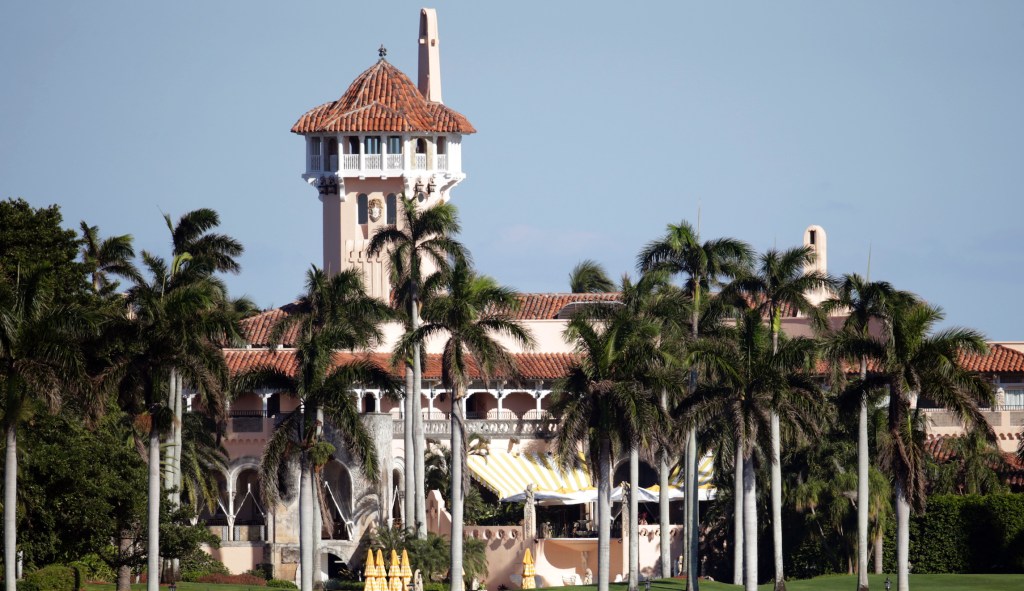
A federal judge released the criminal search warrant and receipt report pertaining to an FBI search of former President Donald Trump’s Mar-a-Lago residence on Monday.
Recommended Stories
The receipt report, showing what FBI agents removed from the former president’s residence, includes boxes of documents, apparently including information related to the President of France (Emmanuel Macron), secret and top secret classified information, and various very high-classification Top Secret-Sensitive Compartmented Information, or TS-SCI, documents. If Trump indeed had TS-SCI documents at his residence without legal justification, that would be of significant concern.
Nevertheless, the warrant and receipt report do not, in and of themselves, do much for our understanding as to whether the search warrant was justified at the intersection of probable cause and public interest.
Public perception of federal law enforcement activity targeting political officials or candidates is necessarily of both extreme importance (noncorrupt, good government) and sensitivity (because of the risk in undermining the democratic process and the public’s confidence in that process). There’s also the broader constitutional importance of ensuring we all feel confident we live in a democratic republic that is served by, rather than subservient to, the coercive instruments of state power.
Because the Mar-a-Lago search concerned a former president who is a prospective presidential candidate in 2024, Department of Justice guidelines and tradition would suggest an extremely high burden of probable cause to justify the intrusive investigative action of the type that the Mar-a-Lago search entailed. These concerns are further emphasized by the fact that Trump is likely to challenge President Joe Biden in 2024, or at least a close ally of the incumbent president.
Top line: What we need to know but still do not know is what particular top secret/SCI classified information the FBI recovered from Trump’s residence, whether information of the same kind was maliciously disposed of, and whether prior less-coercive efforts were taken before now to secure said information.
Because of the FBI-DOJ’s 2016 decision not to charge Hillary Clinton for retaining classified information up to the top secret level, I would argue that it would not be in the public interest to prosecute Trump for retaining documents with information below the top secret classification level. This is further emphasized by the now obvious reticence with which the FBI and DOJ has approached publicly available evidence regarding Hunter Biden’s contact with foreign business interests, especially those linked to the Chinese Communist Party, and his engagement with prostitutes possibly linked to Russian organized crime interests.
If, as some have suggested, Trump retained highly classified information relating to nuclear weapons or intelligence reporting on foreign leaders (Macron?), the FBI likely had a just cause for this search and the relevant investigation. The same is true if Trump obstructed efforts to retrieve that information short of a court-ordered search warrant. But if Trump’s personnel simply shoved a load of documents into boxes and then threw them in a Mar-a-Lago closet? I don’t think this search warrant can cut the aforementioned public interest standard.
We should expect answers by the end of this coming week at the latest.
After all, these boxes include paper documents of a significant but still limited number. Many FBI investigations require a far fewer number of agents and analysts to trawl through tens of thousands of pages of electronic documents or images searching for complicated evidence. In white-collar crime investigations, a few small elements of a few documents among literally thousands of documents can be the difference between indictable evidence of a crime, an accounting mistake, or nothing but simple accounting records.
Put simply, the public interest demands that we know soon, if with some obvious redactions for national security reasons, what the FBI says it found in those boxes.
