

If the midterm election polls hold true, House Republican leader Kevin McCarthy (R-CA) will become speaker of the House in January. But McCarthy attracted media criticism this week after he told Punchbowl News that a GOP majority would adopt a more cautious stance toward financial aid for Ukraine. As McCarthy put it, “I think people are gonna be sitting in a recession, and they’re not going to write a blank check to Ukraine. They just won’t do it.”
Let’s be clear: U.S. support for Ukraine is very important. Russian President Vladimir Putin must not be allowed to trammel the post-1945 European democratic peace. A peace that cost more than 400,000 American lives in World War Two and the service of many more during the Cold War. A peace that has made us richer and freer. As he gazes darkly upon Taiwan, Chinese President Xi Jinping must know that America remains resolved to defend freedom. Still, for three reasons, McCarthy is correct to adopt a more cautious stance on future aid.
LIZ TRUSS IS GONE — WHO CAN REPAIR THE SINKING CONSERVATIVE PARTY SHIP?
First off, wealthy European nations are freeloading off this shared Western responsibility. The Washington Post’s Jennifer Rubin observes that “McCarthy’s comment will also likely shake European allies who worry about their own economic pain and fear that the United States might leave them dangling.” Really?
Well, just look at the Kiel Institute’s graph below. The graph shows respective national/European Union commitments to Ukraine as of Oct. 3. Of relevance: The EU’s total GDP is approximately 90% of that of the U.S. But just look at how much more the U.S. has committed to Ukraine versus the EU and its top economic powerhouses — France, Germany, and Italy.
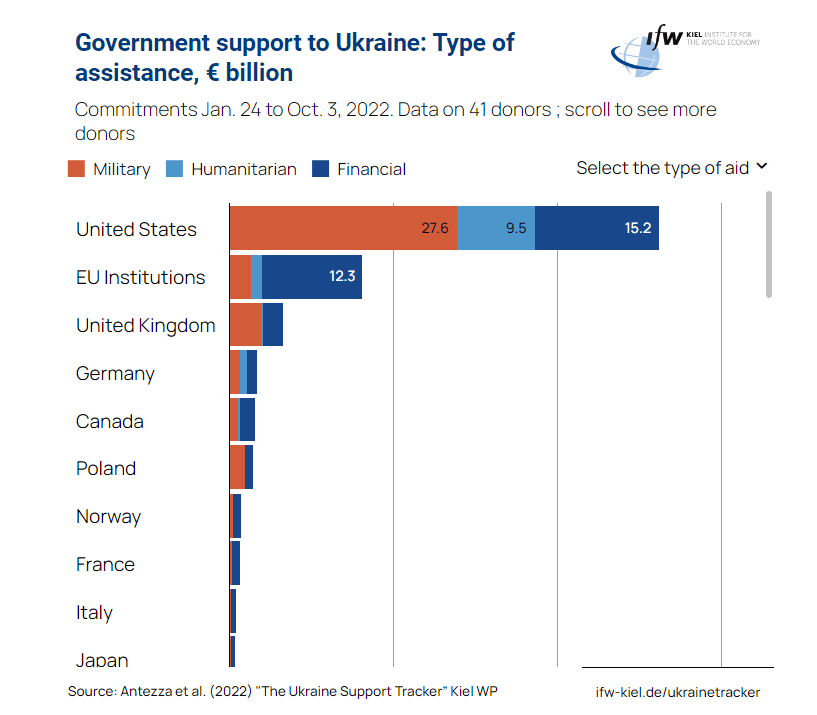
It is absurd that wealthy European powers are doing so little compared to the U.S. to uphold their continent’s democratic security. The point bears repeating: Putin’s war on Ukraine constitutes the most grievous threat to European democratic security since the Second World War. But these data matter for another reason. Because if the Western alliance structure is to endure, it needs much more of the ingredient so fundamental to any alliance: shared sacrifice as proof of the common cause.
Contrary to the commentariat consensus, the populist anger former President Donald Trump cultivated when he railed against European “freeloading,” etc., was rooted not in arrogant delusion but rather in truths born out of math. Namely, the math that proved Europe’s enduring choice to divert money to social welfare programs at the expense of its security needs. And the associated, enduring burden on American taxpayers and service personnel to fill the gap. Contemporary proof of this European neglect is real.
Just go to the ADS-B radar website, scroll over European airspace, click the “U” button at the top, and start clicking on aircraft. Why is it that the vast majority of airlift, refueler, and intelligence aircraft are American? Considering that these assets would be crucial to prospective U.S. victory in an increasingly likely war with China, why aren’t Europeans rushing to boost defense spending to take the weight off the U.S. and better defend themselves at the same time? Don’t tell me that they are doing so. Most European powers have introduced only very modest increases to their own defense budgets since Putin’s invasion (if at all). And I’ll believe German defense boosts when I see them endure over 10 years. Until then, reality will be clear: As the Baltic states, Britain, and Poland carry the burden with America, Chancellor Olaf Scholz flies off to Beijing to lick Xi’s boots.
Next up, there’s the corruption concern.
Ukrainian President Volodymyr Zelensky was elected on an anti-corruption platform for a reason: His people knew their government and economy had become a cesspool of corruption a la Russia. That’s why then-Vice President Joe Biden was right to demand the resignation of a corrupt prosecutor under the former government. Yet corruption remains a real issue in Ukraine. And while U.S. AID is monitoring aid flows, big sums are going to end up being stolen or embezzled. The prudent allocation of taxpayer money is necessary.
Third, and as others have noted, Americans deserve clarity from the Biden administration on specific U.S. strategic objectives in Ukraine. I believe that U.S. policy should seek the survival of Ukraine’s democratic independence and the dislocation of Russian forces from Ukraine’s mainland territory. Without repeating the lunacy of Angela Merkel’s Minsk accords, the U.S. should also encourage Zelensky to discuss terms with Putin once the Russian front collapses (possibly in the coming months). Regardless, if tens of billions of their taxpayer dollars are going to Ukraine, Americans deserve to know what Biden’s objectives are.
CLICK HERE TO READ MORE FROM THE WASHINGTON EXAMINER
Top line: Ukraine’s democratic survival matters a great deal. But so does the Western alliance. And unless the U.S. is willing to demand burden-sharing from allies that can afford it, American domestic support for that alliance will deplete alongside America’s ability to deter and defeat the exigent threat of an imperial China. Republicans should keep up support for Ukraine. But European powers must do much, much more. And Biden should clarify his end game.
