

By most important measures, the kind that fill tables and text in the annual Economic Report of the President, the U.S. economy is on a roll. Real GDP growth is at a five-year high, unemployment is reaching record lows, and construction activity is booming. Perhaps more importantly, total workplace earnings (including bonuses and fringe benefits) are on the rise, and real per capita GDP is increasing.
This good news indicates most U.S. workers and families are getting better off. But there’s usually a “but” with such things, and rarely does every economic signal point upward.
Growing evidence shows that rising uncertainty regarding energy prices, trade, and other government policies is causing managers and owners of businesses to pause, to hesitate, and to review the situation before making major new job-creating investments.
Those business owners see headlines about rising oil prices, higher interest rates (with the Fed promising more of the same), growing trade uncertainty with Canada and Mexico, and belligerent trade conversations between White House officials and Chinese leadership. These are just a few of the major ingredients of an uncertainty soup that private decision makers are trying to understand.
Depending on their specialties, firms could look at any one of these elements and decide to hit the pause button. All of them together could take the wind out of the economy’s high-flying sails.
Speculation is one thing, but what does the evidence say?
When operators of U.S. manufacturing plants face uncertainty, they turn to outside temporary worker firms to contract for additional labor. Instead of making permanent hires, they go with temps. The most recent Bureau of Labor Statistics employment data, reflected in the below chart, show that the rate of growth for manufacturing employment is falling and the growth rate for temporary hires is rising, almost by an equal amount.
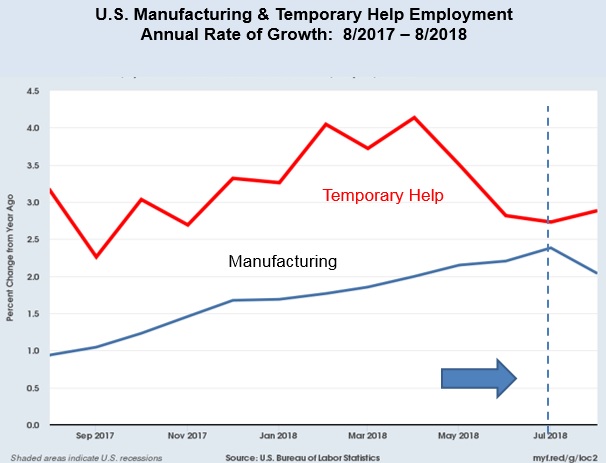
When labor markets are tight and productivity is rising, employers tend to raise wages in order to attract and keep workers. But when uncertainty enters the picture, the same employers instead offer bonuses, more holidays, and other fringe benefits (things they can turn off and on) rather than raising wages. Recent BLS survey data indicate this is happening.
When executives cannot predict which way Washington will move on merry-go-around trade talks, they pull back and review their planned investments. A recent Federal Reserve Bank of Atlanta survey of 330 businesses in its region asked about reactions to trade policy uncertainty. Some 67 percent of the respondents said they are hesitating and reviewing their expansion plans.
Does this mean we are reaching the high point of our current economic expansion? Maybe — we have to balance the good with the bad.
But does that mean it’s time for Washington decision-makers to pause, hesitate in their efforts to disrupt major policies, and to give the economy a chance to take a deep breath? Yes. Let’s make sure we have a chance to enjoy the uptick in prosperity.
Bruce Yandle is a contributor to the Washington Examiner’s Beltway Confidential blog. He is a distinguished adjunct fellow with the Mercatus Center at George Mason University and dean emeritus of the Clemson University College of Business and Behavioral Science. He developed the “Bootleggers and Baptists” political model.
