

Hundreds of millions of dollars will flow into and out of super political action committees this election cycle. The question is, as campaigns come down to crunch time, why aren’t they spending even more than they are right now?
According to the Center for Responsive Politics, as of April 21, super PACs have collected more than $700 million this cycle, with independent expenditures of $286 million (there are other expenditures not included in that figure). A large part of that gap comes from Priorities USA Action, a super PAC supporting Hillary Clinton. The PAC has $45 million in cash on hand. Yes, Clinton is still a big favorite to win the Democratic nomination for president, and the PAC is probably saving its money for the general election. But you’d think the Clinton camp would still be a little more concerned than they are, having only 59 percent of all delegates distributed so far.
Some of that gap also comes from dormant super PACs. Jeb Bush’s super PAC, Right to Rise USA, raised $17.3 million more than it spent this election cycle. With Bush out of the race, it’s not clear what’s going to happen to that money.
The gaps for Republican candidates who are still in the race are much smaller. Reigniting the Promise, one of the several super PACs backing Ted Cruz, has raised $8.3 million more than it’s spent.
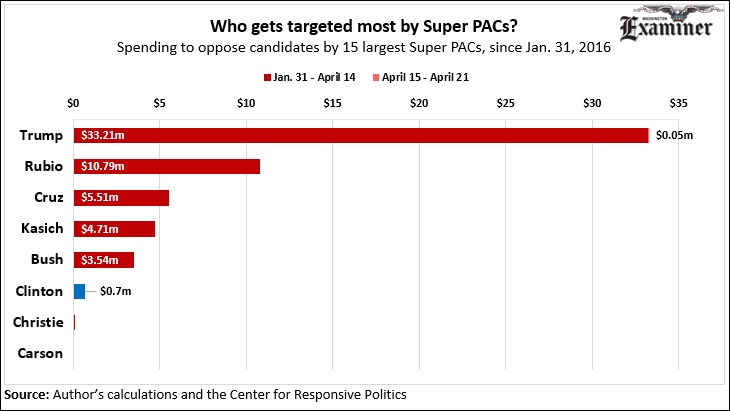
Millions have already been spent by super PACs, but there are still votes to be won this primary season. Some dollars are being spent in support of affiliated candidates, but only $54,000 was spent in the past week by major super PACs against a presidential candidate. That money all came from Our Principles PAC, a super PAC solely devoted to opposing Donald Trump’s candidacy.
Combined, more than $33 million has been spent by major super PACs against Trump since Jan. 31, 2016, the day before the Iowa caucuses. Our Principles PAC is responsible for $12.5 million of that spending, more than any other super PAC. Marco Rubio’s super PAC, Conservative Solutions, is close behind with $11 million.
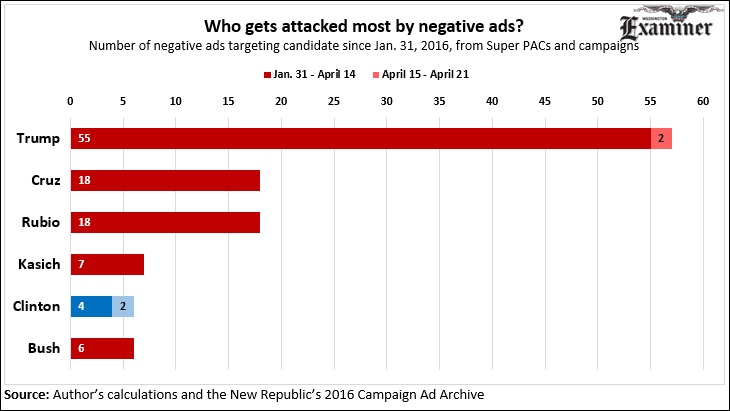
Super PACs aside, candidates are also attacking each other over the airwaves. A majority of negative campaign ads since Jan. 31, 2016 have hit Trump. Clinton has been attacked by just six different commercials portraying her negatively, and most of those came from conservative sources. The two most recent anti-Clinton ads came from the Cruz campaign and aired in Pennsylvania. The two most recent anti-Trump ads also came from Cruz, debuting on April 15 in New York and April 21 in Pennsylvania.
Jason Russell is a commentary writer for the Washington Examiner.
