

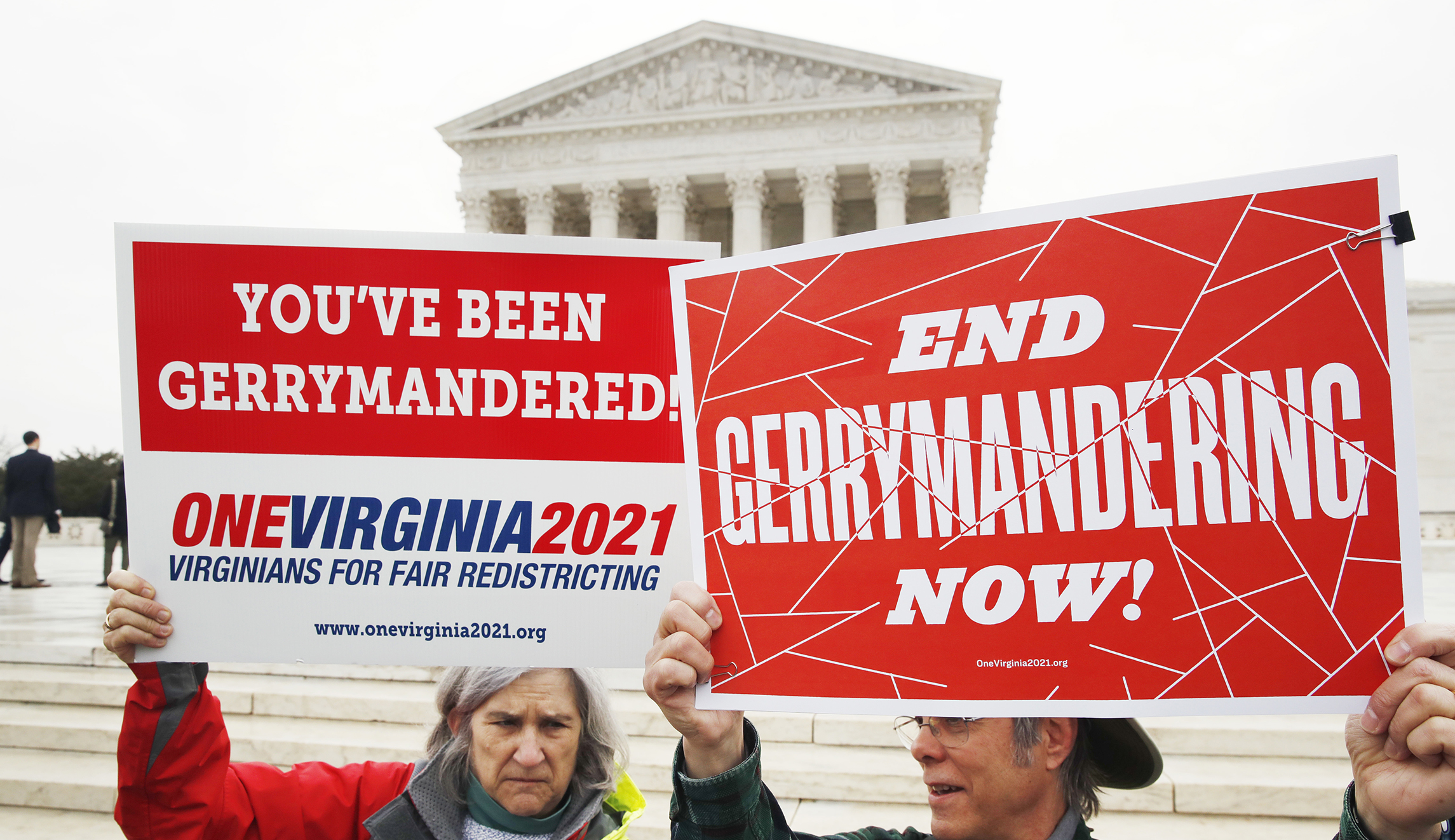
State governments still mean something. They are still sovereign. They retain meaningful power of self-governance, and federal judges are just not supposed to take over their legislatures’ powers without a specific legal mandate.
This is the most important implication of last week’s decision in Rucho v. Common Cause, the partisan redistricting case. Chief Justice John Roberts and the majority invoked the well-known legal doctrine of the “political question,” which refers to issues that are supposed to be decided by the elected branches of government and not by judges.
Recommended Stories


Although Justice Elena Kagan expressed some puzzlement about this in her dissent, she has surely heard of the “political question.” This doctrine has been invoked repeatedly in recent years — for example, by courts blocking lawsuits over global warming. Just as federal lawsuits cannot be used in lieu of legislation to formulate climate policy, federal courts cannot take over state governments’ responsibilities to create legislative and congressional districts after each census.
To be sure, there are federal laws, provisions in the U.S. Constitution, and prior Supreme Court cases that govern redistricting. It’s just that none of them has anything to do with party balance in legislatures. It’s already established under federal law, with painstaking (and sometimes confusing) judicial precedents, that redistricting cannot be used to deprive racial minorities of the opportunity to elect representatives of their choice. This prompted the redrawing of a North Carolina district not long ago. It’s also established, based on the Constitution and a well-known Supreme Court case, that legislative and congressional districts created within the same state must have equal populations.
But as to the question of creating partisan redistricting maps, that’s a decision for state laws and state constitutions and state legislatures. There is no constitutional protection, after all, from political partisanship.
When Democrats drew sharply partisan maps in North Carolina after the 2000 census, to maximize their waning political power in the state, they were following state rules that allowed it. And so were the Republicans who drew the new maps there after the 2010 census. As one of the Republican legislators put it, “I think electing Republicans is better than electing Democrats, so I drew this map to help foster what I think is better for the country.” In true Woody Hayes fashion, he explained further that he had created the map to elect 10 Republicans and just three Democrats to Congress because he did “not believe it [would be] possible to draw a map with 11 Republicans and 2 Democrats.”
That’s a perfectly stated case of political warfare fought by the rules. Republicans’ sweeping victory in North Carolina in the 2010 election — in districts that Democrats had drawn 10 years earlier, by the way — gave them the powers Democrats had exercised 10 years earlier. Only after Republicans started winning too many of these state-level elections did certain “good government” nonprofit groups suddenly decide there was a crisis afoot.
So when Democrats in Maryland draw a grotesque congressional map to maximize the number of Democrats in Congress, that’s their prerogative.
Each state has its own rules about county-splitting, contiguity, compactness, and communities of interest. Some states require members of Congress to live in their districts, and others don’t. We have our opinions on the matter. The justices on the Supreme Court probably have their own opinions. The justices’ opinions show, though, shouldn’t matter.
Is the current system the best way to do redistricting? It’s arguably the worst … except for all the others. You can appoint a nonpartisan commission, as some states do, and that might work well, but partisans have found ways of gaming such commissions, as in Arizona and California. It would be equally bad to lean too hard on simplistic rules about what constitutes fairness. For if you demand nicely shaped districts (compactness) at the expense of other considerations, then you’ll get even more partisan safe districts than currently exist. And if you demand the maximum number of competitive elections, then prepare for far more obscenely-shaped districts from one end of your state to the other, attempting to take in just enough urban liberal and exurban conservative areas to guarantee a fair fight.
The Supreme Court last year rightly rejected the idea that partisan statewide outcomes should reflect the final result, as if all Democratic and all Republican candidates were interchangeable. As we noted with respect to that Wisconsin case, “it is a fallacy to infer… that just because voters in Oshkosh trust a beloved 10-term incumbent and give him 80% of their votes, it means his party deserves more representation” elsewhere in his state. Likewise, it would be a mistake to conclude that low totals “for an incumbent caught habitually driving drunk” that his party was less deserving of representation overall.
The court is likewise right to leave this political question to politicians. Given that everyone has their own ideas about fairness, and given that they often produce unintended or incompatible results, the answer has always been to leave it to the people who win the election, or to the ideas and principles that win in referenda and reach the state constitution. That’s as it should be.
