

China, with Russian support, has broken the sanctions regime targeting Kim Jong Un’s North Korean regime.
This bears notice in the context of secretary of state Mike Pompeo’s new clarification that North Korea will not receive sanctions relief until it has fully dismantled its nuclear program. But while Pompeo is right to resist North Korean arguments that sanctions relief should occur on an immediate step by step timeline, he and Trump must ensure that the existing sanctions targeting Pyongyang are maintained by all parties.
It’s an important concern in that Kim is now benefiting from expanded Chinese and Russian smuggling flows, and China is pushing for greater official sanctions relief from the United Nations.
The Trump administration knows this to be true. They know that even before the June 12 summit between Trump and Kim, the Chinese had opened up their northern border crossings with North Korea and restored significant import-export exchanges. This has strengthened Kim’s position against U.S. pressure by allowing him to gain the goods that sustain his ruling elite, to lubricate North Korea’s black market economy, and to support ongoing infrastructure projects. At the same time China and Russia are allowing shipping companies to smuggle oil and other bulk supplies to North Korean vessels at sea. My annotated map below shows major North Korea smuggling routes (in circles) and areas where ship-to-ship and port transfers take place.
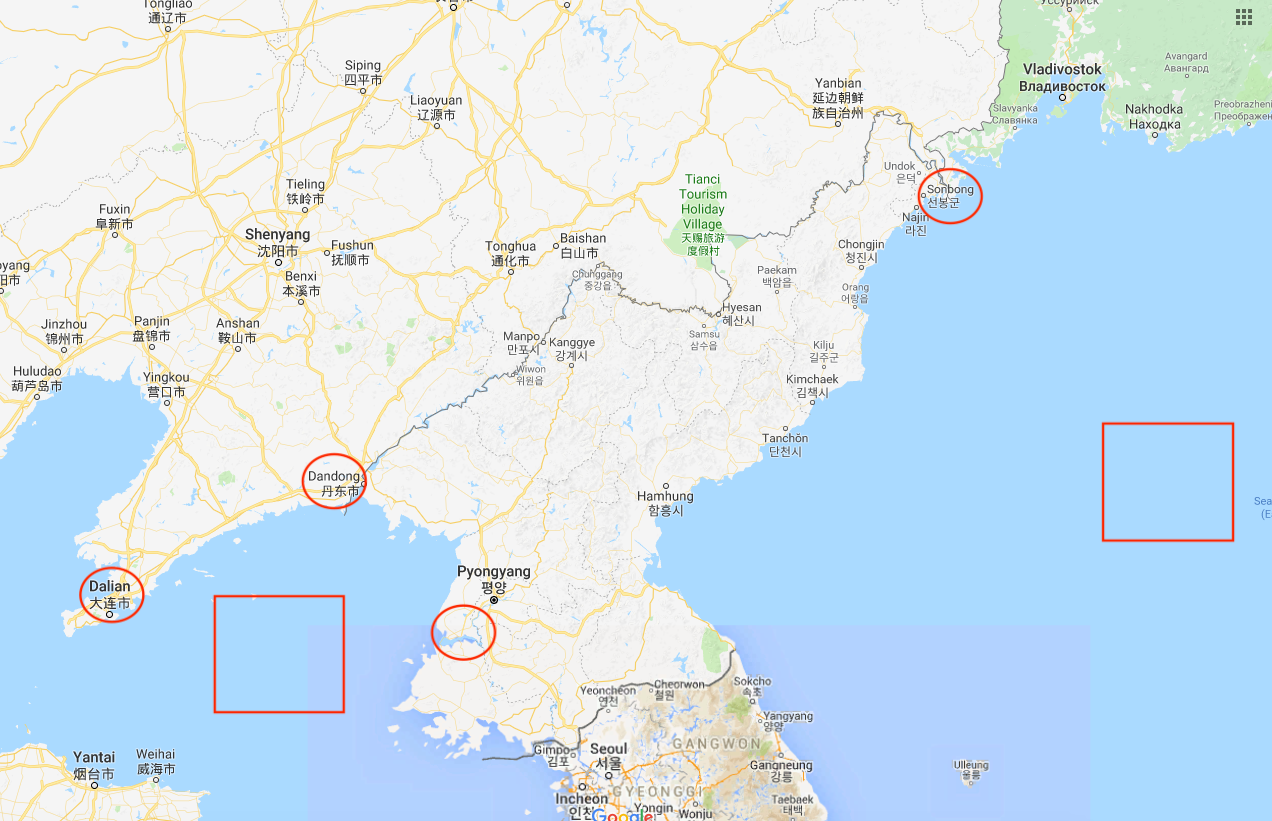
But what’s most striking about these exchanges is not that they are taking place, but rather that the Trump administration is tolerating them. After all, the Chinese, Russians, and North Koreans are well aware that ship-to-ship transfers offer only a pretense of deniability. They know this because they know that an array of U.S. intelligence platforms can easily detect their smuggling activities. Moreover, neither the Chinese or North Koreans are taking any real effort to conceal their land border smuggling.
And it gets worse, because Chinese and Russian financial houses continue to facilitate North Korean foreign capital holdings. This allows Kim to grant patronage to powerful allies and buy the higher-end equipment that he needs to maintain power. These financial activities have largely gone unchallenged by the Obama and Trump administrations, even though the Chinese in particular know that we know what they are doing. (The Russians find it amusing to annoy us in regards to North Korea).
So what should Trump and Pompeo do? First, stop pretending that their maximum pressure strategy remains in force. Trump’s acquiescence to North Korean demands on a longer denuclearization timetable, his cancellation of U.S.-South Korean military exercises, and Kim Jong Un’s lack of associated reciprocity are all major U.S. concessions.
So is Pompeo’s two-year timeline for North Korean denuclearization, which gives the North Koreans time to diminish the sanctions regime and comfortably complete their nuclear warhead-plus-intercontinental ballistic missile program (much of which can be completed covertly in small research factories).
Second, Pompeo should publicize U.S. intelligence of Chinese and Russian material breaches of U.N. sanctions resolutions that they themselves agreed to. Doing so would not jeopardize high-grade intelligence sources and methods. And if the sanctions breaches continue, Trump should sanction those facilitating the smuggling, not just the smugglers themselves. That will affect major Chinese and Russian financial interests and cause measurable pain in both nations’ economies (especially the Chinese).
Ultimately, however, Trump and Pompeo must take hold of this situation. They rightly accused President Obama of allowing Iran to hold all the cards on the Iran nuclear deal, but thus far at least, they are doing the same with North Korea.
