Trump’s approval rating increase is largely coming from Democrats who’ll never vote for him

Published March 30, 2020 4:23pm ET


President Trump’s approval ratings have continued to climb to record highs of his tenure, with his RealClearPolitics polling average increasing by more than a percentage point in the past month alone. While any improvement is always good news for a politician, this particular burst likely won’t matter on Election Day, and certainly far less than his post-impeachment boost.

For one thing, Trump’s approval increase following impeachment had less to do with his acquittal and more to do with his actual presidential successes. He had successfully slain Iranian Gen. Qassem Soleimani and brought low-income workers their lowest unemployment and highest wage growth in decades. Even more importantly, Democrats laughed this off, making Trump look more mature in the process.

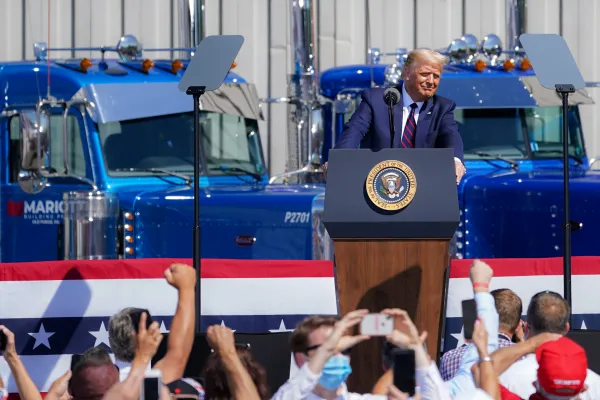
This second boost is coming as a result of the normal galvanization of support during a crisis. But unfortunately for Trump, a lot of it looks like it’s coming from Democrats who are willing to give credit to Trump’s handling of the coronavirus but will never, ever vote for him.

According to Gallup, Trump’s record 49% approval rating came not as a result of Republicans, but independents and Democrats. Republican approval increased by just 1 point, while independent and Democratic approval increased by 8 points and 6 points, respectively.

Since the beginning of the month, Gallup found a 5-point increase, and if a portion of that came from independents who might vote for Trump, that’s good for him. But historically speaking, it’s far from great. For half a century, national crises like the Mayaguez incident and Iran hostage crisis culminated in double-digit booms for presidents, even as unpopular as Gerald Ford and Jimmy Carter. Even though that rally has diminished due to increasing polarization, as Gallup noted, President Barack Obama still saw a 7-point approval increase after the killing of Osama bin Laden and a 5-point increase after the Sandy Hook shooting.

Trump saw no such rally after the Soleimani killing, and right now, the nation is rewarding his handling of a crisis that’s already killed over a thousand U.S. citizens — and that could kill hundreds of thousands — as much as they rewarded Obama for handling a grotesque tragedy that killed 26 people and didn’t result in millions of job losses.

Maybe Trump can benefit from embittered “Bernie bros” rejecting Biden, but even at the height of the strife of Vermont Sen. Bernie Sanders supporters, that potential seems limited. Recent, 15% of Sanders supporters reported that they’d vote for Trump, but 20% of Sanders supporters said they’d vote for Trump over Clinton in the spring of 2016, and only half as many did so on Election Day. If this trend followed, it would only be 8% or 7% who vote for Trump over Biden, even fewer than in 2016. And right now, Biden’s general election polling has not budged much.

As the coronavirus progresses and Trump has more leeway to make proactive decisions rather than respond to immediate medical directives, it’s highly possible that he’ll see lasting improvements in approval ratings. After all, aside from our national debt and limited asset bubble, our economy was the strongest in generations. If the economy does rapidly improve after finding a sustainable coronavirus treatment or successfully using masks and testing to reopen the economy, it’s very likely that Trump’s incumbency advantage proves stronger than ever.

But right now, his increased approval rating is limited and predominately coming from Democrats who continue to make clear in general election polls that they’ll still vote for Biden come November.