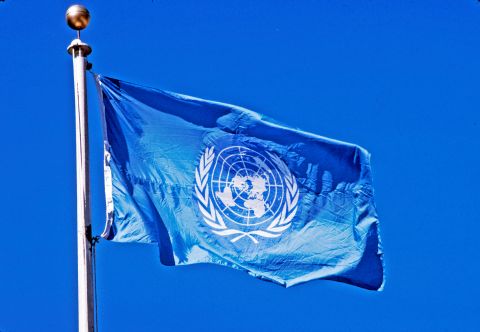
How Trump can root out anti-Semitism at the UN

Published February 25, 2020 4:15am ET


In September, the United Nations’ special rapporteur on freedom of religion or belief, Ahmed Shaheed, released a report to the U.N. Human Rights Council. He noted with concern that claims that the objectives, activities, and effects of the boycott, divestment, and sanctions movement, which seeks to economically pressure the Jewish state alone out of all the nations of the world, are fundamentally anti-Semitic.

Shaheed urged the council to adopt the International Holocaust Remembrance Alliance’s internationally accepted standard definition of anti-Semitism, which is used by various agencies of our federal government and the 33 governments that are members of the alliance. By that definition, “applying double standards [to the Jewish state] by requiring of it a behavior not expected or demanded of any other democratic nation” is an act of anti-Semitism.

This month, the Human Rights Council released an anti-Semitic blacklist of companies doing business in Israeli settlements. This blacklist singles out Israel while ignoring more than 100 other zones of disputed territories around the globe, including areas with more far-reaching settlement activities, in many of which foreign companies actively support the settlement enterprise.

Treating Israel in one way and the rest of the world another way is anti-Semitic by definition. But more to this specific point, there is no basis in international law for this document. The U.N. has long held that merely doing business in occupied territories does not raise any human rights or legal concerns. This was the conclusion of the U.N.’s legal adviser in a 2002 memo on Western Sahara, as well as the U.N. Global Compact’s 2010 “Guidance on Responsible Business in Conflict-Affected and High-Risk Areas: A Resource for Companies and Investors.”

And so, even allowing for the long-standing and well-documented anti-Israel bias of the Human Rights Council, it simply went too far this time. Its members broke the law, and they did so while acting outside their lawful role on the commission.

Several of the nongovernmental organizations that the Council relied on to compile the list, groups that support the boycott, divestment, and sanctions movement, employ convicted terrorists. They also maintain ties with U.S.-designated terrorist groups, including the Popular Front for the Liberation of Palestine and Hamas.

U.S. federal anti-terrorism statutes outlaw providing material support or services to certain designated terrorist organizations. The Supreme Court in Holder v. Humanitarian Law Project found that “a person of ordinary intelligence would understand the term ‘service’ to cover advocacy performed in coordination with, or at the direction of, a foreign terrorist organization.” (Emphasis added.)

The Office of the High Commissioner on Human Rights should be investigated by U.S. authorities for violating this law. First, building upon the suggestion of Senator Ted Cruz, the United States should withhold funds from the U.N. equivalent to the funding provided to the Human Rights Council and the Office of the High Commissioner for whatever period the blacklist remains in effect. Those funds are set aside and earmarked for entities that can demonstrate a negative effect caused by the blacklist.

Second, because this action is ultra vires — that is, beyond the legal scope and authority of the Human Rights Council — its members are not entitled to hide behind the immunity customarily afforded to the U.N. and its agencies under applicable treaties. As such, they can and should be sued or prosecuted for any damage they cause. At a minimum, the companies on the list should send cease and desist orders threatening to hold the council and its officers responsible for their actions.

Finally, the State Department should impose visa and travel restrictions on the officials responsible for this campaign, including High Commissioner for Human Rights and former Chilean President Michelle Bachelet. President Trump’s recent executive order on combating anti-Semitism incorporated the international definition of anti-Semitism, and it states that his administration is committed to “combating the rise of anti-Semitism and anti-Semitic incidents in the United States and around the world.”

What better way to implement that policy than to stand up for our allies and to state that anti-Semites are not welcome on our shores?

Dr. Mark Goldfeder is special counsel for International Affairs at the American Center for Law and Justice and a member of President Trump’s private legal team. Gary Epstein recently retired as global chairman of Greenberg Traurig’s Corporate and Securities Practice.
