

President Trump has taken a beating from all corners in Washington, and for once it has nothing to do with special counsel Robert Mueller, his unpresidential behavior in the Oval Office, or hush-money payments. Trump’s decisions to withdraw all U.S. ground troops from Syria and 7,000 troops from Afghanistan has been about as popular in the Beltway as sitting in rush-hour traffic. Democrats such as Sen. Chris Coons of Delaware are calling the withdrawals a Christmas gift to the Kremlin courtesy of the White House; Republicans such as Sen. Lindsey Graham of South Carolina are comparing it to former President Barack Obama’s abrupt Iraq departure in 2011.
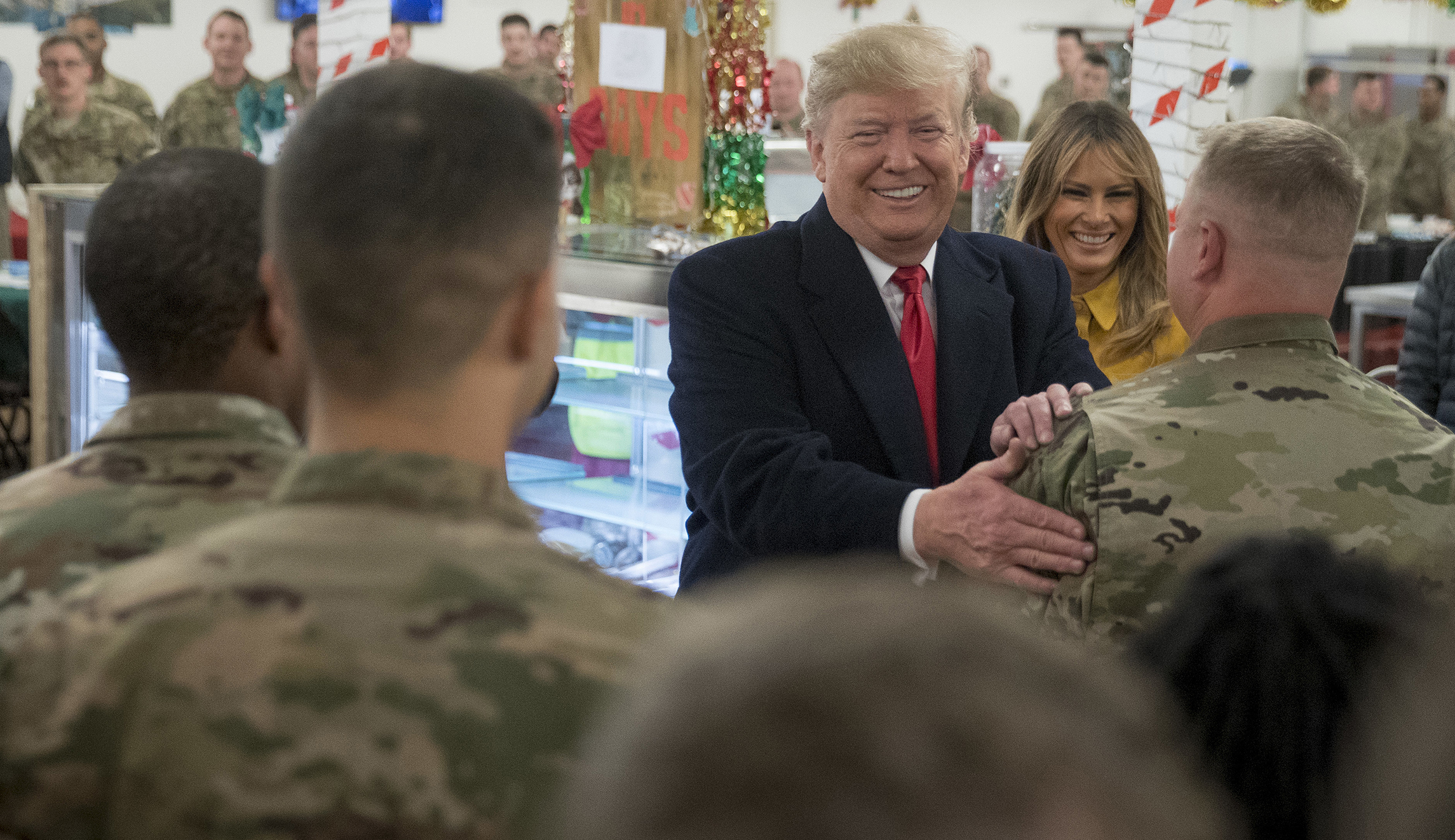
Trump, however, is unapologetic and unrepentant. He views the mission in Syria as done and over with and the war in Afghanistan as a failed experiment in Western-style democratization — which, of course, it is. Trump, supremely confident in the road he took, flew to al-Asad Airbase in western Iraq late on Christmas Day to defend it to the troops.
Recommended Stories



Posing for selfies with the brass and signing autographs for the soldiers stationed in Iraq’s expansive western desert, Trump’s main message was this: Trust me, it’s good we’re getting out of these places.
“We’re no longer the suckers, folks,” Trump declared in his typical Trumpian way. “It’s time for us to start using our head. We don’t want to be taken advantage of anymore by countries that use us.”
Agree or disagree with Trump in general or with his Syria and Afghanistan policies specifically, it’s hard not to support the quote above. The president is beyond fast and loose with the facts (actually, he doesn’t like facts, period), but there are times when his remarks ring true. No American that I have spoken with wants other countries, allies or adversaries alike, to exploit America’s goodwill for their own self-interest. But this is exactly what Washington’s allies and partners have done going as far back as the Cold War.
Europeans, for example, feel like Americans need the occasional lecture on what it means to be a friend. Yet politicians like France’s President Emmanuel Macron fail to understand how ironic it is that Europe is the one lecturing the U.S. when it is the U.S. that has largely subsidized their defense budgets for decades. Trump may have a uniquely self-destructive way of hammering the point, but the point itself is valid.
The same can be said of Trump’s take on Syria and Afghanistan. In Washington, where intervention is king, it would have been the safer political bet to keep U.S. forces in both countries until the end-times. But the president saw it differently and in much the same way many Americans see the situation: as hopeless causes that the U.S. has neither the patience, resources, intellectual capacity, nor interest to remedy. If there is a solution on the table, better for the people of the region to find it. You can deploy the entire U.S. Army into Syria, Afghanistan, Iraq, Yemen, and North Africa, and it would be nothing more than a band-aid. What the Arab world needs is a full-blown triage in the operating room.
At bottom, the region’s convolutions are about incompetent governance, predatory security forces, unequal economies, top-down bureaucracies, political favoritism, sectarianism, ethnic hatred, and geopolitical competition. The U.S. Army can’t resolve any of this. If Washington’s previous experience is a guide, U.S. political leaders shouldn’t even make the attempt.
As Washington insiders continue to howl, Trump remains defiant. On Syria and Afghanistan, he has the American public behind him — even if the elites aren’t.
Daniel DePetris (@DanDePetris) is a contributor to the Washington Examiner’s Beltway Confidential blog. His opinions are his own.
