
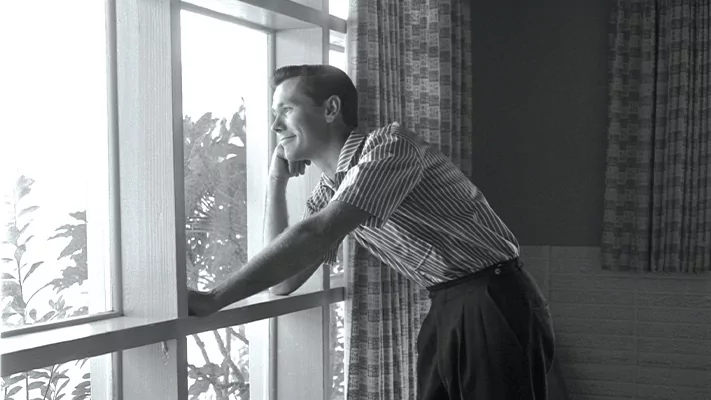
David Letterman compared Johnny Carson to a “public utility.” Walter Cronkite anointed him the “most durable performer in the whole history of television.” An “OK” hand signal from behind Carson’s desk (“a gesture from God,” according to Richard Belzer) could make or break a comic’s career. I’ve been told by comedy podcasts that Carson had great timing, like a jazz drummer, which was part of his “central circuitry” and “calibrated instrument of stage precision,” as Bill Zehme puts it in his new biography of the great TV host, Carson the Magnificent.

Johnny Carson was omnipresent on American television for three decades (1962 to 1992), flickering in the dark as people went to bed, tucking 15 million-17 million of them in at night, including Arsenio Hall, who compared his soothing ubiquity to a “bedtime story.” Nonetheless, this most televised of men is an enigma. “You get the impression that you are addressing an elaborately wired security system,” said Kenneth Tynan, who profiled Carson in 1978. “He’s great by omission,” said Art Stark, Carson’s producer from 1962 to 1967, his “television dad.” Zehme describes him as somehow being both a “security blanket” and “a flawlessly designed winking performance hologram,” the upgraded version of what Orson Welles described as an “invisible talk host” who was paradoxically as ubiquitous as Mickey Mouse.
Real journalism.Trusted by millions.
Unlimited access to in-depth reporting, expert analysis, and the stories that shape our country.
Already a member? Log in