

Look at this chart below.
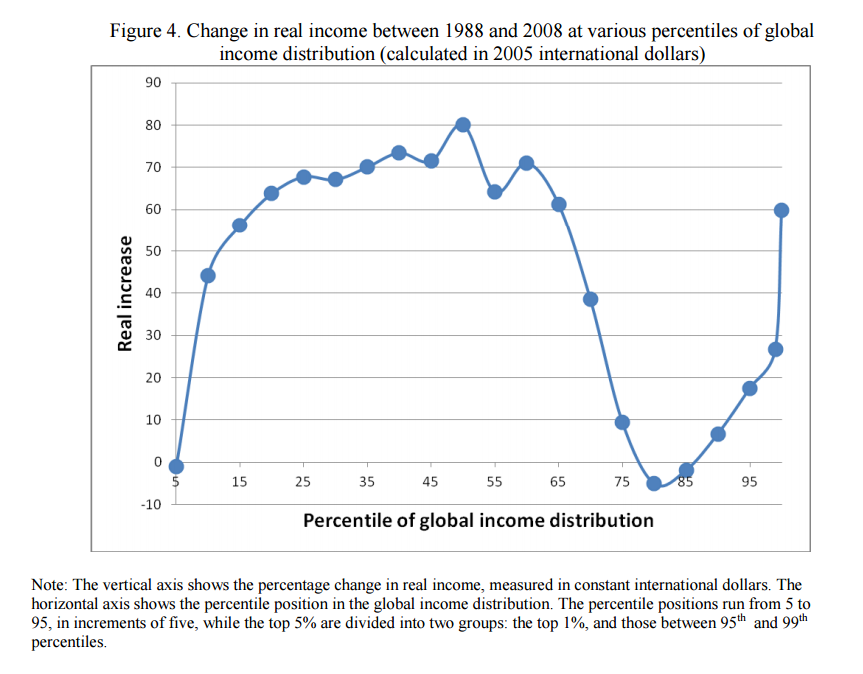
Roughly, that’s a chart of how the global population fared over the 20 years from 1988 until just before the financial crisis. On the far left are the poorest of the poor. They’re just as poor as they were. But almost everybody else — the poor, the global lower-middle class and global middle class — saw their fates improved dramatically.
But the global upper-middle class? Some of them are worse off than they were in 1988. The global upper-middle class, as this article in Bloomberg reports, could include the middle class and the working class in wealthy countries — such as the U.S.
One possible way to read this chart: Globalization has benefited almost everybody, except for the middle- and working class in wealthy countries. They had previously received a subsidy of sorts: being born in the U.S. Globalization opened up the U.S. working class to competition from the global middle class. This has benefited the global middle class and hurt the U.S. working class.
If this is accurate, an economist might say that almost everyone in the world has benefited except for some people — the low skilled in a rich country — from a more efficient global labor market. In the U.S., leaders say free trade helped the whole world and makes the economy stronger, and the working-class guy looks and sees the U.S. elites are getting richer from globalization, and they say, “screw you.”
And they vote for Trump.
Timothy P. Carney, The Washington Examiner’s senior political columnist, can be contacted at [email protected]. His column appears Tuesday and Thursday nights on washingtonexaminer.com.
